
Previously, we introduced QualiZeal’s Reliability Insights Center (RIC) and how it transforms the performance engineering cycle across the PLAN, EXECUTE, and INSIGHTS phases to enhance production readiness of enterprise software. The fully integrated AI-powered platform readily connects with the GenAI-powered QMentisAI. In the rest of this blog, we will dive into the evolution of RIC from a RAG-based GenAI architecture to a multi-agent architecture where specialized agents work cohesively to provide deeper, more contextual insights into performance engineering. Read through to explore how RIC enables a platform-led model for continuous reliability assurance and how it creates an intelligence layer and improves operational efforts that elevate engineering tasks.
The Agentic AI Architecture: What Phase 2 Changes
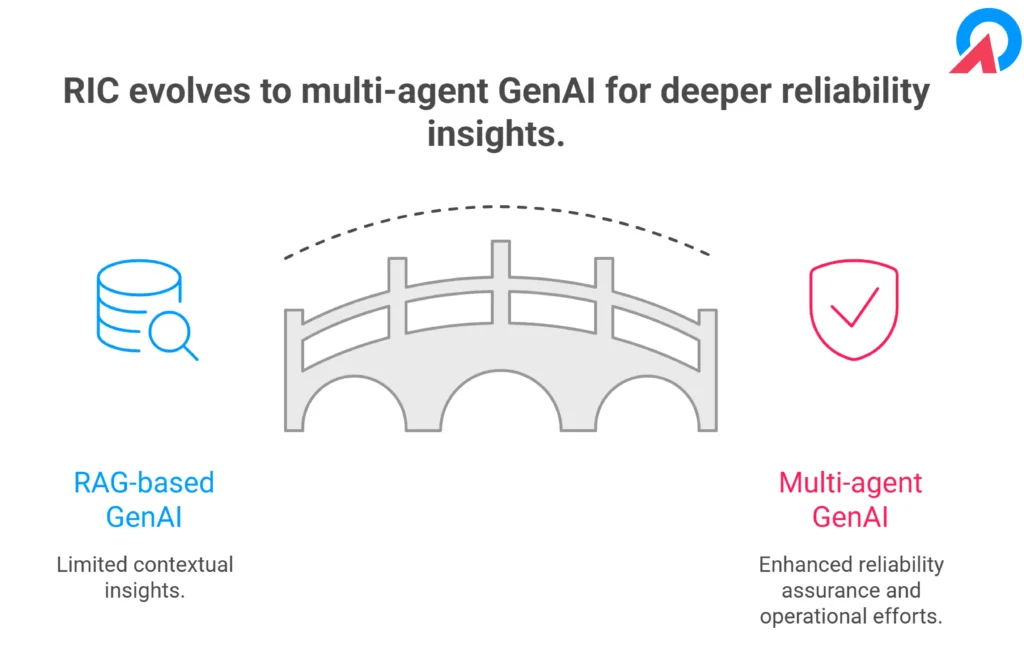
The current version of the RIC platform is built on a traditional RAG-based GenAI architecture. The next evolution, with active development, introduces a multi-agent system that fundamentally elevates the platform’s intelligence ceiling.
While Phase 1 had a single generative model reasoning across all performance domains, Phase 2 introduces four specialized agents with specialized reasoning capabilities operating within an orchestrated workflow:
- Workload Analysis Agent: Deep pattern recognition across multi-APM data streams
- Performance Optimization Agent: Hypothesis generation and remediation prioritization
- Environment Sizing Agent: Dynamic sizing recommendations with growth projections and confidence intervals
- Test Strategy Agent: Adaptive test design based on application topology and risk profile
The agent orchestration layer coordinates reasoning across these four systems with full transparency into each recommendation’s reasoning chain, not just its conclusion. This reasoning capability is a material distinction in the enterprise governance contexts, where explainability is not negotiable. Further, the multi-agent architecture is designed for forward compatibility, with the platform Azure-native and containerized, and MCP (Model Context Protocol) readiness. Together, this allows for seamless integration with enterprise AI hub architectures as they mature.
Why the Platform-Led Model Matters for Engineering Leaders
Traditionally, performance engineering is episodic, cost and human-effort-intensive, where a team runs a test cycle, receives a report, and repeats the process in the next major release. This approach is counterproductive, as it misses performance regressions that accumulate between major milestones when reliability testing is conducted at a project-based cadence. Due to its headcount-intensive nature, this approach increases costs without guaranteeing value delivery.
The RIC’s platform-led hybrid model changes this equation. The platform maintains continuous institutional memory of the system under test, such as historical performance baselines, workload models, SLA thresholds, and known failure modes. Each test cycle builds on the last. This way, the reusable workload model reduces the cost of running a mid-sprint performance validation as it does not require rebuilding from scratch each time. For engineering leaders, this feature helps ship faster without incurring reliability risks or exceeding performance testing budgets before every major release by serving as a lightweight, continuous signal within the delivery pipeline.
In addition, the platform’s subscription covers the infrastructure and intelligence layer; services are priced separately for execution support, RCA facilitation, and custom recommendation workflows. Clients can right-size both dimensions independently as their program matures.

The Practitioner’s View: What This Looks Like in Practice
For a senior performance engineer, the RIC workflow changes how they work by removing the operational overkill involved in building a workload model. Instead of spending a great deal of time collecting monitoring data, building workload models, provisioning test environments, and creating reports, engineering teams can focus on high-value tasks like interpreting edge-case behavior, designing adversarial scenarios, analyzing performance risk, and advising product and engineering teams on performance improvements.
The platform’s impact is equally visible during execution. The RIC removes the manual effort involved in setting up infrastructure for every release cycle, approval delays, and the need to coordinate across environments for different test windows to provision the required setup and execute tests across the required cloud, region, and operating system combinations. Teams can perform on-demand reliability testing or around release timelines, reducing the operational friction that often delays performance validation.
At the post-execution phase, the RIC platform helps shrink the time spent in JTL files into spreadsheets, preparing charts, and failure analysis. Engineering teams gain a massive leg up with AI-powered, shareable insights that are easier to act on. Also, the platform helps reduce surface bottlenecks, errors, request-level issues, and performance patterns in a more presentable and decision-ready format, allowing API owners and engineering teams to quickly understand what failed, why it matters, and where corrective action is needed.

For QA Directors or Engineering Leaders
RIC helps bring consistency and standardization to performance engineering. The platform readily reduces reliance on individual expertise or siloed spreadsheets by providing built-in test models, testing history, performance baselines, bottlenecks, and insights. Ultimately, it helps teams to scale performance engineering while maintaining continuity across releases and QA personnel changes.
For a CTO or Engineering Executives
RIC helps institutionalize performance engineering as a proactive reliability practice rather than a reactive testing activity. By allowing visibility into production incidents, realistic performance risks, not just in engineering effort but in customer contexts, SLA exposure, and business impact, it enables better prioritization, reducing the risk of costly production incidents and detractors to reliability and customer experience.
The Shift That Is Already Happening
GenAI has already advanced innovation in software testing. The shifts in performance engineering are already underway. Organizations are already building capabilities in-house with the attendant infrastructure, model management, and domain expertise, or by partnering with platforms that navigate those decisions.

QualiZeal’s RIC platform represents a third path beyond the binary of ‘buy a generic load testing SaaS’ or ‘build your own AI-driven performance practice from scratch.’ Purpose-built and developed through live enterprise engagements, including global professional services firms, the platform’s architecture is designed to evolve as agentic AI matures from a capability into a standard.
To summarize, reliability is not a metric but an engineering posture, shaped by decisions made under uncertainty and validated in real-world scenarios through institutional memory to understand what failed and why. QualiZeal’s RIC offers a change from conventional performance testing, allowing enterprises the leg up they need to handle the unprecedented pressures and risks post-production. The platform’s intelligent insights layer and prioritization remediation plan redefine the standard for performance engineering teams, delivering speed, visibility, and accuracy rather than visually pleasing dashboards full of hard-to-comprehend raw metrics.
Are you looking to rethink the structure of your existing performance testing program with one that empowers engineering leaders to map current maturity, identify where AI-driven workloads deliver the greatest improvements, and design a phased adoption path that seamlessly aligns with your delivery cadence?