

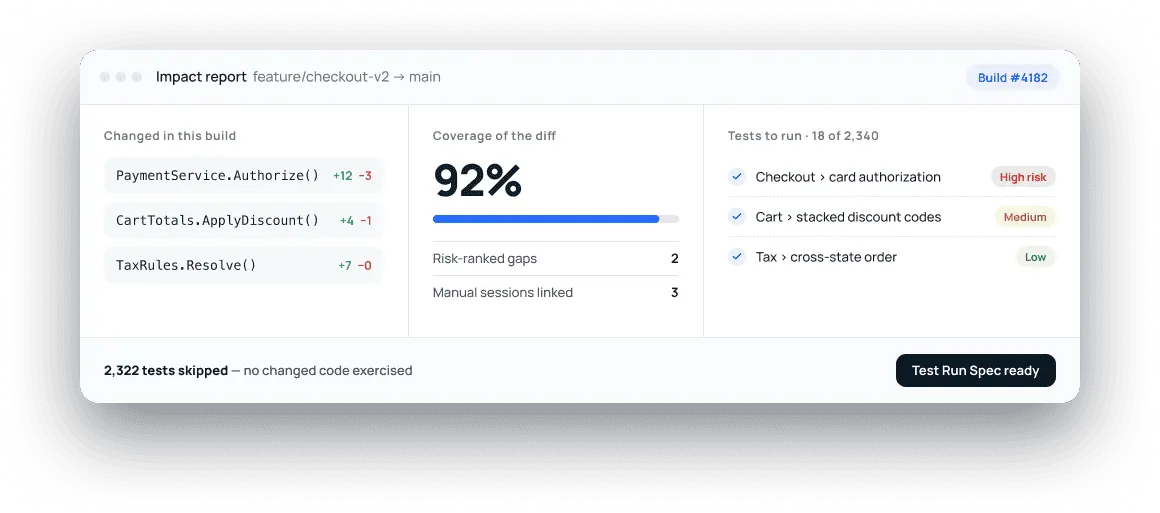

Test What Changed.
Ship with Proof.

QZTrace’s purpose-built agents map every test to the exact code it exercises,
so every build runs only on the tests that matter — with proof of what it safely skipped.

Everything changed in your
build; what did testing actually
cover?

Full regression with every release

Hours spent on unchanged code

Gaps surface only after release

Over-testing that burns budget — and trust.

No evidence of what a build actually tested

QZTrace is intelligent test impact analysis for enterprise engineering teams.

Traditional impact analysis leans on static models, so teams fall back on full-suite regression — burning hours of compute on code that never changed.

QZTrace’s agents build a living map across your repositories, services, and coverage data, and keep it current so testing is always pointed where the risk actually is.

Ready to replace overtesting with a single, evidence-backed answer?

Purpose-built agents at every step

No application-code rewrites

Only coverage counters leave your network

Reversible in one click.

One system for impact, coverage,
and proof

Precision,
Not Volume

QZTrace selects the individual test that a change actually touches, never the whole suite it lives in.

It compares a feature branch against main, not only build-to-build.

Total Visibility with Every Build

Coverage is measured against this release’s changed code, not last quarter’s average. So, the red gaps are real, current, and actionable.

Manual and exploratory sessions feed the same inventory as automation, so nothing you test by hand disappears from the record.

Enterprise-Grade by Design

QZTrace installs as one system—impact analysis, coverage, manual capture, and reporting together—not four licensed products stitched together with agents.

Instrumentation is PR-gated, visually verified, self-hosted, and reversible in a single click.

Six Unique Steps, Each Powered by a
Purpose-built Agent

Connect & Scan

Read-only token. Every file and method fingerprinted. A readiness verdict before any commitment.
Instrument

Build-config changes only — no application logic rewritten. Delivered as pull requests your team approves.
Execute

Your existing suites run unchanged, on your infrastructure. Manual sessions count identically.
Collect

Only coverage counters leave the app — no payloads, no personal data, per-test attribution as a delta.
Map & Analyze

Coverage matched to fingerprints, so refactoring never breaks the map. Risk-ranked gaps, per build.

Act

A prioritized Test Run Spec — what to run, what’s uncovered, and why — ready for your test team.
Measured on Real Enterprise Codebases

0 M
Lines scanned
files
detected
0
methods fingerprinted
0
repositories
0
$ 0 M
Saved

Successfully deploying an advanced quality-intelligence platform in a complex enterprise environment.

0 Weeks
To the first build-over-build impact report

Risk-ranked changes, coverage of the diff, true gaps.

Saved $3M.

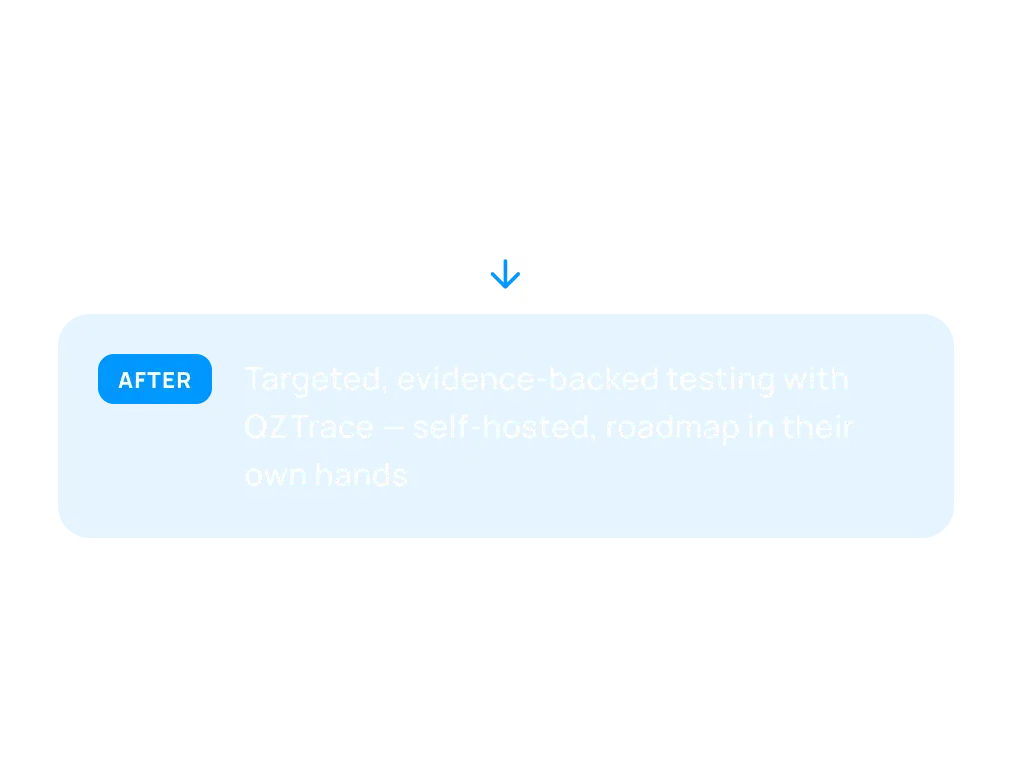
An enterprise QE team running a full-scale application estate displaced an established, commercial quality-intelligence platform with QZTrace — moving from full-suite regression to targeted, evidence-backed testing, self-hosted, with the roadmap in their own hands.

Start with a free readiness scan.

Ready to Test Only What Changed? Let’s Talk

Questions teams ask before their first scan

QZTrace builds a fingerprinted map of your codebase, watches what changes between builds, and attributes real runtime coverage — automated and manual — to every test. Each build gets a risk-ranked, traceable list of the tests that actually need to run.

No. AI agents propose test mappings and candidate cases; the selection path itself is deterministic and auditable. The same commit always produces the same analysis, and every recommendation traces back to the method that produced it.

QZTrace is self-hosted on your infrastructure, and only coverage counters leave the application — no test inputs, no request or response contents, no personal data. Nothing reaches a repository without a human-approved pull request, and instrumentation is inert above your test environments.

Yes. Instrumentation strips in a single action, and your coverage data is retained for instant restore if you reinstate it later.

.NET, Node.js, Java, and Angular codebases on Azure DevOps (Repos, Pipelines, Test Plans) and GitHub, executing through Katalon, Playwright, LambdaTest HyperExecute, and Perfecto. Python and Jira support is coming next.

Yes. Manual and exploratory sessions feed the same inventory as your automated coverage — testers drive the live app, and QZTrace records which methods each session exercises and tags them to test cases with pass/fail.

Built-in impacted-test tooling is typically single-stack, single-machine, and stops at unit tests. QZTrace works across your full stack, compares a feature branch against main (not only build-to-build), selects the individual test rather than re-running its containing suite, and folds manual coverage into the same picture.

A free, read-only readiness scan in week one, PR-approved instrumentation in week two, and your first build-over-build impact report — on your own numbers — by week three.

Every engagement starts with a free readiness scan, followed by a scoped, fixed 3-week pilot on one repository. Talk to a QE specialist for pricing scoped to your application estate.

Discover AI-Powered Software Testing

Explore how AI-driven solutions can enhance software quality, streamline testing processes, reduce costs, and accelerate time-to-market.

Trusted By