
How often do software engineering teams end up in a ‘test trap’, endlessly validating whether the system is doing what it was intended, and missing specifics like reliability and stability under extreme conditions? The answer is quite often. According to the Consortium for Information & Software Quality (CISQ), the cost of poor software quality in the US was estimated at $2.41 trillion or more, and the figure continues to rise year-on-year. Findings from the Tricentis Quality Transformation Report indicate that 66% of global organizations are at risk of a software outage in the next year. These facts highlight how adrift your testing strategies can be, measuring the wrong things in controlled testing environments and missing user-impacting risks in production.
If you are a renowned retail, healthcare, or banking company, you cannot call yourself customer-centric if your QA team cannot test how your flagship system actually behaves when 40,000 users hit it simultaneously at 9:02 AM on a Monday morning after a long weekend. If your QA teams overlooked reliability testing, it is abundantly clear that you have an engineering intelligence problem—and it will cost you far more than your board realizes.
QualiZeal’s Reliability Insights Center (RIC) is a step forward in performance engineering that unifies the entire lifecycle. It is a fully integrated, AI-powered platform built to scale across all enterprise customer use cases and seamlessly integrates with our patent-pending QMentisAI platform. Unlike conventional performance testing, which, even when automated, is structurally unable to close the reliability gap that slips into production, the RIC is built with a fundamentally different approach, combining Agentic AI, real-user telemetry, and intelligent workload modeling. Together, it transforms performance engineering from a reactive cost center into a proactive strategic capability.
Read the rest of the blog to uncover how QualiZeal’s RIC is its next leap in the Quality Engineering innovation journey.
Performance Engineering and Testing Myopia
In most enterprises, performance testing follows a familiar pattern—a team scripts a few critical user journeys, configures a load generator, runs the test in a pre-production environment, and publishes a report showing response times, throughput, and pass/fail thresholds. On paper, the application looks ready. However, in production, the story can be very different because the workloads are modeled incorrectly. The reason is that across the enterprise’s software engineering team, performance testing is treated as a ‘narrow execution exercise’ rather than a ‘complete reliability engineering discipline’, resulting in performance myopia. This is likely to result in failed product launches, emergency war rooms at 2 AM, SLA breaches that cost contracts, and engineering teams spending 30–50% of every sprint firefighting rather than building.
Performance myopia is a sign of a disconnect between developers and users. The engineering teams become too vested in perfect code and enhancing theoretical efficiency. They end up defining virtual users based on assumptions, executing tests in environments that do not reflect real-world usage patterns, and relying on static reports that explain what happened but do not point to production defects or their remediation. Below, we have explained how this creates major blind spots that can result in downstream impact on the software performance under real-world conditions:
When the test planning is based on guesswork: The traditional workload models will be built on outdated, historical estimates, stakeholder inputs, or raw throughput numbers. This data excludes the complexity of real user behavior. For instance, a test that models 500 uniform virtual users cannot serve as a performance benchmark for 500 real users across different devices, geographies, session lengths, pacing patterns, and network conditions.
When execution is manual and fragmented: The test environments must be configured with distributed load and test artifacts uploaded or pulled. Test launches often depend on multiple handoffs across teams. If the test execution is manual and not automated or standardized, performance testing becomes really hard to repeat consistently across releases, regions, and application changes.
When insights often stop at metrics: Conventional test reports may reveal response times, error rates, throughput, and server utilization. However, they rarely convert those signals into clear engineering decisions, leaving teams to manually correlate test results with server metrics, identify bottlenecks, interpret risk, and prepare stakeholder-ready recommendations.

This is where QualiZeal’s RIC changes the conversation. RIC is not designed only to generate better workload models. It connects the full performance engineering cycle across PLAN, EXECUTE, and INSIGHTS. It ingests RUM and APM data, performs data wrangling and pattern extraction, and generates AI-driven workload models. Further, it applies workload parameters, automates test execution, distributes load across regions, feeds JTL and server metrics back into the platform, and provides AI-generated insights on a shareable dashboard.
In other words, RIC addresses the real illusion in performance testing– a successful test run equals production readiness. Software reliability requires more than scripts and dashboards. In fact, it hinges on realistic planning, repeatable execution, and AI-powered insights that help engineering teams gain a deeper understanding of the reasons behind systems’ performance and of vulnerabilities, enabling them to assess risk severity for active remediation.
What the Reliability Insights Center Actually Does
RIC, QualiZeal’s platform-led engineering practice for enterprise performance, is not a managed testing service with GenAI bolted in. It is a structured intelligence layer across three phases of every performance program:
- PLAN: AI-driven workload modeling from real telemetry.
- EXECUTE: Automated, distributed test execution at enterprise scale.
- INSIGHTS: GenAI-powered analysis and shareable recommendation dashboards.
Each phase is distinct, but they are designed to be composable so that enterprise clients can adopt the full loop or start with the component where their current maturity creates the most friction.
PLAN: Workload Intelligence, Not Workload Guesswork
The PLAN phase commences with data ingestion from APM platforms, including Azure AppInsights and Datadog, along with RUM data that captures real user sessions in production. This raw telemetry undergoes automated data wrangling and pattern extraction before feeding into RIC’s workload model generation engine. This uses a RAG (Retrieval-Augmented Generation) architecture grounded in the client’s own domain knowledge, SLAs, and historical performance logs.
The output is not a throughput number but a richly parameterized workload model that includes:
- Users-to-transactions-per-hour (TPH) mappings that reflect production concurrency patterns
- Pacing and think time recommendations calibrated to actual session behavior
- Test type selection rationale—load, stress, spike, and endurance—with AI-generated justification for each
- SLA response-time analysis benchmarked against p90 and p95 percentiles, not just averages
- Environment sizing recommendations for production-equivalent test conditions
- Geographic load distribution models for globally distributed user bases

This is where GenAI capabilities earn their place in the stack. A rule-based system can automate well-defined calculations, but a generative model can reason across sparse, noisy, multidimensional telemetry and produce a defensible workload design that a senior performance engineer would recognize as credible. Further, the reasoning will be grounded in the same data that an engineer would want to inspect.
RIC’s Phase 1 implementation for a renowned client’s Workforce Lifecycle Management program delivered a comprehensive workload modeling engine, including RAG-based domain-knowledge integration, automated SLA analysis, and test recommendation modules with AI-generated justification. This was achieved within a 10-week prototype sprint.
EXECUTE: Distributed Automation at Enterprise Scale
Execution in RIC is handled through an automated test orchestration layer that configures test environments, applies workload parameters, distributes load across geographies, manages test artifact uploads or pulls, and handles the full preview-to-launch workflow without manual handoffs. JTL files and server metrics feed back into the platform, creating a closed instrumentation loop between the test engine and the insights layer.
This execution layer is designed for complex enterprise testing needs. RIC can support multi-region, multi-OS, and multi-cloud performance testing, enabling teams to validate applications under more realistic infrastructure and user access conditions. For organizations with stricter security or governance requirements, tests can also be executed within the client’s own environment or cloud tenant, enabling teams to run performance validation in a safer, more controlled environment.

The RIC platform supports tiered deployment models designed around COE practicality. Teams can operate within a Core subscription for bounded exploratory testing, scale to Advanced for larger load profiles, or deploy an Enterprise instance within their own cloud tenant for unlimited virtual users and greater control over infrastructure.
Additionally, RIC allows teams to provision the required infrastructure quickly and either start test execution immediately or schedule it for a later release window, making performance testing easier to operationalize across delivery cycles.
This tiered model reflects a deliberate architectural decision. Unlike headcount-based performance testing engagements, platform-led delivery scales without linear cost growth. This is beneficial in scenarios where a client running quarterly performance cycles does not maintain a dedicated performance engineering team year-round. The platform supports a repeatable execution workflow and a performance data trail; the team applies judgment to the outputs.
INSIGHTS: From Metrics to Engineering Decisions
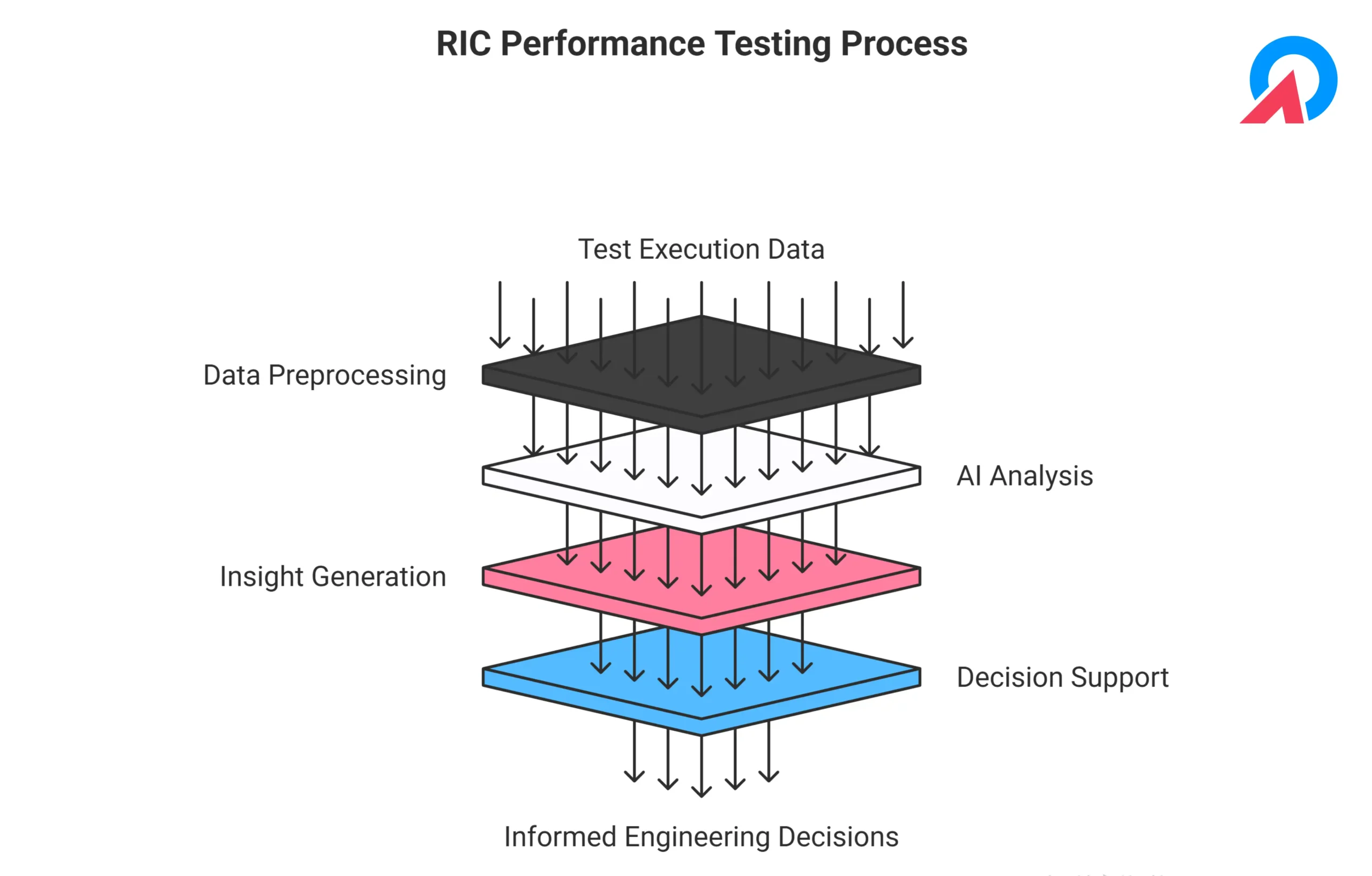
The INSIGHTS phase is where RIC most visibly diverges from conventional performance testing. Rather than producing a dashboard of response time charts and throughput graphs, RIC generates shareable AI-powered insights that help teams move from performance observation to engineering action. It ingests JTL files and server metrics, applies data preprocessing and AI analysis, and converts test results into reports, insights, and recommendations that engineering and business stakeholders can act on.
The analytical backbone applies AI inferencing to test execution data and infrastructure metrics to identify patterns that raw numbers can easily obscure. This includes request-level root cause analysis, advanced error analysis, bottleneck identification, and performance behavior comparisons across test runs. Instead of looking at each execution in isolation, teams can compare results, identify trends, evaluate degradation or improvement over time, and understand which requests, services, or infrastructure signals are contributing most to performance risk.
RIC also brings structure to how performance health is communicated. Features such as advanced filtering, shareable results, and a performance index score help teams prioritize what matters, rather than getting lost in raw metrics. For example, a memory leak under endurance conditions, a CPU-saturation pattern linked to a specific API cluster, or response-time degradation caused by regional latency can be translated into a clearer engineering narrative.
Critically, the insights are designed to be actionable at the engineering team level and stakeholder-ready at the leadership level. The platform does not simply show what the data says; it helps explain why a given performance risk matters, how it may affect user experience, where it creates SLA exposure, and what remediation areas should be prioritized.
In the era of agile development, where rising customer expectations and digitization define the quality benchmarks for complex software applications, performance engineering needs a massive leap not just in automation but in intelligent, realistic insights that accelerate feedback and enable development teams to act promptly. QualiZeal leads in GenAI-powered QE, transforming manually intensive testing into an intelligent, agent-driven Quality Lifecycle Management process. With RIC, we are championing the transformation of the most critical element—performance testing—from a reporting exercise into a decision-support capability.
Curious to learn how QualiZeal can help your enterprise build sustainable advantage, unleashing its AI-native QE capabilities?
Connect with our experts now!