
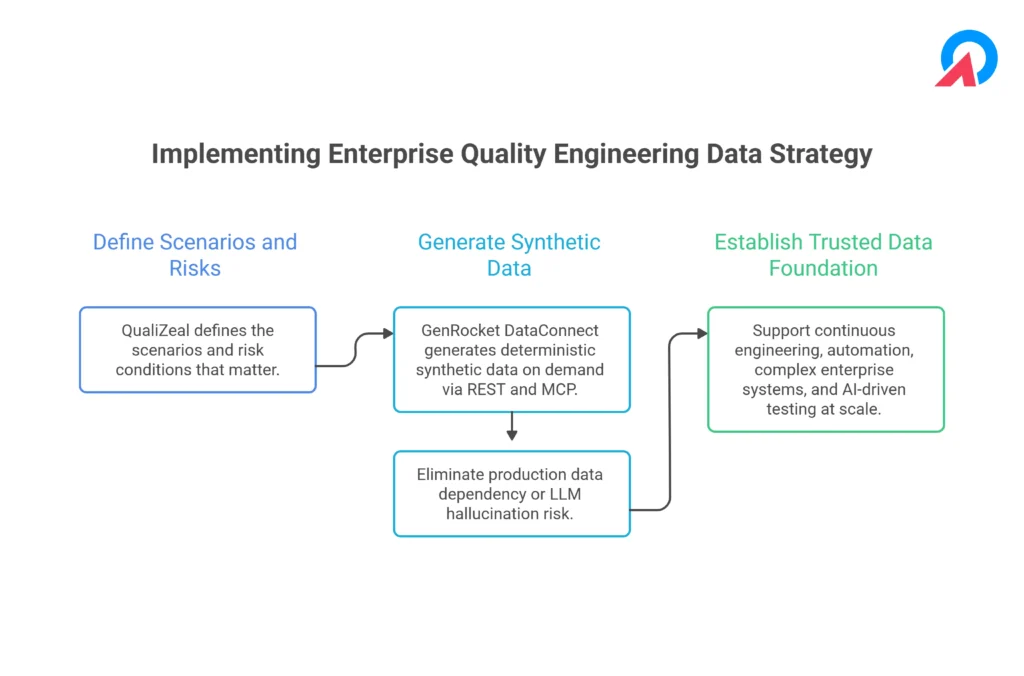
Quick Summary: Enterprise Quality Engineering needs reliable, rule-bound test data, not only realistic-looking records. QualiZeal defines the scenarios and risk conditions that matter; GenRocket DataConnect generates deterministic synthetic data on demand via REST and MCP, without production data dependency or LLM hallucination risk.
Enterprise applications are becoming more connected, data-intensive, AI-enabled, and increasingly autonomous. As this shift accelerates, Quality Engineering must validate far more than application functionality. It must account for complex business processes, integrations, automated workflows, AI-driven applications, and emerging agentic systems.
Yet every one of these testing scenarios depends on something fundamental: The right data being available at the right time and under the right conditions.
Traditional test-data approaches were built primarily to support testing environments. Modern enterprises need something broader, a trusted data foundation that can support continuous engineering, automation, complex enterprise systems, and AI-driven testing at scale.
That requires bringing Quality Engineering strategy and modern synthetic-data capabilities together.
Why Test Data Has Become an Enterprise Quality Challenge
For many organizations, obtaining test data still depends heavily on production systems. That can create delays, privacy concerns, governance challenges, and limitations in the scenarios teams can realistically test.
Production data also reflects what has already happened. Testing often needs to validate what could happen, such as, unusual transaction combinations, negative conditions, boundary cases, new product configurations, future-state workflows, or scenarios that occur too rarely to source easily from production.
At the same time, modern engineering practices are increasing demand for data. Automated regression suites, continuous testing, API testing, CI/CD pipelines, and distributed enterprise applications all require reliable datasets at higher frequency.
AI adds another layer. Large language models can generate plausible-looking data, but software testing requires more than plausibility. Test data often must follow precise business rules, preserve relationships between fields, recreate known conditions, and produce the same scenario consistently across repeated runs.
The challenge is, therefore, no longer simply how to obtain more test data. It is how to create reliable, secure, repeatable, and scenario-specific data that can support a continuously evolving Quality Engineering ecosystem.
How Does QualiZeal Connect Test Data to Quality Strategy?
Building a trusted data foundation does not begin with generating data. It begins with understanding what needs to be tested and why.
This is where QualiZeal’s pure play Quality Engineering solutions become vital. Quality Engineering provides the business and risk context behind testing. It identifies the workflows that matter, the conditions that could create business impact, the integrations that require validation, and the level of coverage needed across the engineering lifecycle.
From a test-data perspective, that means connecting data requirements to:
- Critical business processes and workflows
- Application and integration risk
- Functional and non-functional testing
- Regulatory and compliance scenarios
- Negative, boundary, and edge conditions
- Automation and regression coverage
- CI/CD and continuous testing
- AI and agentic-system validation
The objective is not simply to ask, “What data can we generate?” The more important questions are: Which scenarios matter? What data conditions are required to validate them? How should that data be provisioned, governed, and consumed throughout the engineering lifecycle?

QualiZeal helps establish that context. A payment workflow, for example, may require successful and failed transactions, different account conditions, unusual combinations of customer attributes, and precise integration states. An API may require specific payload combinations. A regression suite may need identical starting conditions across multiple test runs.
By defining those requirements through a Quality Engineering lens, test data becomes part of the broader quality strategy rather than an isolated activity performed downstream.
What Does GenRocket DataConnect Deliver?
Once the required scenarios and data conditions are defined, organizations need a reliable way to create and deliver that data.
GenRocket DataConnect™ provides that enabling capability. DataConnect is an enterprise Synthetic Data-as-a-Service platform that generates synthetic data from predefined rules, relationships, constraints, and generation logic to create deterministic datasets. Unlike probabilistic approaches that generate statistically plausible outputs, deterministic generation allows data to be created according to explicitly defined conditions. That distinction is particularly important for testing.
A customer record may look realistic while still failing to satisfy the business conditions required for a specific test. Testing may require relationships between customer attributes, account types, transactions, eligibility rules, or other fields to behave in a precise way.
DataConnect is designed to generate those conditions deliberately. Its key capabilities include:
- Deterministic synthetic-data generation (no statistical inference)
- Business-rule and cross-field constraint enforcement
- On-demand generation (including high-volume calls) without production data as a source
- REST API and Model Context Protocol (MCP) interfaces for automation frameworks, CI/CD pipelines, AI agents, and LLM toolchains
- Capacity-based pricing tied to data volume rather than token consumption
- Industry-aware generation for banking, financial services, insurance, healthcare, telecommunications, retail, and other regulated domains
This changes the role of test data from something that must be manually prepared before testing begins to something that can increasingly be requested and generated as part of the engineering workflow itself.

How QualiZeal and GenRocket Connect Quality Intelligence with Trusted Data?
The value of the partnership lies in bringing these two layers together.
QualiZeal provides the Quality Engineering context.
It helps determine which scenarios require validation, the business and technical risks behind them, the appropriate testing strategy, and where synthetic data should be integrated across automation, continuous testing, and emerging AI-driven environments.
GenRocket provides the deterministic synthetic-data capability.
DataConnect translates those requirements into controlled datasets that can be generated repeatedly, provisioned on demand, and consumed by both traditional automation and machine-driven systems.
Together, the model becomes: Business & Quality Risk → Test Scenario → Data Requirement → Synthetic Data Generation → Test Execution → Quality Insight
Consider a complex enterprise transaction spanning several applications. Quality Engineering first determines the critical workflow, identifies the risks, and defines the conditions that must be validated. Those conditions are translated into specific data requirements. DataConnect can then generate the required datasets, automation executes the scenario, and the results contribute to a broader understanding of quality and risk.
The same model becomes increasingly relevant as AI and agentic systems become part of Quality Engineering.
AI-enabled testing systems may assist with identifying scenarios, generating tests, orchestrating execution, or analysing results. But greater autonomy also increases the importance of controlling the data those systems consume.
Through APIs and MCP, DataConnect can provide machine-accessible synthetic data based on defined rules and scenarios. This creates a model in which intelligent systems can interact with controlled data rather than relying solely on probabilistically generated inputs.
In short, Quality Engineering determines what needs to be validated; deterministic synthetic data creates the conditions required to validate it.
Where Can This Foundation Be Applied?
The combined approach can support several areas of modern Quality Engineering.
- In continuous testing, scenario-specific data can be provisioned as part of recurring automated test cycles.
- For test automation, teams can generate data for individual scenarios rather than repeatedly relying on static datasets.
- In regression testing, deterministic data enables known conditions to be recreated across multiple executions.
- For API and integration testing, precise data combinations can be generated to validate interactions across connected enterprise systems.
- For negative and edge-case testing, teams can intentionally create conditions that may be rare or unavailable in production.
- Within CI/CD pipelines, synthetic-data generation can be incorporated directly into automated engineering workflows.
- For AI and agentic testing, REST and MCP interfaces allow intelligent systems to access controlled data programmatically.
Across each of these use cases, the underlying principle remains the same: provide the right data for the right quality scenario, when it is needed.

Faster Engineering Without Compromising Trust
Enterprises are moving toward faster delivery cycles, greater automation, and increasingly autonomous engineering environments.
But speed and autonomy should not come at the cost of control.
A trusted data foundation can help organizations:
- Broaden testing coverage by creating scenarios on demand
- Reduce delays caused by traditional data-provisioning dependencies
- Limit unnecessary use of production information
- Improve repeatability across automated testing
- Increase confidence in the conditions behind quality decisions
As enterprise technology becomes more intelligent, Quality Engineering must evolve with it. Better automation alone is not enough. Organizations also need trusted data beneath every test, workflow, and increasingly, every machine-driven quality decision.
By combining QualiZeal’s enterprise Quality Engineering expertise with GenRocket DataConnect’s deterministic synthetic-data capabilities, organizations can move toward a model where test data is aligned to business scenarios, available on demand, embedded into engineering workflows, and governed for enterprise use.
The result is more than a better approach to test data. It is a trusted data foundation for the next generation of enterprise Quality Engineering.
Ready to build a more trusted data foundation for modern Quality Engineering? Explore how we can help you bring deterministic, on-demand synthetic data into your testing, automation, and AI-driven engineering workflows. Connect with us to learn more.
FAQ
Synthetic data generated from predefined rules, constraints, and relationships so every value is engineered rather than statistically inferred—supporting repeatability and auditability for testing.
DataConnect generates data by design (rules and constraints) rather than probabilistic prediction, reducing hallucination risk and using capacity-based pricing instead of token consumption.
Because modern testing, automation, CI/CD, integrations, AI, and agentic systems, depends on the right data conditions being available consistently, not only on realistic-looking records.
Yes. Native REST API and MCP interfaces allow AI agents, automation frameworks, and CI/CD pipelines to request and receive deterministic synthetic data on demand.