
Another day, another dollar, and another article about AI. Sounds familiar? About two years ago, PwC’s Global CEO Survey led with this sentiment in an article, calling out GenAI’s unprecedented rate of adoption as a swiftly moving train that’s hard to board. Fast forward to 2026, and the gap in understanding GenAI’s potential and risks persists, despite 25 million academic records and more than 50% of internet articles published on the topic.
This conversation matters especially given enterprises’ vigorous deployment of GenAI across sensitive use cases in finance, healthcare, insurance, government, and more. Moreover, the technology’s opaque and stochastic nature compounds the concerns, leaving leaders with some taxing questions on Quality Engineering for GenAI systems:
- How to test systems with a non-deterministic behavior pattern?
- How to identify an inaccurate GenAI output that sounds convincingly legit?
- How to detect risks and failures that surreptitiously slipped into production beyond regular compliance checks and audits?
- What proof can be produced as evidence that the system can be trusted?
But the most pressing question of all: is there a standard method to assure your chatbots, summarization engines, coding assistants, policy advisors, and document generators?
Not all GenAI systems are the same. They vary widely in capabilities, architecture, and use cases. Large Language Models (LLMs) generate and summarize code and text. Multimodal systems are trained on data that helps them produce a combination of text, audio, video, and image content. Retrieval-Augmented Generation (RAG)-based systems extract relevant, recent, and accurate information from external proprietary databases. Agentic systems don’t just produce outputs to prompts; they execute decisions, calling APIs and external software without human oversight.
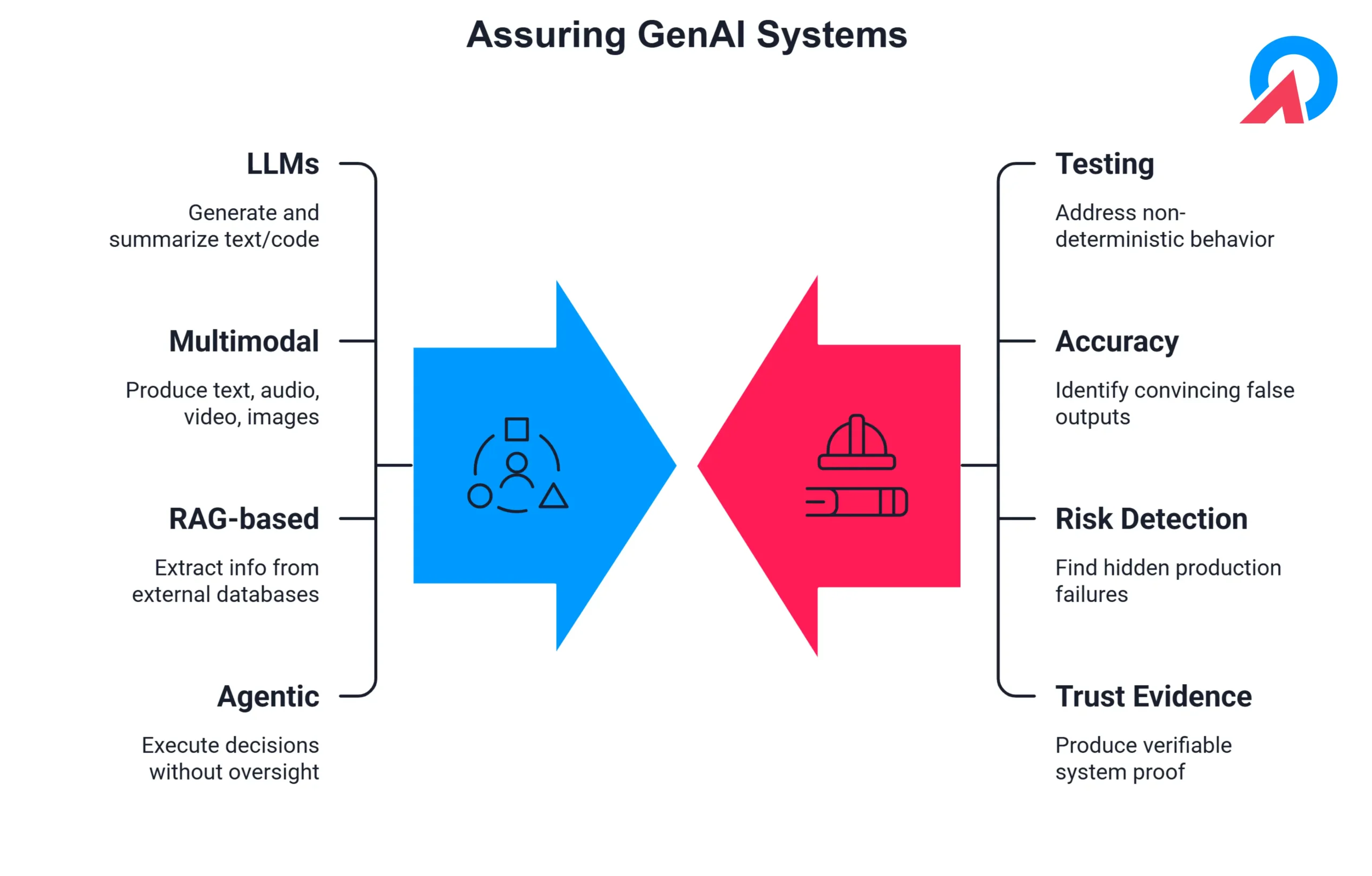
In a nutshell, there are different families or archetypes of GenAI systems with unique risk profiles, making standard testing methods unfit for all of them. This demands a new approach—an Archetype-Driven Assurance Framework (ADAF) —a repeatable, simple operating model.
Read through this blog to understand a QE leader’s viewpoint on bringing clarity to chaos, leveraging ValidAIte’s ADAF to make GenAI assurance targeted, efficient, and defensible.
A Real-World Scenario: Where Oversight Breaks Without Structure
Let’s revisit one of the most common GenAI failures. A customer support copilot deployed across digital channels produces strong results during the pre-launch testing. The responses are accurate, helpful, and aligned with brand guidelines.
Over time, subtle issues emerge in the post-production phase:
- Some customer segments receive noticeably different response tones
- Edge-case queries trigger hallucinated or incomplete policy information
- Model updates introduce behavior drift that correlates with rising complaints
These are the issues that are rarely caught through ad-hoc testing because:
- Ownership for failures and risk becomes unclear once the model is live
- Traceability between prompts, responses, and model versions is limited
- Bias and drift emerge gradually, not as discrete failures
The problem is not with testing. It is an oversight failure that prevents risk signals from surfacing early and linking them to the concerned owners to enforce corrective steps before regulatory exposure, loss of customer trust, and brand reputational damage.

Introducing ADAF: An Operational Framework for GenAI Quality Oversight
ValidAIte, QualiZeal’s newly launched enterprise-grade AI assurance platform, is purpose-built to help move beyond the pilot purgatory by assuring AI systems against risks that surface at user, operational, architectural, data, and compliance levels. Whether your enterprise is building LLM applications, chatbot agents, or swarms, the platform supports archetype-aware risk classification, severity assessment, testing, safety evidence, and continuous governance and executive accountability.
The ValidAIte Application Manifest (VAM) starts by identifying the system archetype by naming and classifying the family. The modifiers are then applied (e.g., RAG, multimodal, fine-tuned, enterprise-integrated), followed by assigning a risk tier (low, medium, high, and critical). And importantly, a decision trace shows the reasoning: “retrieval.enabled = true → archetype includes RAG; integration.systems = ServiceNow → enterprise modifier; autonomy = 0 → agent without autonomy.”
The reasoning provides QE leaders with clarity on risk severity, enabling them to select a ready-made assurance playbook that provides insights into the controls that should exist, appropriate tests to run, and metrics and thresholds to track for rollout or back decisions. The playbook, specifically, is mapped to the GenAI arctypes, making GenAI assurance a scalable, consistent, and repeatable process that leaves no room for blind spots.
The last step is to produce regulator-ready evidence gathered in the evidence pack and share insights to influence the authorization decision to approve or fail the test, which would be valid for a defined period. It also helps set monitoring rules (e.g., drift < 10%, freshness < 3 days, no incidents). If the system changes or undergoes an update to become more autonomous, the GenAI assurance model automatically reclassifies it to rerun tests on the updated archetype.

A Leadership Tool Embedded in Delivery Pipelines
One of the confirmed benefits of ADAF is moving from uncertainty to awareness for decision transparency that helps shift the QE mindset from:
- From Chaos to Clarity: QE teams no longer have to shoot in the dark to understand the type of assurance framework that would best fit the GenAI system. Archetypes help name and frame the GenAI systems, providing enough context to reason with AI development teams and the board on whether the initiative is worth their while.
- Move from Ad hoc to Repeatable: ADAF simplifies assurance, making the four steps consistent and scalable across all GenAI systems without requiring major changes to testing and risk screening approaches.
- Trust Engineering Over Testing: While testing is critical, AI system assurance must move beyond looking for bugs and fundamental performance failures. ADAF helps enterprises focus on building systems that are reliable, safe, and auditable.
- Defensive to Strategic Proof: Instead of defending the GenAI systems’ safety, ethics, transparency, accuracy, and explainability, ADAF provides a pathway to respond to regulators’ and auditors’ queries with evidence.
- Technical Risks to Business Alignment: ADAF helps QE leaders articulate the technical complexities of GenAI systems in a language that CIOs, risk officers, and compliance leaders understand, aligning every team with the overarching business goals.
Conclusion: Oversight Is the Line Between Experiments and Enterprises
The enterprise GenAI game will not be defined by who experiments fastest, but by who scales responsibly. Organizations that rely on ad hoc testing or policy-heavy governance will struggle as GenAI systems become more autonomous, influential, and visible. ADAF is designed to be lightweight and practical for QE leaders to embed quality oversight in a matter of weeks. In the long run, ADAF represents an opportunity to empower understanding of GenAI system archetypes and their associated risks and failure patterns. Those insights are enough to build an assurance pathway that can be revisited and is evidence-driven, institutionalizing assurance so that trust becomes provable and enterprise-ready.
Intrigued to explore a simple 90-day playbook for ADAF adoption? If you are curious about the rigor behind QualiZeal’s Quality Engineering for GenAI applications with archetype-first and assurance-first ADAF, connect with our experts to schedule a demo.

Disclaimer: This article draws insights from the LinkedIn article “Beyond Ad Hoc Testing: The Archetype-Driven Assurance Framework for Generative AI Systems,” authored by Madhu Murty Ronanki.