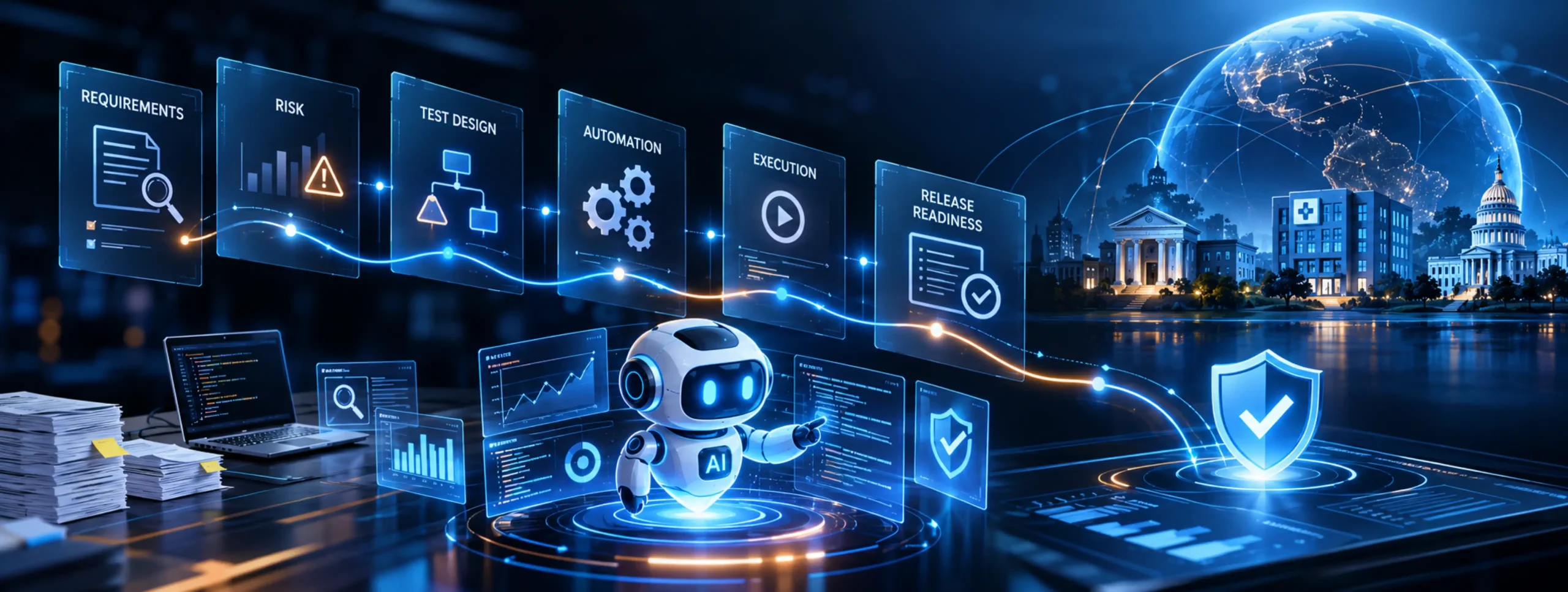

Over the last two years, we have consistently observed a pattern across several enterprise engagements. When organizations migrate to AI-powered applications, whether they are deploying LLM copilots, autonomous agents, or a small feature dependent on GenAI, the first thing to break is not the software itself. It is their Quality Engineering (QE) practice.
When AI is integrated into the existing application, the existing QE scripts fail, throw false positives, and dashboards show patterns and numbers that are hard to interpret, leaving key stakeholders with the golden question: “Are we confident about this system’s behavior and is it performing correctly as intended?” This question resurfaces across different forums in almost every other industry. And that’s exactly what Quality Intelligence (QI) is built to answer.
But before we get there, a clarification that the industry desperately needs neither QI is the next version of QE, nor is it just QE packed with better tools. The two disciplines exist for fundamentally different types of systems. Confusing them with the same or interpreting them as interchangeable concepts can be one of the more expensive mistakes enterprises make when they start their AI transformation journeys. Read the blog further to unlock QualiZeal’s approach towards Quality Engineering and the shift towards Quality Intelligence.
Why QE Was Never the Problem
The tech industry over the past two decades has witnessed several evolutions, mostly linear upgrades. In QA, we went from manual testers to SDETs. And SDETs progressed to shift-left QE integrated into CI/CD pipelines.
Concurrently, software engineering also underwent significant change, with agile development, continuous deployment, and cloud-native architectures demanding a different quality model. The industry as a whole responded to that change. QE accommodated to the new development environment, with rigorous, script-driven validation and assurance of deterministic systems that will always produce the same output. However, it is not designed for what enterprises are building now— AI-native applications that are not only faster and more complex but categorically different, with a non-deterministic behavior pattern in which an LLM-powered system does not guarantee a fixed output for a given input.
These systems have a probability distribution over outputs that shift with context, data drift, input settings, and model updates. For instance, an AI application result that was accurate last Tuesday may be confidently wrong on Wednesday. These inconsistencies may not be due to a code change, but to upstream model behavior that the application development team can’t control directly.
Another example is for an AI application: engineering teams cannot write a Selenium script to validate it or catch model-level drift in a nightly regression run. This is not a gap in QE’s execution but in its scope. QE was designed for a different category of problem, and enterprises building on AI now need a second operating layer alongside it.
Where Enterprises Are Actually Struggling
From what we see across client engagements spanning financial services, healthcare platforms, and large-scale insurance applications, three failure patterns keep repeating. These failure patterns are structural cracks that QE cannot fix in AI-era systems:
1. Non-Determinism
When the quality framework is built around binary assertions, “does the output match the expected value?”, it has no conceptual vocabulary for a system that produces valid but variable outputs. An AI feature might return three different, entirely reasonable answers to the same query. A standard QE test may treat every variation as a failure. There will be an avalanche of false positives that erode trust in the pipeline, leading engineers to suppress alerts rather than investigate them. That erosion of trust is quietly one of the most damaging things affecting organizations during their first year of AI adoption.
2.The Insight bottleneck
Most enterprises today are generating extraordinary volumes of telemetry logs, traces, metrics, & data. When production issues occur, teams still spend hours correlating noise across multiple tools, manually reconstructing a causal chain. The monitoring suggests that something broke. But rarely points toward what was going to break. However, in AI-native systems where a model’s output quality degrades gradually rather than failing sharply, there is a high risk that the system will appear to work perfectly well while its outputs degrade. As a result, issues are identified much later, leading to costly errors.
3. Lack of Governance Monitoring
In a world where a model can drift, data poisoning, or prompt injection can cause bad outcomes at lightning speed, the traditional approach of catching defects in a staging environment before production release doesn’t work. Regulatory exposure, brand risk, and contractual violations can materialize before any schedule review cycle has had a chance to intervene. AI systems need an AI governance framework that keeps pace with their adoption and reliance.

What Quality Intelligence (QI) Actually Is
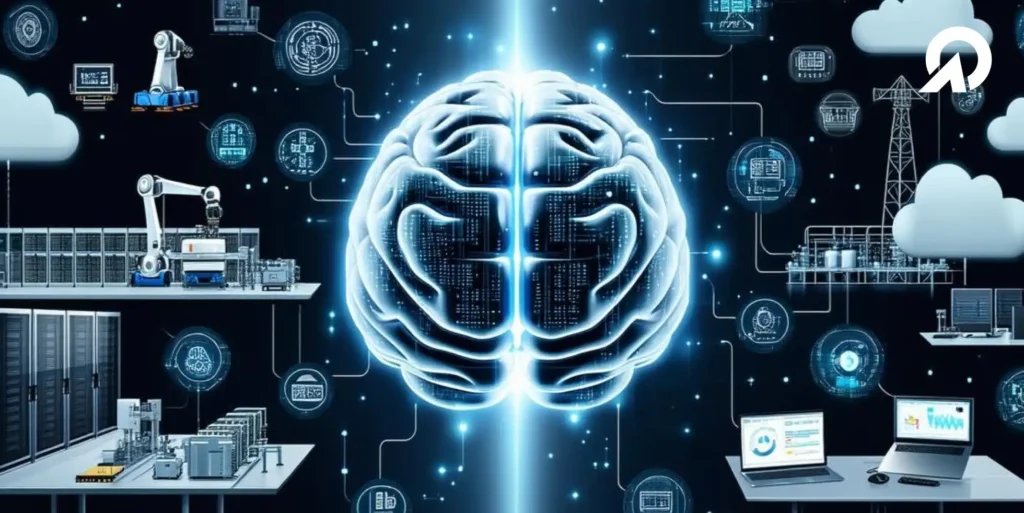
QI is the discipline of using AI as an operational brain to govern the reliability, resilience, and trustworthiness of enterprise systems. This approach is not to test AI models, but to orchestrate system-wide health at a level and speed that human oversight alone cannot sustain.
QI leverages AI as its intelligence layer to manage the broader enterprise system, which includes legacy applications to AI applications. Think of QI as the watchdog for the entire enterprise operating environment, spanning code, infrastructure, data pipelines, model outputs, integrations, user behavior, etc. It makes autonomous decisions, such as risk prediction and what to do about it, before that risk reaches production.
This operating model rests on three core pillars.
1. Predictive Defect Analytics
Typically, QA teams run thousands of tests against every commit using predefined templates without learning from data, logs, or patterns from the previous commit. The framework ingests historical commit data, code churn patterns, production incident logs, and real-time system state to calculate a mathematical risk profile for every code change before it is merged. The result is not a list of tests to run; it is a risk-ranked prioritization that provides insights into where to look, how deeply to look, and what conditions to recreate. This is particularly true in organizations with large, complex legacy codebases that coexist with newer AI-powered components, where the blast radius of a change is genuinely difficult to reason about manually.
2. Autonomous Testing and Self-Healing
We all experience this every day, when an element ID changes in a web application, the existing Selenium or Cypress script breaks until someone manually updates it. A Quality Intelligence framework uses computer vision and semantic understanding to interpret what the test was trying to validate — the intent of the interaction, not just the locator — and adjusts its own pathing dynamically. This is not just about reducing maintenance overhead, though that alone can represent a meaningful saving in engineering time. It is about building a testing layer that keeps pace with systems that change continuously, including AI-driven interfaces that generate or modify their own UI components.
3. Observability-Driven Quality
The most powerful shift in Quality Intelligence thinking is the end of the boundary between testing and production monitoring. Rather than treating these as two separate phases with a gate between them, Quality Intelligence (QI) uses real user paths, production errors, live load patterns, and model output distributions to feed the development lifecycle with ground truth continuously. Actual production conditions serve as the source of test scenarios, replacing the synthetic edge cases engineers imagine in isolation. And critically, the intelligence layer runs this feedback loop continuously as an ongoing operational function.
Quality Engineering and Quality Intelligence Comparison
To make this concrete for enterprise technology leaders thinking about how to position these two disciplines in their operating model, here is a side-by-side view of where they differ structurally.
| Capability Dimension | Quality Engineering (QE) | Quality Intelligence (QI) |
| Operational Stance | Proactive & Scripted | Predictive & Autonomous |
| Primary Metric Focus | Test Coverage %, Defect Density | System Resilience, Failure Lead Time, Causal Resolution |
| Data Architecture | Isolated test logs, local databases | Real-time streaming telemetry, cross-domain event correlation |
| Automation Engine | Manually/AI written code and locators | Generative test flows, dynamic self-healing, ML-driven orchestration |
| System Scope | Codebase and infrastructure | Code, continuous data streams, model behavior, and enterprise risk surface |
The important thing to understand about this table is that it does not describe a replacement relationship. Enterprises running traditional software alongside AI-native applications will need both. QE governs the predictable parts of the stack. QI governs the parts that operate at machine speed and non-deterministic scale.
Building the Quality Intelligence Operating Layer: A Practical Path
Previously, we have dived into the basics of Quality Intelligence (QI), a new discipline in which AI serves as the operational area for governing and managing the reliability, resilience, and trustworthiness of enterprise systems. While QI is fundamentally different from Quality Engineering (QE), there is a lot for enterprises to absorb before treating it as a ‘rip-and-replace’ exercise. Organizations that try to transform everything simultaneously tend to accomplish very little of either ambition. The practical approach would be a progressive build, starting with the foundational data architecture and layering intelligence capabilities on top.
Step 1: Unify the Telemetry Layer
Existing enterprise tech and team structures enable disconnected data silos. And building intelligence on top of disconnected data silos leads to chaos. Every QI implementation that can succeed starts with a data unification exercise, aggregating development signals (Jira tickets, pull requests, code churn), testing signals (test run history, coverage gaps, flaky test patterns), AI signals like trustworthiness, hallucination, and production signals (OpenTelemetry traces, error logs, user behavior telemetry) into a coherent, queryable foundation. This is the foundation on which QI models train. In its absence, enterprises would be left to pattern-match on noise.
Step 2: Implement Algorithmic Risk Grading
Once the telemetry foundation is in place, integrate intelligent agents directly into the code repository workflow. When a developer opens a pull request, an automated agent evaluates the change against the unified telemetry layer, correlating it with historical incident patterns, code churn frequency, and system dependency maps. A change touching a legacy payment module with a historically high incident rate gets flagged as high-risk, blocked from auto-merge, and routed to an isolated testing environment for deeper validation. This is not an obstruction to developer velocity; it is a precision instrument for directing human attention where it matters most.
Step 3: Establish Continuous Distributional Monitoring
For applications running live models, the QI layer needs a dedicated validation function that continuously monitors output distributions —not at deployment time, but as an ongoing operational activity. By measuring statistical divergence between production input distributions and the baseline training data, the system detects distributional shifts before they surface as user-facing failures. The QI system raises an alert, quarantines affected output paths, and—in more mature implementations—initiates autonomous remediation flows.
Step 4: Measure Intelligence Performance, Not Testing Throughput
This area has the sharpest contrast with traditional QE thinking. The metrics that matter in a QI operating model are not about how many tests are run or the test coverage percentage. They are about how well the intelligence layer is performing its job of governing enterprise system health. The table below outlines the metrics we recommend QI practitioners should track, with a few worth calling out in detail.
| Quality Intelligence Metric | What It Measures |
| Prediction-to-Production Accuracy | How reliably QI’s early warning signals mapped to real system failures — measures intelligence quality, not test throughput |
| Predictive Failure Lead Time | How far ahead of an actual failure the QI system surfaced a meaningful signal — longer lead time equals higher intelligence value |
| Cross-Domain Causal Resolution Rate | Percentage of root causes correctly traced across code, data, infrastructure, and processes without human investigation |
| Systemic Risk Coverage | Proportion of the enterprise’s live operating risk surface actively under QI observation — the intelligence equivalent of test coverage, but at enterprise scale |
| Autonomous Resolution Ratio | Percentage of detected risk conditions resolved by the system without human intervention, weighted by severity |
| Intelligence Latency | Time between a system condition emerging and QI surfacing a clear, actionable insight — measures insight quality, not just detection speed |
Of these, Predictive Failure Lead Time and Cross-Domain Causal Resolution Rate would be prioritized in any QI maturity assessment. Predictive Failure Lead Time tells you whether your intelligence layer is actually getting ahead of problems, or just reacting faster. Cross-Domain Causal Resolution Rate tells you how deep the system’s understanding actually goes, whether it can trace a failure to its true origin across code, data, infrastructure, and process without a human doing the detective work.
Intelligence Latency and Anomaly Signal-to-Noise Ratio are equally important as the system matures. A QI layer that surfaces alerts too slowly or drowns the team in false signals degrades trust in the same way a flaky test suite does. Getting those two metrics right is often the difference between a QI implementation that gets adopted and one that gets quietly abandoned.
Rethinking the Quality Professional’s Role
Traditionally, quality professionals focused on validating software functionality, identifying defects, and ensuring releases met predefined requirements. While those responsibilities remain important, today’s AI-driven and highly autonomous systems demand a much broader perspective.
Modern quality leaders are increasingly expected to understand system behavior, anticipate risks before they become incidents, interpret complex operational signals, and help organizations build trust in intelligent systems. The conversation is no longer limited to “Does the feature work?” It has expanded to “Is the system behaving as expected, and can we trust its decisions at scale?”
As QI becomes a reality, several new roles are emerging within forward-thinking organizations.
| Emerging Role | What They Focus On |
| Reliability Strategist | Looks beyond test coverage to identify and predict risk across the entire system. Their focus is on understanding where failures are most likely to occur and helping teams proactively reduce operational risk. |
| Quality Data Scientist | Ensures the data powering AI-driven testing and quality platforms is accurate, reliable, and representative. Their role is to build confidence in the data that drives quality decisions. |
| Reliability Engineer | Builds and maintains resilient quality infrastructure, including self-healing automation, intelligent monitoring, and automated risk assessment capabilities that reduce manual intervention. |
| Trust Engineer | Oversees the trustworthiness of the entire digital ecosystem, including software, AI models, data pipelines, infrastructure, and governance controls. Their goal is to ensure systems remain reliable, transparent, and accountable. |
In a QI-driven enterprise, quality becomes less about finding problems after they occur and more about creating the insight needed to prevent them altogether.
Conclusion
The transition from QE to QI is not about replacing one discipline with another. For most organizations, the future will be a hybrid reality in which traditional applications continue to rely on proven QE practices. At the same time, AI-native systems demand new capabilities to understand, predict, and govern increasingly complex behaviors.
The organizations that gain a lasting advantage will not be the ones that wait for complexity to become a problem. They will be the ones that start building the foundations of QI today—connecting telemetry, measuring risk, improving observability, and creating systems that can operate with greater autonomy and trust.
Talk to our experts to about your enterprise’s QE goals to adopt several strategic focus areas to move from reactive, automation-driven testing to proactive, AI-native quality control.