
Enterprise copilots embedded in everyday business workflows redefine how enterprises can unlock productivity gains and cost savings. No wonder, they are rapidly moving from experiments to production at a rapid pace.
According to McKinsey, 88% of organizations now report regular AI use in at least one business function, up from 78% a year earlier, with workflow redesign among the biggest drivers of value. That is the real shift—copilots are not valuable merely because they generate text or code. They are valuable because they change how work gets done.
That, in turn, changes the Quality Engineering question, or how are we testing enterprise copilots.
The central issue is no longer whether copilots can produce accurate answers, but whether those answers can be trusted inside the enterprise workflows where they are used. A weak response in a sandbox is one thing; a flawed response inside a live finance, HR, or operations workflow is completely another. It can mean a wrong decision, a delayed escalation, a policy violation, or a compliance exposure.
As a result, quality can no longer be measured by just model behavior. It has to be measured by whether a copilot continuously retrieves current information, respects access controls, follows policy, handles sensitive data safely, and remains observable after deployment.
That is precisely where QualiZeal’s ValidAIte becomes relevant: validating not just the AI response but also the risk, workflow context, evidence, and governance readiness behind it, and helping organizations move from AI experimentation to AI confidence.
Enter Continuous Testing
Conventional software testing was built for largely deterministic systems. Enterprise copilots, however, do not behave that way. Their prompts, models, retrieval sources, and tool integrations keep changing underneath them. So, just because the copilot passed testing last month doesn’t mean it is still trustworthy today.
Hence, enterprises need a continuous validation architecture that spans the AI system’s planning, design, data, build, validation, deployment, monitoring, feedback, and improvement. ValidAIte treats AI assurance as a continuous lifecycle discipline, built around a structured sequence—Trust, Risk, Metrics, Tests, Evidence, and Observability —that identifies the risk landscape, generates relevant test scenarios, computes trust scores, and continuously monitors how the AI behaves as conditions change.
The result is not just a testing report. It is an evidence-based view of whether an AI system is behaving as intended, needs improvement, or should be paused before it creates downstream business impact.
Measuring Trust Where It Matters
A common mistake in enterprise AI assurance is using generic evaluations that ignore the workflow. A customer support copilot, a finance policy assistant, a developer copilot, and an agentic operations assistant do not carry the same risk and should not be validated in the same way.

What enterprises instead need is bespoke evaluations tailored to a workflow’s purpose, users, data, integrations, decisions, and potential failure modes. But even workflow-specific evaluation results have limited value if they remain scattered across technical metrics and test reports. They need to be consolidated into a clear, business-readable view that shows whether the copilot is ready to deploy or scale, where additional controls are required, and what risks still need attention. That is the role of the Trust Score.
ValidAIte helps enterprises build a Trust Score by evaluating the dimensions that matter the most to a particular AI system and the specific workflow it operates in. It organizes trust around seven dimensions, drawn from NIST’s AI Risk Management Framework—valid and reliable, safe, secure and resilient, explainable and interpretable, privacy-enhanced, fair, and accountable and transparent. These are deliberately business dimensions, not model-performance metrics, because they are what a CXO, risk officer, or auditor needs before trusting an AI system within a workflow.
Each dimension is backed by a technical evaluation underneath it. Safe means testing whether a copilot calls the correct system with the correct parameters before filing an audit report or sending an email on someone’s behalf. Valid and reliable means testing whether the answer is actually grounded in retrieved knowledge or quietly invented. Accountable and transparent means an agentic workflow can show which step it took and why, so a decision can be traced rather than taken on faith.
By connecting trust dimensions to business outcomes—instead of measuring what is merely convenient—ValidAIte provides a trust score that CXOs can use with confidence within their enterprise copilots.
From Test Results to Executive Visibility
As enterprises deploy more copilots across functions, CXOs need a consolidated, continuously updated view of trust across their copilot portfolio to identify emerging risks, compare readiness, and decide where to scale, pause, or intervene.
AI governance, therefore, cannot depend on scattered reports or technical dashboards that are accessible only to engineering teams and understood only by them. CXOs need a business-ready view that can help them justify investments, govern risk, and make informed decisions.

This is where the ValidAIte Trust Score Dashboard becomes important, providing leaders with a business view of AI readiness, risk posture, and governance, and answering questions such as which copilots are ready to move from pilot to production and what evidence can be shown to risk or compliance stakeholders. This is not governance for the sake of governance. It is governance as a decision system.
Depending on the scores, leaders can choose to scale, pause, retrain, or add oversight, and QE leaders can move from saying “we tested it” to showing exactly what was tested, how it was tested, and what still needs attention.
Yet, a strong Trust Score and consolidated governance view are only meaningful if they translate into measurable business outcomes, as an enterprise can have a technically sound, well-governed copilot that still fails to create real business value.
Business Impact from Trusted Scale
The real test, therefore, is whether a trusted copilot delivers measurable business impact. Gartner warns that over 40% of agentic AI projects may be canceled by the end of 2027 due to escalating costs, unclear business value, or inadequate risk controls. This is a strong argument for having a stronger validation right from the outset.
QualiZeal’s own validation work points to what this looks like in reality. In an enterprise chatbot engagement, continuous validation across knowledge base quality, agent behavior, prompt injection, guardrails, and functional and security testing delivered 40% cost savings in call center operations, improved response accuracy by 35%, reduced hallucinations by 50%, automated 80% of validation activity, and lowered SME effort by 40–60%.
Similarly, in an agentic development engagement, continuous validation focused on whether agents completed the correct sequence of steps, maintained role fidelity, and avoided unsafe actions, helping the organization reach production 3x faster.
These outcomes, however, aren’t created just by validation technology. They come from combining the platform with the right processes, domain expertise, governance, and continuous oversight.
From AI Risk to AI Confidence
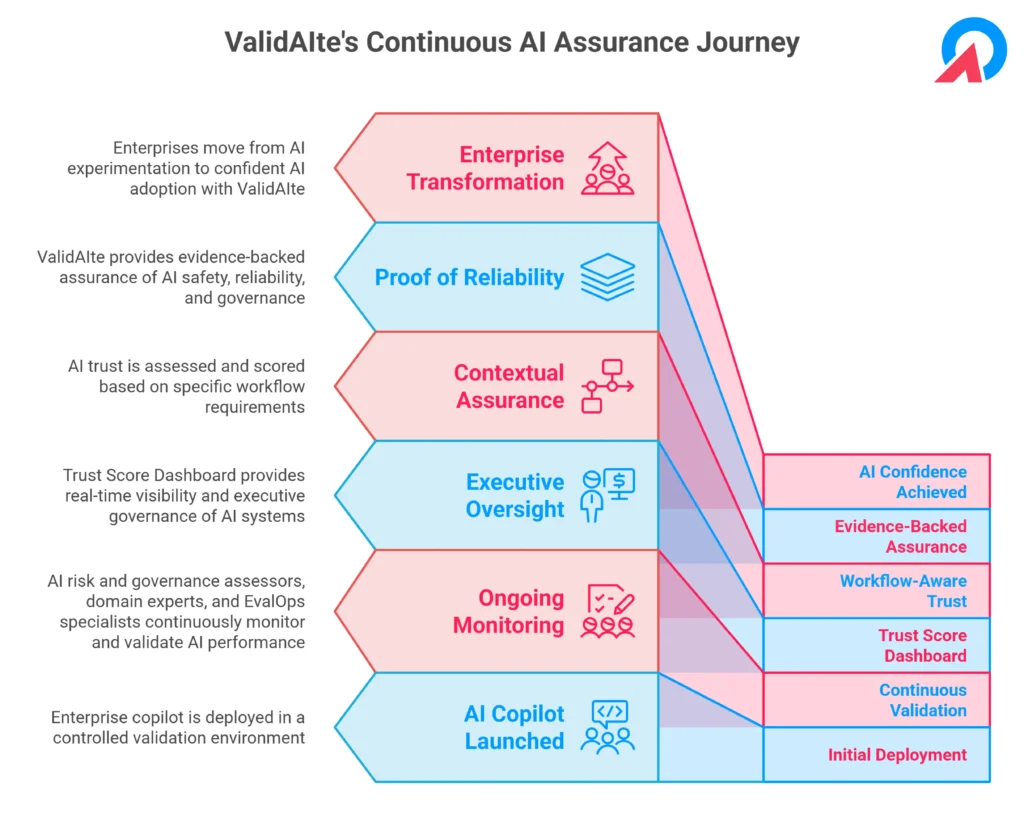
Trust in enterprise copilots is inherently contextual. A response or action that’s completely acceptable in one workflow may be too risky in another. ValidAIte addresses this complexity by combining its platform with AI risk and governance assessors, GenAI evaluation engineers, domain experts, automation engineers, and EvalOps specialists, supported by the processes and oversight needed to validate AI in the conditions in which it will actually operate.
And that assurance model needs to remain active even after initial deployment since a copilot that performs well in a controlled validation can still drift as models, prompts, knowledge sources, usage patterns, and workflows change. Trust, therefore, cannot be certified just once; it needs to be a continuous exercise.
As enterprise copilots become part of how work gets done, quality engineering will become even more important. The enterprises that succeed will not be the ones that deploy the most AI features fastest. They will be the ones that can prove, continuously and confidently, that their AI systems are grounded, safe, reliable, governed, and fit for the workflows they support.
That is the shift ValidAIte enables. By combining continuous validation, workflow-aware trust scoring, evidence-backed assurance, observability, and executive governance through the Trust Score Dashboard, it helps enterprises move from AI experimentation to AI confidence.
Connect with our team today!