
Quick Summary: AI is changing not just how engineers work, but what skills engineering teams need, and most organizations are reacting instead of preparing. QualiZeal’s approach treats talent as a capability to continuously build, not a role to fill. Forecasting skill needs 90–180 days out, developing both early-career and experienced talent in parallel, and running a repeatable cycle of Forecast, Attract, Develop, Deploy, Rotate, Reskill, Repeat, rather than hiring only when a gap opens up. For Quality Engineering specifically, this means building teams that can work across the full AI system lifecycle: Building, Testing, Assuring, and Improving.
AI is transforming more than the tools engineers use day to day, it is changing which skills teams need, how engineers gain experience, and how organizations think about building talent in the first place.
For engineering organizations, this creates a challenge that goes beyond hiring AI specialists. The question is no longer simply how many people a company needs, but what capabilities those people will need as technology, customer expectations, and engineering practices continue to evolve.
A recent Gartner research predicts that, beginning in 2028, AI will create more jobs than it eliminates, while also reshaping how people gain experience and progress through their careers. The research highlights the growing significance of internal talent pipelines and skills-based development as organizations adapt to changing roles. Gartner has also pointed out how AI is impacting software engineering roles and the capabilities engineers need as AI becomes increasingly integrated into software development.
Building these AI-ready teams takes more than just recruiting people who already have AI experience. It requires a talent strategy team, involving young talent, experienced professionals, structured training, continuous upskilling, workforce forecasting, and flexible resource models.
For Quality Engineering, this shift is particularly significant. AI-enabled engineering asks for something beyond traditional testing expertise. It requires a combination of software engineering knowledge, AI capabilities, industry expertise, Quality Engineering techniques, and the ability to work alongside AI rather than just test around it.
Explore more about it from our Talent Strategy team
How to Build the Talent Engine Before You Need It
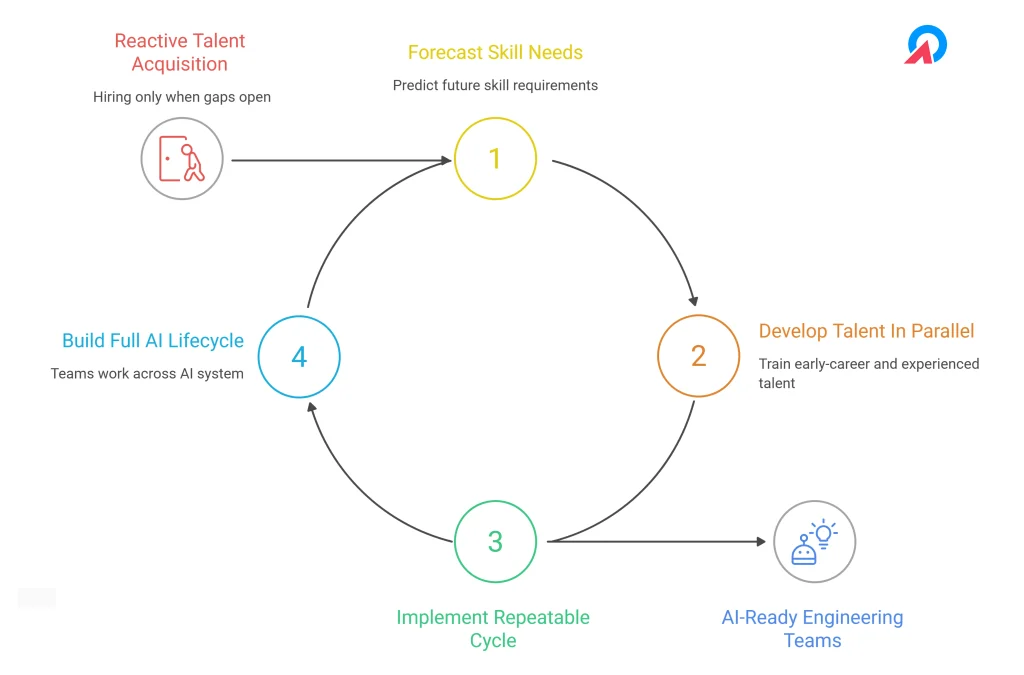
At QualiZeal, the starting point is forecasting, not reacting. Building an AI-ready engineering team cannot be treated as a reaction to an immediate hiring requirement. By the time a new capability becomes critical, the demand for it may already be high across the market. A more sustainable strategy would be to anticipate what customers, and engineering teams will need and begin developing those skills at the earliest opportunity.
In practice, that means looking 90-180 days ahead and connecting workforce planning with strategic direction, customer requirements, and emerging technology. The objective is not to predict every future role perfectly. It is to understand where the field of engineering is heading and building enough capacity to meet that demand.
Rather than asking “what role do we need to fill?”, the better question becomes “what capability we need to develop?” This distinction defines how talent is attracted, developed, and deployed.
A part of that strategy involves developing a pipeline of early-career talent; students and graduates from reputable technical universities who bring the right foundation, curiosity, and ability to learn quickly, without needing to arrive with every industry-specific skill already mastered.
The opportunity is to provide high-potential people with a structured environment where such capabilities can be developed. This is where learning, mentoring, practical experience, and project readiness become integral parts of the talent management process rather than post-hiring activities. The goal is to enable a pathway from potential to contribution, allowing early-career professionals to develop the AI capabilities needed in real-world environments progressively.
At the same time, organizations cannot just rely on their emerging talent. Some capabilities require skills that takes years to develop and are best developed through direct experience. Experienced professionals can provide an organization with specialist expertise, faster response to customer needs, and a way to accelerate new capability-building across the team.
A resilient talent management strategy needs both – new hires bring diversity of thought, existing engineers bring depth and consistency, and early-career talent builds the pipeline for what comes next, put together, this is how an organization builds capability instead of just filling vacancies.
Best Ways to Developing Capability Within the Existing Workforce
Building an AI-native workforce also involves recognizing that some of the most valuable resources may already exist in the organization. As AI is transforming engineering, Quality Engineering and engineering professionals have an opportunity to expand their capabilities. Their understanding of software, customers, systems, and quality provides a solid foundation for developing AI skills.
It is important to note that not all engineers need to specialize in AI. Every individual has different skills and contributes in unique ways. Some might opt to become better at AI engineering. In contrast, others might be interested in AI-assisted engineering, validation, quality, governance, applications, or a new approach to working with AI.
What matters is creating opportunities to build capabilities needed for future directions of engineering.
This also reflects a broader shift from role-based evolution to skills-based growth. A person’s present job title does not necessarily determine the capabilities they can develop next. An engineer may take on a new responsibility, switch functions, work on an emerging technology, or transition into a role that did not exist when they joined the organization. For an AI-native company, that flexibility is increasingly important.
How to Design Teams for Continuous Evolution
The biggest mistake an organization can make here is treating an AI-native team as a finished product. It can’t be, because the environment around it never stops moving. New technologies, shifting customer expectations, evolving engineering practices, and new AI capabilities that bring both new opportunities and new risks. Roles that make sense today may look very different in eighteen months.
That means the workforce needs real mechanisms that give people opportunities to evolve alongside the technology.
This includes upskilling, rotating across functions, taking on new responsibilities, moving into emerging AI roles, and returning to the workforce through structured pathways after a career break. Continuous learning becomes more than just an employee benefit. It becomes a part of how the organization maintains its engineering capability.
This is consistent with Gartner’s broader observation that organizations must move away from traditional, fixed career paths toward skill-based advancement built on learning agility and adaptability.
That has a direct implication for the employee proposition.
Engineers want opportunities to work on meaningful problems, understand how products are built, learn new technologies, and see where their contributions create value. Access to leadership, exposure to innovation, continuous learning, and visible career growth and development can become critical for attracting and retaining talent in a highly competitive market.
The question here isn’t whether an organization can hire the talent it needs. It is whether it can create an environment where people want to learn, contribute, and continue growing.
The Role of Quality Engineering in an AI-Native Workforce
The talent shift is particularly critical for Quality Engineering since the emergence of AI changes not only what engineers build but also what they need to ensure.
Traditional means of ensuring quality continue to remain applicable and relevant. However, it is necessary to pay special attention to their behavior, reliability, evaluation, and further improvement. Similar insights can be drawn from Gartner’s research on the skills required for AI engineering, which emphasizes the necessity of developing capabilities that extend beyond conventional software development, including AI development techniques and approaches for evaluating and mitigating defects in AI-based systems.
This creates a need for AI-native Quality Engineering teams who would have the expertise to work throughout the lifecycle of AI-systems – from building and testing to assuring and continuous improvement.
Thus, for QualiZeal, the talent management practice becomes closely connected to the evolution of Quality Engineering.
Those who shape the next generation of Quality Engineering will need to understand both aspects – the engineering approach, which has always been an inherent part of developing quality software, and the AI skills required to develop, evaluate, and assure AI-based software.
Such a combination cannot be achieved just through hiring alone. It requires a constant cycle of hiring, gaining experience, and redeployment.
From AI Hiring to AI-Native Capability
This adds up to a different way of thinking about talent management altogether. The aim is not to build a workforce simply by adding more people with AI-related experience. The idea is to create an organization that can continuously build the capabilities required by an ever-changing engineering landscape.
That means hiring externally and developing internally at the same time, giving young talent room to grow while bringing in specialists where deep expertise is genuinely needed, forecasting ahead of vacancies rather than reacting to them, and building in enough flexibility for people to move into new areas as their skills and the business evolve.
QualiZeal’s hiring model can be described as follows:
Forecast à Attract à Develop à Deploy à Rotate à Reskill à Repeat
The keyword in this sequence is “repeat”
There is no finish line where an organization can call itself fully AI-ready, because AI engineering itself is still emerging, and the talent model behind it must keep evolving too.
That changes how success actually gets measured. Headcount is only one data point. The more meaningful questions are:
- How quickly can new talent become productive
- How efficient is the development of new capabilities among engineers?
- How easily can people move into emerging areas?
- Is it possible to adapt when customer requirements change?
- Can an organization continuously develop new AI capabilities?
These questions connect talent strategy more closely to engineering outcomes, not just to recruiting metrics.
Building What Comes Next
Most conversations about AI talent focus on scarcity; not enough AI engineers with the right skills, intense competition for experienced people, pressure to hire faster. Those pressures are real. But hiring faster only solves part of the problem. The long-term solution is to build an organization capable of continuously creating the talent it needs. That means nurturing potential, developing existing expertise, bringing in experience when needed, and creating an environment where learning and development of movement are part of everyday engineering careers.
For QualiZeal, becoming AI-native in Quality Engineering is inseparable from this shift in how talent gets developed. The goal was never simply finding people who already have the right skills; it’s building the pathways that let those skills grow. Engineering will keep evolving as AI becomes further embedded in it, and the organizations best positioned for what’s next will be the ones that treat talent as a capability they continuously build, not something they acquire once and move on from. AI transformation is talent transformation.
Building AI-native engineering isn’t about replacing the people who build technology. It’s about building teams capable of engineering and continuously improving whatever comes next.
Want to build your career at the center of this shift? Explore open roles at QualiZeal
FAQs
What does “AI-native” mean for an engineering team?
An AI-native team doesn’t just use AI tools; it’s built around the assumption that AI capability, and the skills to work with it, need to be developed continuously rather than hired for once and considered solved.

How is this different from just hiring more AI engineers?
Hiring alone doesn’t scale, because by the time a skill becomes critical, demand for it is already high market wide. QualiZeal’s approach forecasts skill needs in advance and develops them internally alongside external hiring, rather than relying on hiring as the only lever.
What is QualiZeal’s hiring model for AI-native talent?
A repeatable cycle: Forecast, Attract, Develop, Deploy, Rotate, Reskill, Repeat – with “repeat” being the operative word, since there’s no fixed endpoint where an organization is “done” preparing for AI.
Do all Quality Engineers need to become AI specialists?
No. Some engineers focus on AI engineering itself; others focus on AI-assisted engineering, validation, governance, or new ways of working with AI. The goal is to expand capability across the team, not turn every engineer into a specialist.
Why does this matter specifically for Quality Engineering?
AI changes not only what gets built, but what has to be verified – behavior, reliability, evaluation, and bias, on top of traditional functional correctness. That requires QE talent who combines engineering fundamentals with AI-specific evaluation skills.