
Green QA in the AI age isn’t just smart testing to build products the right way. It’s more about preserving what’s precious to us—human experience and the environment. In 2025, every Quality Assurance (QA) leader will agree on the importance of front-loading sustainability principles while building highly reliable and user-friendly products. Organizations that align quality lifecycle management processes with ESG targets without compromising speed, cost, or performance will gain a defining edge in a market saturated with performative CSR checkboxes.
In the rest of this blog, we’ll uncover how common testing practices are at odds with your enterprise’s ESG missions. Also, explore QualiZeal’s approach, powered by our AI-infused and automation-first principles, which embed sustainability in your quality engineering (QE) lifecycle.

The Environmental Footprint of Traditional QA Practices
A BCG’s global survey of C-suite executives across 25 industries reveals that nearly half of all software development initiatives face schedule setbacks or exceed their allocated budgets. QE often runs quietly in the background. However, quantifying its environmental impact will be a great starting point to identify areas for optimization. Every redundant test cycle consumes CPU, electricity, and cloud resources, directly increasing carbon emissions. This inefficiency is evident in delivery performance.
As testing becomes increasingly cloud-native and AI-assisted, the volume of compute cycles triggered during test execution becomes material, especially at enterprise scale.
Here are some of the common contributors to testing-related carbon emissions:
- Repetitive Full-Test Cycles: Running large test suites for small code changes unnecessarily consumes CPU time and storage space, thereby increasing emissions.
- Underutilized Test Environments: Virtual machines and test infrastructure, while often available 24/7 for agility and responsiveness, can consume power even during idle periods. Without intelligent scheduling and teardown protocols, such setups gradually inflate the carbon footprint.
- AI Resource Overhead: While AI is a key enabler of modern QE, large or inefficient models can increase compute and energy usage. To mitigate this risk, even platforms built on GenAI foundations now emphasize prompt engineering, token-level efficiency, lightweight models, and domain-specific agents that streamline testing paths and enhance interpretability. These approaches maintain both performance and sustainability without compromising test accuracy.
- Inefficient Cloud Resource Use: Unused resources are powered even when oversized virtual machines are used, or serverless/test-specific computation is neglected.
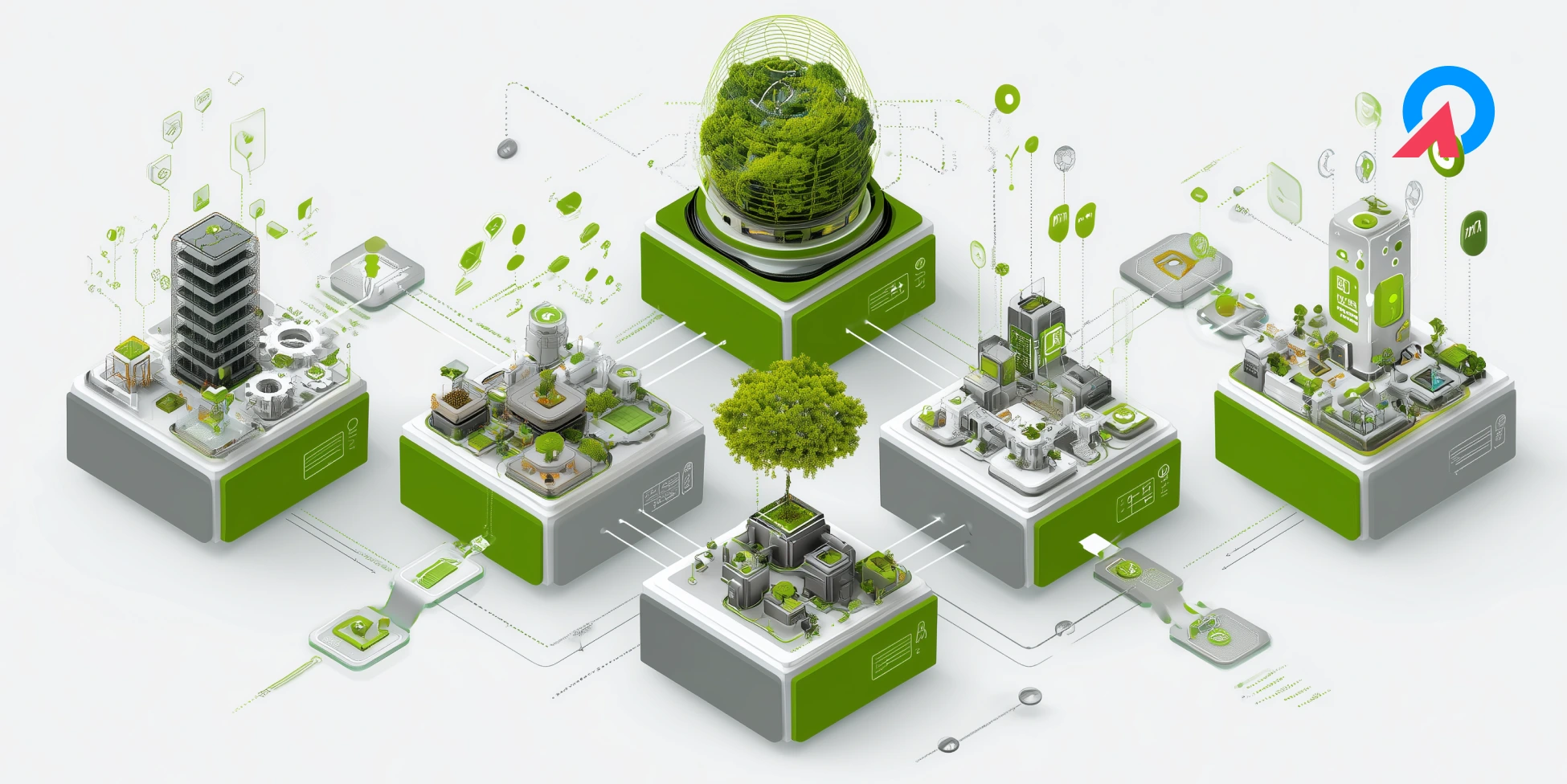
Five Pillars of Sustainable QA: Best Practices for Green Testing
QualiZeal’s approach to green QA is to make testing smarter with intelligent automation that replaces repetitive manual efforts with AI interventions that reduce rework, increase reuse, and drive productivity. QMentisAI, the patent-pending, GenAI-powered software testing platform, is built with intelligent, adaptive, and future-ready capabilities to address real-world testing challenges. Unlike point solutions that address isolated testing workflows, the enterprise-grade platform augments the entire quality lifecycle management, supporting user story refinement, test planning, design optimization, self-healing, etc.
Additionally, our ready-to-use test automation frameworks and unified suite of QE assets and active accelerators boost productivity and enhance release frequency. Below are some of our approaches for Green QA:
1. Lean, Risk-Based, & Shift-Left Testing to Minimize Waste
Incorporating shift-left testing strategies ensures issues are detected earlier in the pipeline, minimizing fix-related compute overhead. Risk-based techniques further reduce test volume by focusing on high-impact areas.
Practical methods include:
- Test Impact Analysis: Triggering tests only for impacted areas.
- Test Suite Pruning: Identifying and eliminating obsolete or redundant tests.
- Developer-QA Collaboration: Shift-left practices that bring QA into early stages of the SDLC.
- Hyper-automation: Coordinating multiple automation tools in sync to reduce friction and duplication across test cycles.
2. Lightweight and Purpose-Built AI in QE
Not all AI is green by default. The Green AI movement promotes more efficient, focused models, especially relevant in QE contexts where accuracy and speed can coexist with sustainability.
For QA leaders leveraging GenAI, this translates into:
- Using task-specific agents (e.g., for defect triage or test optimization) rather than relying on heavyweight general-purpose LLMs.
- Token-level optimization and prompt engineering enhance the interpretability of complex test cases and build more efficient, accurate test flows.
- Transfer learning and on-device inference to avoid unnecessary cloud usage or redundant model training cycles.
Optimizing how AI is applied, from how it’s trained to how it’s prompted, can make testing smarter and greener.
3. Self-Healing and Low-Code Automation to Reduce QA Overhead
Traditional test scripts often break as software evolves. Self-healing test automation solves this by automatically identifying and repairing broken tests, reducing manual rework and infrastructure usage.
Similarly, low-code/no-code testing platforms allow testers to build automation with minimal coding, accelerating velocity while lowering system load. In summary:
- Self-healing test frameworks minimize script maintenance.
- Visual workflows reduce the need for heavy developer involvement.
- Reusable components help teams avoid redundant test creation.
4. Modular, Reusable Testing Architectures
Test environments often suffer from duplication: creation of multiple frameworks for similar tasks, redundant code, and inconsistent environments. Modular plugin-based architectures address this problem by:
- Reusing common logic (e.g., logging, test setup).
- Avoiding full reinitialization by spinning up only the necessary components.
- Trimming execution time and compute demand.
These practices reduce the energy footprint of regression cycles and enable scalable, sustainable automation.
5. Simulated Test Environments & Green Computing
Virtualized, cloud-native test environments are scalable and more energy efficient. Green computing practices focus on reducing idle computing, maximizing test reuse, and eliminating unnecessary infrastructure overhead.
- Cloud-based test environments help simulate real-world conditions with minimal hardware.
- Serverless compute models automatically scale down after execution.
- Avoiding always-on test labs prevents a silent energy drain.
- Governance KPIs like carbon-per-test or energy-per-hour can be tracked via CI/CD dashboards.
By embedding sustainability into architecture and measurement, QA teams align technology delivery with ESG goals.

From Strategy to Execution: Building a Green QA Framework
These are some of the best practices that come together to form a Green QA operating model:
- AI Efficiency: Avoid power-hungry LLMs and instead use lean, purpose-driven agents.
- Cloud Intelligence: Scale intelligently, use serverless compute, and monitor usage patterns.
- Risk-Aware Testing: Minimize waste and focus on high-impact areas.
- Modular QE Design: Reuse code and infrastructure efficiently.
- Governance & KPIs: Embed energy and emissions into every QA metric.

Conclusion: Redefining Quality as Responsible Engineering
IGreen QA is no longer optional. It has implications for regulatory readiness, cost efficiency, brand reputation, and internal ESG reporting.
Today, our enterprise clients prefer technology partners who are fast, scalable, and environmentally responsible. Embedding green thinking into your QE strategy sets your organization apart as a sustainability-conscious leader.
At QualiZeal, we’re passionate about helping clients optimize their QA processes with sustainability in mind. From building automation suites to implementing carbon-aware test routing, we help you stay ahead of technology and ESG curves.
Let’s make QE greener, by design, intent, and impact.
Contact our team for more information.