
GenAI Moment in the Insurance Industry
Insurance is one of the most document-heavy and decision-intensive industries. In the US alone, the industry processes over 100 million claims annually. Each claim can involve adjuster notes, medical records, photographs, policy clauses, legal interpretations, correspondence, and claim history. These workflows have traditionally depended on human judgment and manual review.
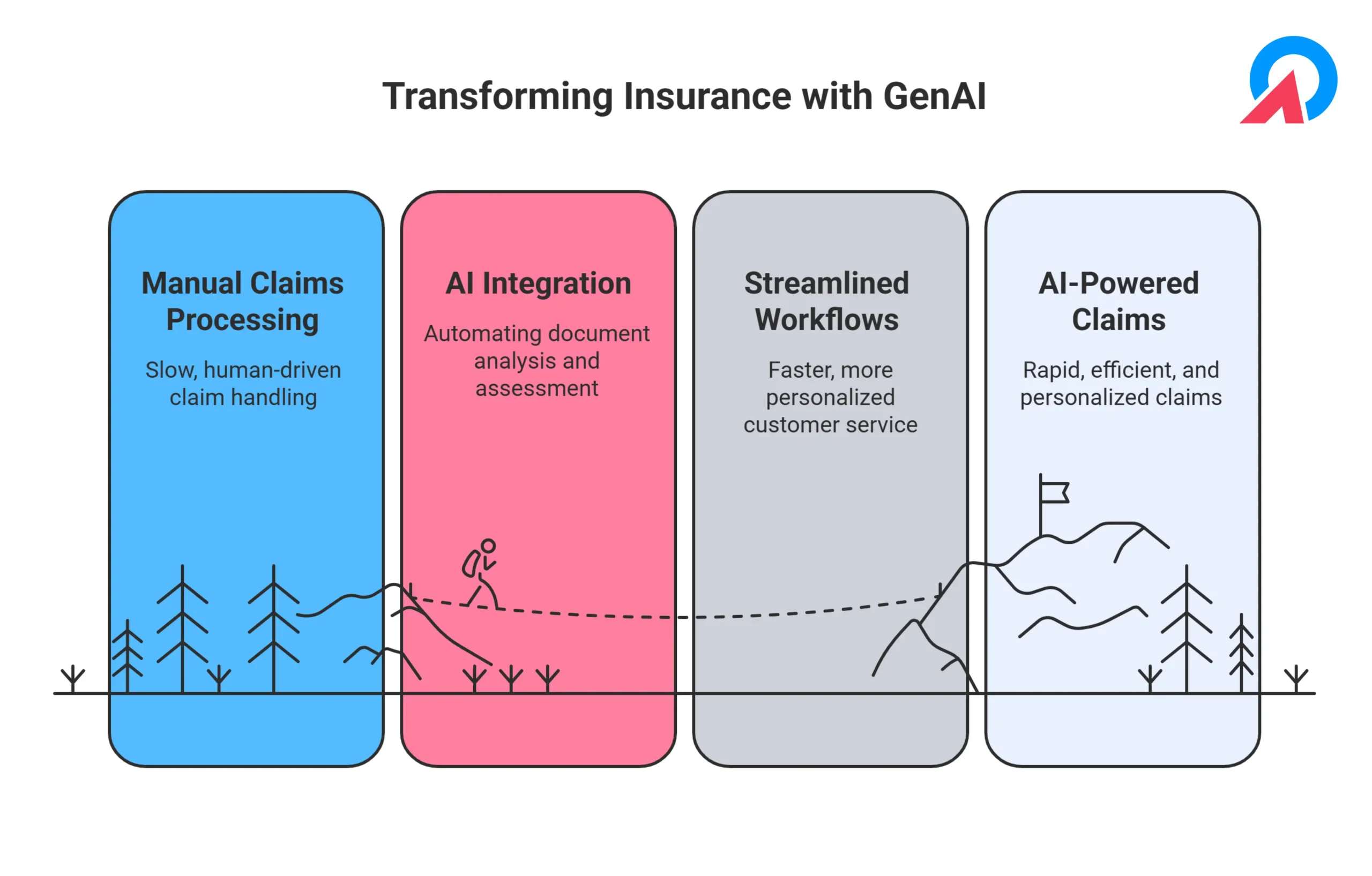
Generative AI (GenAI) integration has been reshaping these operations. In claims automation, AI-powered capabilities accelerate the extraction of policy details from unstructured documents, the assessment of damage from images, the interpretation of medical terminology, and the generation of settlement recommendations, reducing claim cycle times from weeks to hours.
Across several insurance scenarios, like policy document analysis, fraud detection, underwriting, and customer services, AI-powered tools streamline and transform tasks involving large document volumes, complex regulatory requirements, decision-heavy workflows, and growing customer expectations for faster, more personalized service. However, this opportunity comes with high stakes. Insurers that deploy GenAI without strong governance may face regulatory enforcement actions, litigation exposure, and reputational damage that outweigh the efficiency gains.
In the rest of the blog, we will explore the role of AI-native Quality Engineering in assuring GenAI systems used across scenarios in the insurance industry.
The Risk Behind the GenAI Revolution
One of the irrefutable advantages of deploying AI in insurance is its reusability and repurposability, which can be scaled across different areas of enterprise and business operations. For instance, chatbots used by insurance employees can be leveraged for customer support, answering policyholder queries, explaining coverage, and providing 24/7 assistance.
Knowledge assistants can help agents locate relevant clauses and claim histories in real time. And underwriting copilots can synthesize applicant data, risk models, and pricing inputs to support faster decisions. According to McKinsey’s research, over the past five years, insurance companies that are AI leaders have generated 6.1 times the total shareholder return (TSR) of AI laggards.
While extracting meaningful value from AI across the full value chain, there is significant room for errors that can have major downstream impacts. Consider a claims processing AI system that reviews accident reports and recommends denials based on excluded coverage clauses. The systems’ recommendations may appear reasonable. But months later, regulators identified that the AI had misinterpreted a policy amendment, leading to thousands of wrongful denials. This can lead to millions of dollars in regulatory penalties and the loss of customer trust.
Errors like hallucinated claims interpretations occur when a model generates plausible but incorrect policy interpretations, legal precedents, or coverage explanations. Because these outputs sound authoritative, they can be difficult to spot.
Additionally, the risk patterns of AI vary. Another example is biased underwriting recommendations that emerge when AI systems learn from historical data that contains discrimination. Even if protected characteristics are not directly used, the model may rely on subtle proxies for race, gender, disability, or other sensitive attributes. Further, when AI-generated decisions fail to meet compliance audits and thresholds, they can result in serious violations of state insurance rules, fair lending requirements, or consumer protection laws.
PII leakage is another serious concern, especially when conversational systems expose sensitive customer information or fail to maintain privacy boundaries. Another common scenario involves model drift that can degrade AI performance as claim patterns, regulations, customer behavior, or fraud tactics change.
GenAI systems are also vulnerable to security risks, such as prompt injection attacks that manipulate chatbots or AI assistants with crafted inputs, potentially causing them to reveal proprietary information or take unsafe actions. Legal liability also increases when AI-generated denial letters, summaries, or settlement offers are used as evidence in disputes.

Why Traditional QA Fails for GenAI
Insurance companies already have mature QA practices for traditional and deterministic policy administration systems, claims platforms, customer portals, and enterprise applications. But GenAI breaks that assumption, as the same claim description can generate different summaries, recommendations, or explanations. This variation is not always a defect; it is part of how these models operate. Moreover, GenAI’s input space is effectively infinite, so finite input-output testing cannot prove reliability. Traditional testing treats outputs as either correct or incorrect, but GenAI outputs exist on a spectrum. The GenAI system response may be partially accurate, incomplete, biased, poorly grounded, or insufficiently explainable.
UI and API automation can confirm whether a chatbot interface works or whether an AI service returns a response. But it cannot judge whether that response is factually correct, compliant, fair, or safe. Traditional QA also lacks dedicated mechanisms for hallucination detection, bias testing, prompt governance, model drift monitoring, explainability validation, and adversarial robustness.
This creates an illusion of validation. The system may technically function while hidden risks continue to accumulate.
What Is AI-Native Quality Engineering?
QualiZeal is at the defining edge of AI-native Quality Engineering, ahead of many traditional QE service providers. We rethink quality assurance in an era where AI evolves, but enterprise priorities for quality, trust, customer experience, and compliance remain the same. AI-native QE, delivered through our homegrown IP-led innovation and dedicated research, ValidAIte ensures that QE for AI systems is a continuous, risk-aware, and model-aware discipline. The enterprise-grade AI assurance platform is purpose-built to understand, measure, and manage how these systems fail in production. The overarching goal is not to make AI perfect but to make it more governable: measurably safe, demonstrably fair, continuously monitored, and audit-ready.
AI-Native QE Across Insurance Use Cases
Claims Processing: In claims processing automation, AI systems misinterpreting policy exclusions or coverage conditions can result in the rejection of a valid claim and approval of an excluded claim.
AI-native QE approach powered by our ValidAIte platform enables establishing ground-truth policy datasets with annotated coverage rules. It also helps validate claim interpretations through benchmark testing across scenarios, detect hallucinations, monitor denial rates, and create audit trails linking decisions to specific clauses.

AI-native QE approach powered by our ValidAIte platform enables establishing ground-truth policy datasets with annotated coverage rules. It also helps validate claim interpretations through benchmark testing across scenarios, detect hallucinations, monitor denial rates, and create audit trails linking decisions to specific clauses.
Insurance AI chatbot: Insurance AI chatbot systems can provide incorrect coverage information, create expectations the insurer may need to honor, or disclose personal information through prompt injection.
AI-powered QE for chatbots enables conducting extensive red-team testing with adversarial prompts to understand the risk of extracting sensitive data or manipulating the output. It helps verify response accuracy against a curated list of user prompts or questions. Further, by implementing real-time PII filtering, conversation monitoring, and automated regression testing as knowledge bases evolve, this approach helps prevent major mishaps that can potentially harm customers and insurers.
Underwriting Copilots: AI may recommend pricing based on factors that correlate with protected classes, creating disparate impact without explicit discrimination.
Our mitigation approach involves performing comprehensive bias testing with demographically stratified datasets. Creating fairness metrics, such as demographic parity and equalized odds, and conducting causal analysis helps identify legitimate risk factors that proxies have never captured. Ongoing bias pricing monitoring helps identify discrepancies in pricing based on applicants’ characteristics and geography. Further, it runs these analyses against the documentation that outlines the protected characteristics to ensure they are not used as features.
Fraud Detection: AI systems used for fraud detection may flag legitimate claims as anomalies at higher rates for certain demographics or fail to detect sophisticated fraud patterns.
Quality Engineering for AI systems includes validating false-positive and false-negative rates across segments, testing for fraud patterns through adversarial testing, and monitoring flagging rates by claim type and claimant characteristics to ensure explainability for investigators. It also involves continuous revalidation to keep up with evolving fraud tactics.
Policy Document Summarization: AI systems can omit critical exclusions or misrepresent coverage terms, leading to incorrect customer guidance.
Our approach to QE for policy document summarization systems and agents involves comparing AI-generated summaries with human expert summaries to capture the right context and nuances. Further, it includes leveraging scoring completeness, accuracy, and appropriate emphasis of critical terms. By checking for mandatory disclosures and exclusions, this approach helps test across policy variations and linking summaries to the correct document version.

Regulatory Readiness: From Innovation to Audit-Proof AI
Whether it is GenAI or agentic systems, inaccurate, biased, or non-compliant decisions and outputs result in financial liabilities and subject them to intense regulatory scrutiny. State commissioners, federal agencies, lawsuits, customer harm, and regulatory penalties. Especially under the changing regulatory climate at the international, federal, and state levels, expectations have become more stringent for demonstrating proof and documentation across areas such as AI transparency, human oversight and control, bias and fairness, auditability, data privacy and cybersecurity, and risk classification.
Frameworks like the NIST AI Risk Management Guide structure the identification, assessment, and management of AI risks. The EU AI Act classifies systems by risk level and classifies insurance applications involving credit or eligibility decisions as high-risk. ISO 42001 establishes management systems for responsible AI, and the GDPR obligations around automated decision-making require meaningful information about the logic involved. Further, HIPAA considerations apply across use cases in which systems process customers’ protected health information (PHI).
Across these frameworks, the common thread is evidence. AI-native QE generates evidence that is regulator- and audit-ready, in the form of documentation, reports, risk classification, quantitative metrics, model documentation, proof records, and governance records.
Our Two Cents
In insurance, trust is the ultimate currency. As insurers adopt GenAI to improve productivity, automate operations, and scale transactions, managing AI risk becomes equally critical. The first step is understanding and tiering AI systems based on regulatory, financial, and reputational impact — especially for high-risk use cases involving claims, pricing, coverage, and customer decisions.
QualiZeal’s trust-first, AI-powered QE approach combines insurance domain expertise, AI assurance, data validation, regulatory compliance, and continuous risk evaluation to help enterprises move confidently from PoC to production-grade AI systems. Our experience across real-world customer engagements enables us to identify failure points, validate non-deterministic systems, and establish production-ready governance frameworks.
From red teaming and dataset validation to AI-native QE integrated with CI/CD and LLMOps, our approach is built for responsible AI adoption at scale.
Connect with our experts to see how ValidAIte can help strengthen trust, compliance, and reliability across your insurance AI systems.