
Quick Summary: Though enterprise AI agents are getting easier to build, the trust factor in them is still debatable. Prompt-based tooling has cut build time from months to hours, but the risks of reliability, governance, and compliance haven’t gone away. Most enterprise AI agents fail between pilot and production because of weak context grounding and unproven evaluation, not weak models. Reliability at enterprise scale requires a continuous loop of observe, evaluate, optimize, and not a one-time launch check. Not every workflow should run on full autonomy, especially early on. NexaAI helps plan and build AI systems for measurable value through phase-by-phase evaluation and tailored metrics, while ValidAIte provides independent AI assurance and continuous monitoring to deploy with confidence at scale. Together, this ecosystem closes the gap between a working demo and a production-ready enterprise AI agent. This is where agentic AI in enterprise environments needs more than a smart model; it needs AI agent Quality Engineering built into the process from day one.
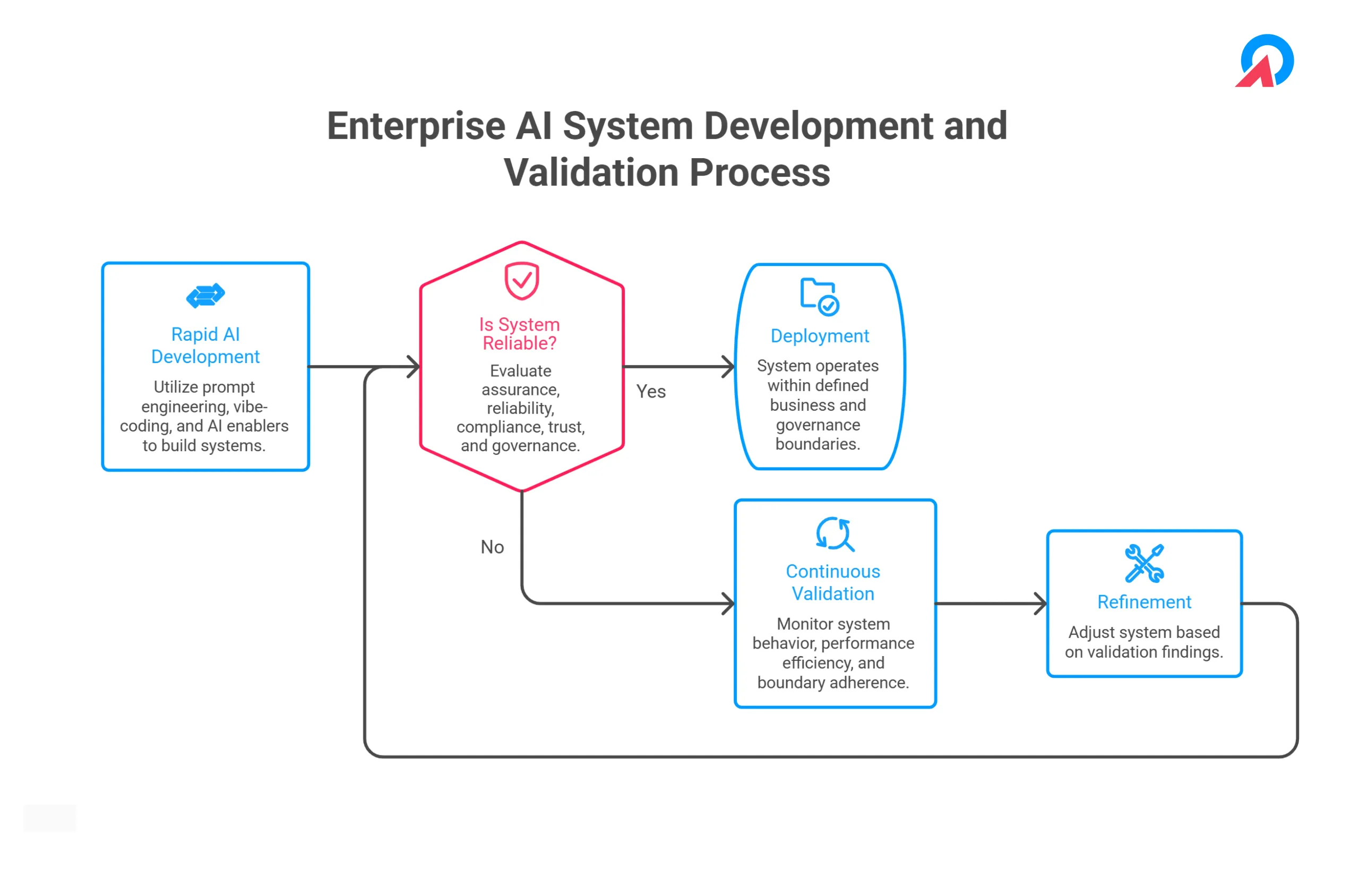
If you look across enterprise IT today, there is barely an industry or business process that has not encountered the potential of AI agents and automation. Enterprises are constantly looking for the fastest ways to build AI systems, and the flexibility of prompt engineering, vibe-coding, and a wave of new AI enablers in the market makes it look easier than ever. But that ease is deceptive, as the risks around assurance, reliability, compliance, trust, and governance in enterprise AI systems haven’t gone anywhere. You can provide requirements, define workflows, and generate code in a matter of seconds, but establishing a reliable AI system requires much more than rapid development. It requires continuous validation to understand how the system behaves, how efficiently it performs, and whether it operates within defined business and governance boundaries.
Production-ready AI agents need far more than fast setup; they need proven reliability before they ever reach real users. As an independent, AI-native Quality Engineering and AI Assurance partner, QualiZeal helps enterprise IT add reliability to those agents and validate them to ensure AI assurance of their performance before deployment and at scale in production.
In this blog, we cover everything from what it takes to build reliable enterprise AI agents to how NexaAI and ValidAIte support the journey from AI development to AI assurance.
What Is a Production-Ready AI Agent?
A production-ready AI agent is an enterprise AI agent that performs consistently outside the demo environment, such as on messy internal data, under real operational pressure, with real consequences for a wrong answer. A demo only has to succeed once, in a controlled setting. A production agent has to succeed by default, at scale, on inputs nobody planned for, and it has to do so in a way the business can verify, not just observe. In short, production-ready AI agents are judged on AI agent reliability, not on how well they perform in a single demo.
This is why so many enterprise AI agents stall between pilot and rollout. Teams build something impressive in a proof of concept, then watch it struggle against a real ERP schema, an incomplete order history, or a decision with no single correct answer. Getting from ‘it worked in the demo’ to ‘it works in production’ is a matter of engineering reliability, and proving it, from the start.
Why Building Enterprise AI Agents Got Easy But Trust Didn’t?
Today, building an agent is no longer the most difficult part. Low-code and no-code tools, prompt-based development, and easy workflow builders let teams spin up a functional prototype in hours. Feed in your requirements, describe a workflow, and a working agent comes back almost immediately. That accessibility is genuinely valuable, but it also means the bar for ‘an agent exists’ has dropped much faster than the bar for ‘an agent can be trusted.’
That gap is where enterprise AI agents actually live or die. The question was never whether an organization could build an agent; it’s whether that agent can be trusted with a live system, sensitive data, or a regulated workflow once it’s out of the box.
Deterministic vs. Agentic Systems: Where Autonomy Should (and Shouldn’t) Apply in Enterprise AI Agents
Not every process inside an enterprise should become a fully autonomous agent, and treating ‘more autonomy’ as inherently better could be a mistake. Deterministic systems, such as scripts and rule engines, may remain the right choice for regulatory approvals and budget controls. Agentic reasoning earns its place in ambiguous, judgment-heavy steps, such as supplier selection, exception investigation, and drafting a first pass at a document. The most reliable enterprise AI agents orchestrate alongside deterministic systems rather than replacing them, and extend autonomy only where it adds genuine, proven value.
Getting this balance right is itself a discipline and a core part of AI agent quality engineering because the wrong autonomy boundary can undo an otherwise well-built agent. This is where agentic AI in enterprise settings earns its value in ambiguous, judgment-heavy steps, not blanket automation.
How Do You Make Enterprise AI Agents Production-Ready: The Role of NexaAI
The most talked-about failure mode in Generative AI is hallucination, a model confidently inventing information that doesn’t exist. But among enterprise AI agents, a subtler and more damaging failure shows up just as often: ‘confident irrelevance.’ This is when an agent answers a plausible version of the question you ‘meant’ to ask rather than the one you actually asked, delivered with the same confidence as a correct answer. It is harder to catch precisely because it doesn’t sound wrong. Maybe a newer and more powerful foundation model could fix this? Not exactly!
A smarter AI system that doesn’t have enough grounded context to make the right call will just continue to produce a more articulate wrong answer, at a higher cost. Reliability depends far more on retrieval quality, context construction, and memory design than on which model sits at the center of the workflow. Solving for this is central to AI agent reliability, and it starts long before deployment.
You need to treat large language models as reasoning engines and not data sources. Anything factual, like inventory counts, lead times, historical records, and customer status, should come from a retrieval or tool call and never from model recall, all in a continuous reason-act-observe loop that keeps every action traceable.
This is exactly what NexaAI, QualiZeal’s trust-first enterprise AI development service line, caters to. NexaAI designs, builds, integrates, and scales AI agents, copilots, RAG solutions, and domain-specific AI applications, with governance, security, explainability, and observability built in from day one, not retrofitted after the fact. So, every AI system is engineered to the same trust standards that ValidAIte independently validates against.
The consulting front end of NexaAI, NexaScaleAI, applies a repeatable method to turn scattered AI ideas into a decision-grade roadmap. Here’s what it provides:
- A prioritized ‘Now vs. Next’ use-case shortlist scored on value, feasibility, and risk
- A Value Ledger that frames expected business value in honest ranges and confidence levels rather than inflated projections
- A readiness heatmap with an evidence-backed remediation backlog
- A governance and EvalOps starter kit (policy, RACI, risk register)
- A board-ready decision pack that leadership can actually act on
Some of the largest firms across industries have successfully leveraged NexaAI’s services to span strategy, build LLMOps, and scale ongoing AI operations. They have built a clear roadmap that enables them to move production-ready AI agents from idea to deployment, with evidence at every step.

How ValidAIte Ensures Enterprise AI Agent Reliability at Scale?
Reliability at enterprise scale isn’t something you assess only once at launch. It’s something you continuously prove, across three connected questions: What did the agent do (full reasoning traces and tool calls, not just uptime)? Did it do it well (task success and safety, stress-tested against edge cases)? How can it do better (managing accuracy, latency, cost, and drift as an ongoing balance)?
Every AI model release, prompt change, or workflow update should be re-validated before it reaches production because instructions that may seem stable throughout the process can still go off track at scale.
This continuous, standards-aligned discipline is what a proper AI agent evaluation framework looks like in practice, and it’s the core of what ValidAIte, QualiZeal’s enterprise-grade AI assurance framework provides. ValidAIte independently validates AI systems (chatbots, LLMs, predictive models, agents, and multi-agent systems) across trust, safety, reliability, fairness, transparency, and compliance readiness, mapped to the NIST AI RMF, the EU AI Act readiness, and the TEVV principles. It operates on a POD model that provides enterprises with a complete package of platform, people, and processes that can easily integrate with existing systems.
Without a repeatable AI agent evaluation framework, reliability claims remain anecdotal rather than evidence-based.
So, instead of a subjective sign-off, ValidAIte produces an ‘AI Trust Score’ and an audit-ready evidence base that enterprises can use to make a defensible go/no-go call, verifying model behavior, exposure to hallucinations, guardrails, and risk controls in the process. It enables measurable AI agent reliability with proof over promises at every release. In practice, this has delivered 90–100% traceability across the AI lifecycle and 20–35% lower compliance costs, earning the 2026 AI Leader Award Gold recognition for Best Responsible or Explainable AI Tool.
Auditability compounds the reliability of AI systems. In an autonomous environment, the AI agent can be right 99 times out of 100, but even one mistake in a production scenario can cause colossal damage.
This is where experts-in-the-loop play a pivotal role for high-stakes decisions. An AI system can reason, retrieve, and recommend for sensitive outcomes, but a human still decides, with a full, reviewable trail of how the agent arrived at its recommendation.
AI assurance is not a one-time sign-off, but a continuous loop between production behavior and evaluation data. ValidAIte’s audit-traceable evaluation scoring is what makes this reviewable rather than anecdotal, essential in regulated industries and any high-stakes environment where ‘trust us’ isn’t an acceptable answer.
NexaAI and ValidAIte: A Quick Glance
How NexaAI and ValidAIte act as the backbone of AI agent Quality Engineering for agentic AI in enterprise environments where the former builds trust-first and the latter proves it.
| Capability | NexaScaleAI | ValidAIte |
| Role | Trust-first development service line — strategy, build, integration | Independent AI assurance and governance platform |
| Core Output | Decision-grade strategy, governed agents/copilots/RAG | AI Trust Score + audit-ready evidence |
| Standards | Built to the standards ValidAIte assesses against | NIST AI RMF, EU AI Act readiness, TEVV |
What Are the Best Practices for Building and Validating Enterprise AI Agents?
Based on all the principles we covered in this blog, here is a coherent approach to building and validating enterprise AI agents that are genuinely production-ready AI:
- Ground every factual claim in a retrieval or tool call, never model memory
- Balance autonomy with deterministic guardrails
- Prioritize with evidence and not opinion, like, score use cases on value, feasibility, and risk before building
- Build a defined dataset with domain experts, specific to the actual workload
- Re-validate continuously as new models and prompt changes need to get tested before production
- Version-control prompts and test them like production code, not informal instructions
- Make outputs auditable against recognized standards, every claim should trace back to its source
- Keep experts in the loop for high-stakes decisions, with a reviewable trail
- Capture structured feedback and route it back into evaluation, not just a monitoring dashboard
Followed consistently, these steps are what turn ad hoc automation into dependable AI agent reliability.
How NexaAI and ValidAIte Fit Perfectly in This Loop
NexaAI operationalizes the strategic and advisory build side, while ValidAIte ensures independent evaluation, auditability, and an AI Trust Score that turns a promising pilot into a production-ready enterprise AI agent a business can depend on. The gap between an agent that looks good in a demo and one that holds up in production isn’t solved by a bigger model; it’s solved by grounded architecture, deliberate boundaries of autonomy, continuous evaluation, and auditable outputs, engineered in from day one. That combination is what makes AI agent quality engineering practical for agentic AI in enterprise IT; not a one-time roadmap, but a continuous discipline.
Ready to see how NexaAI and ValidAIte apply these principles to your own enterprise AI agents? Talk to our experts today!
Frequently Asked Questions
An enterprise AI agent that performs consistently outside the demo on messy data, under real pressure, with real consequences for a wrong answer. It succeeds by default, at scale, in ways the business can verify, not just observe.
Low-code and prompt-based tools let teams spin up a working agent in hours. That’s made ‘an agent exists’ easy, but the bar for ‘an agent can be trusted’ hasn’t moved, and untrusted variability becomes real risk the moment it touches production.
Treat the LLM as a reasoning engine, not a data source. Every factual claim — inventory, lead times, customer status — should come from a retrieval or tool call, never model recall, inside a traceable reason-act-observe loop. This is what prevents “confident irrelevance”: a fluent, wrong answer to the wrong question.
Deterministic systems (scripts, rule engines) are predictable and auditable, right for regulatory approvals and budget controls. Agentic reasoning fits ambiguous, judgment-heavy work like supplier selection or exception handling. Reliable enterprise AI agents orchestrate alongside deterministic systems, not instead of them.
QualiZeal’s trust-first AI development service line enables the design, build, and scaling of AI agents, copilots, and RAG solutions with governance and explainability built in from day one. Its consulting arm, NexaScaleAI, turns AI ideas into a decision-grade roadmap: use-case scoring, a Value Ledger, a readiness heatmap, and a board-ready decision pack.
QualiZeal’s enterprise-grade AI assurance framework independently validates AI systems for trust, safety, fairness, and compliance, mapped to NIST AI RMF, EU AI Act readiness, and TEVV principles. These standards form the core of a defensible AI agent evaluation framework.
People remember AI’s failures far more than its successes. An agent can reason and recommend, but for sensitive outcomes, a human still decides with a full, reviewable trail.