
AI adoption is pervasive across industries, enterprise operations, and everyday workflows. But what’s the ultimate acid test for its success? Beyond expense reduction, repetitive task automation, and intelligence upgrades, there’s an efficiency paradox at play in which AI-driven productivity gains dilute differentiation. However, AI also delivers the leadership advantage, redefining how businesses can compete, not just operate, affirms the IBM IBVs The Enterprise in 2030 report. The findings also highlight that the leaders who earn a competitive edge will be those who clearly envision their organization’s goal and reinvest their AI-powered efficiency gains in capital, talent, and decision-making capability to power growth and innovation.
At QualiZeal, we have led with an AI-first mindset, redefining Quality Engineering beyond automation efficiency and experimental novelty, and have grown into a trusted enterprise transformation partner in today’s fast-evolving digital environment. Championing AI-native innovation in QE at scale, rigor, and governance maturity also meant that we are aware of the core enterprise concerns about AI reliability, bias, explainability, governance, and compliance that prevent most projects from moving from pilots to production. While AI systems are mostly black boxes without measurable assurance and accountability, the leadership angle that articulates the ‘why’ and ‘how’ sets an intentional tone for our workplace transformation driven by enterprise AI adoption.
Read the blog post to understand why AI adoption is a human system before it is a technology program and how QualiZeal’s leadership priorities set a clear strategy roadmap for enterprise AI transformation.
Understanding the Human-Centric Lever for AI Adoption
Change and reimagination of job roles are among the most widely recognized AI influences. Job roles and decision-making in an ecosystem led by human-machine collaboration depend on whether the whole enterprise and its leaders trust AI systems and tools as a productivity lever rather than an add-on tech accessory. Therefore, C-suite and key leaders of enterprises must view AI adoption beyond technology transformation projects. In fact, like every enterprise-wide initiative, AI adoption depends on three forces that rarely progress at the same pace—technology, people, and risk.
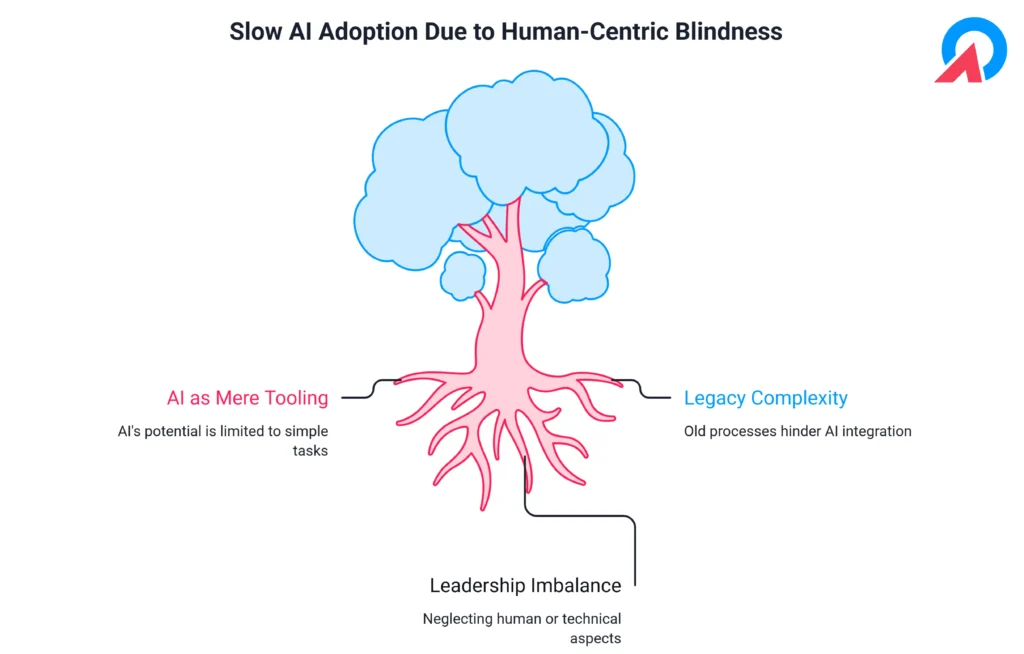
The technology implementation comes first, with tool adoption receiving approvals, pilot projects commencing, dashboards being introduced, and productivity improvements emerging in isolated areas. Then comes the challenge phase, where employees are driven to force-fit themselves, their current roles, and work practices to adapt to the new systems. After some time, the leadership then determines which initiatives warrant scaling. This playbook worked well in the good old times when the competitive moats were different. However, the stakes are typically high now, and very few organizational transformations have high success rates. The mandate now is to communicate intent while creating the change order, prioritizing value creation and enabling the development of new skills and behaviors that support change in job structures and transformation. Insights from the Humans x Machines report by Deloitte also argue against the traditional practice of layering AI into existing legacy work models as a counterproductive approach and recommend intentional work designs that enable the reimagining of roles, workflows, and decision-making around this new AI-human convergence.
Over the last five years, QualiZeal has reinvented Quality Engineering, aligning practices with AI realities that are actively defining software delivery. By evolving beyond traditional QE, our company is pioneering next-generation roles such as FDE (Forward Development Engineer), FQE, and AIQE to build a future-ready workforce.
Human Experiences and Learnings Central to Shaping the AI Narrative

Human experiences and perspectives are the core of QualiZeal’s innovation in building solutions that validate AI systems, enabling their adoption with proof and confidence. Our differentiation as a company that leads in AI-powered Quality Engineering and Quality Engineering for AI systems is rooted in the collective expertise across industries and domains. Our subject matter experts’ perspectives on business workflows, unique to each industry, operational challenges, and evolving technology needs have guided our AI workforce-readiness and literacy roadmap to identify where technology can deliver value, what needs thorough validation, and which areas are ready to adopt AI-driven solutions.
This philosophy is reflected in our investments in specialized training and certification programs, including the Generative AI Testing Foundation (GATF), which focuses on GenAI testing, AI assurance, and platform-specific expertise across solutions such as ValidAIte and QMentisAI.
These initiatives have helped us build a broad-based, AI-ready workforce, ensuring that Quality Engineering professionals across roles—from manual testers and automation engineers to architects and test leaders—can actively contribute to AI validation initiatives. As a result, we can scale Quality Engineering for AI engagements more effectively, accelerate onboarding into AI programs, and apply consistent AI validation, risk identification, governance, and trust frameworks across client engagements.
Extended Workforce Doesn’t Necessarily Translate to Extended Adoption Abilities
Today, there’s a clear distinction from past IT operating models, where workforce size directly determined their capacity to manage complexity, operational risk, and delivery and adoption. With AI altering the economics of this approach, the new model advocates a judicious mix of intelligent systems supported by skilled professionals, rather than simply larger teams. Leaders must shift focus from efficiency through headcount to efficiency achieved through judgment, automation, and adaptability.
An AI-ready enterprise readily demonstrates this change through structural changes rather than superficial adjustments. At QualiZeal, our instinct was to build a viable mix of an AI-first mindset that democratizes AI capabilities, enabling cross-functional collaboration, domain expertise, and realistically scalable operating models. As a result, Projects that once required 20 people over six months are now being completed by five people in three months through AI-assisted execution.
The responsibilities of QE professionals are shifting from repetitive tasks, document-intensive workflows, and manual coordination through automation and agent-based systems to focus on risk analysis, orchestration, governance, and intelligent decision support. AI is fundamentally altering the core focus of QE work by enhancing regression efficiency, documentation, and traceability. This will collectively make the transformation more qualitative than quantitative.
Workforce Evolution Requires Trust, Inclusion, and Accountability

Leadership ownership is essential for workforce transformation that encourages AI adoption. Evolution seldom succeeds through policy statements alone. Employees need proof in the form of role models and intentional strategies that make AI a true ally of the workforce rather than a replacement for their creativity and insight. This means organizations must move away from archaic constructs, such as focusing solely on efficiency metrics as a benchmark for AI adoption. Their teams may publicly comply while privately resisting, leading to rapid erosion of trust.
A distinct organizational culture develops when leadership approaches AI adoption as a long-term workforce evolution challenge rather than a short-term productivity initiative. This involves fostering experimentation, reducing the fear of failure, and investing in mentorship alongside automation. Transparency regarding changes in work processes is also essential.
Also, several enterprises now operate within two concurrent realities: legacy operating models that continue to deliver business value and AI-native models that are rapidly transforming enterprise economics. Leadership teams that do not effectively navigate both contexts often generate confusion among employees, who encounter ambitious AI narratives externally while internal systems, incentives, and learning structures remain static.
This tension is particularly evident in discussions and anxieties about AI bias, fairness, and discrimination issues. Bias and discriminatory output produced by AI systems are not solely technical issues embedded within algorithms. It is a direct reflection of workforce imbalances, insufficient representation, and limited decision-making structures that flow downstream into the datasets used to train AI models. Gender disparities within AI and data science teams directly influence the design, validation, governance, and finally the adoption of these systems.
For this reason, diversity, equity, and inclusion (DEI) must be integrated into AI strategy discussions. Deliberate hiring strategies and equitable employee policies with flexible work arrangements and expanded access to AI-related career paths are becoming operational imperatives rather than mere branding efforts. Inclusive teams are better positioned to identify blind spots in AI systems that significantly impact user experience, compliance, financial outcomes, and enterprise risk.

Trust and Ethical Clarity: The Real Scaling Mechanism
The subsequent phases of enterprise AI adoption will be constrained not by technological capability, but by the level of organizational trust.
Stakeholders assessing AI transformation capabilities consider a multitude of factors beyond productivity metrics and revenue growth. FOs require objective visibility into ROI, employees need confidence in ethical augmentation, legal teams must safeguard against reputational and customer risks, and AI systems must integrate seamlessly without disrupting legacy dependencies.
This changes the role of leadership. Transformation strategies demand both ethical clarity, explainability, and transparency. Therefore, every enterprise requires governance models that balance intelligent automation with human accountability to verify that the AI systems are explainable, auditable, and operationally defensible.
Conclusion:
If we reflect deeply, enterprise AI initiatives are fundamentally human-centric projects. However, this doesn’t mean that AI’s role should be constrained to mere tooling. This next phase of technology disruption presents an opportunity to eliminate years of accumulated complexity across legacy processes, workflows, roles, and decision-making structures. And leadership remains at the center of this transformation, balancing both human and technical dimensions to ensure neither “human debt” nor technical debt is created or left unaddressed.
QualiZeal’s approach reinforces this shift, treating AI adoption as a human-centric transformation powered by governance, Quality Engineering, and enterprise-wide trust delivered through our in-house innovation, ValidAIte.
Talk to our experts today!