
A single model errs, and a human catches it. A network of autonomous agents makes an error, and the damage compounds before anyone notices.
That’s the governance gap enterprises scaling agents and multi-agents face today. Gartner predicts more than 40% of agentic AI projects will be scrapped by 2027. The reason these ambitious projects stall is not that the technology has a failure risk that they haven’t yet accounted for, but because costs spiral, value remains unproven, and risk controls don’t hold. A 2026 industry survey backs this up: fewer than 1 in 4 organizations can trust their agents to run without a human-in-the-loop.
While the tools for building agents have matured, the discipline for proving they behave hasn’t kept pace. In fact, there isn’t a single standardized approach that AI development teams and CIOs can confidently vouch for to understand how multi-agent systems perform under real, messy, interconnected conditions.
QualiZeal isn’t claiming to have solved this. We’re offering something more useful: a structured, governance-first way to think about it — built on our work with ValidAIte, and grounded in NIST’s AI RMF and TEVV discipline, ISO 42001, and the EU AI Act.
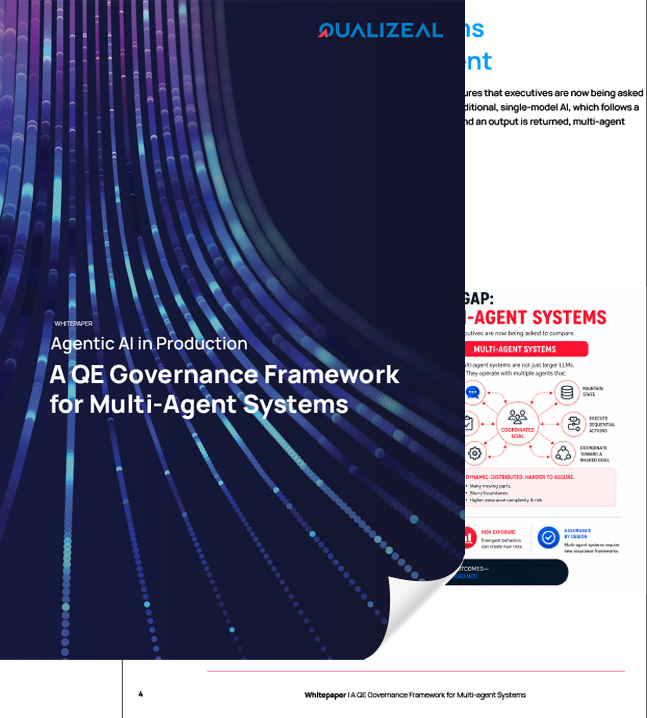
Read the whitepaper to learn:
- Why multi-agent systems demand governance models that single-model AI never needed
- Where today’s evaluation frameworks fall short
- The quality metrics that make trust measurable, not aspirational
- QualiZeal’s five-layer QE Governance Framework across the agent, interaction, tool, governance, and production monitoring
Your agents are already making decisions. Make sure you can prove they’re the right ones.