
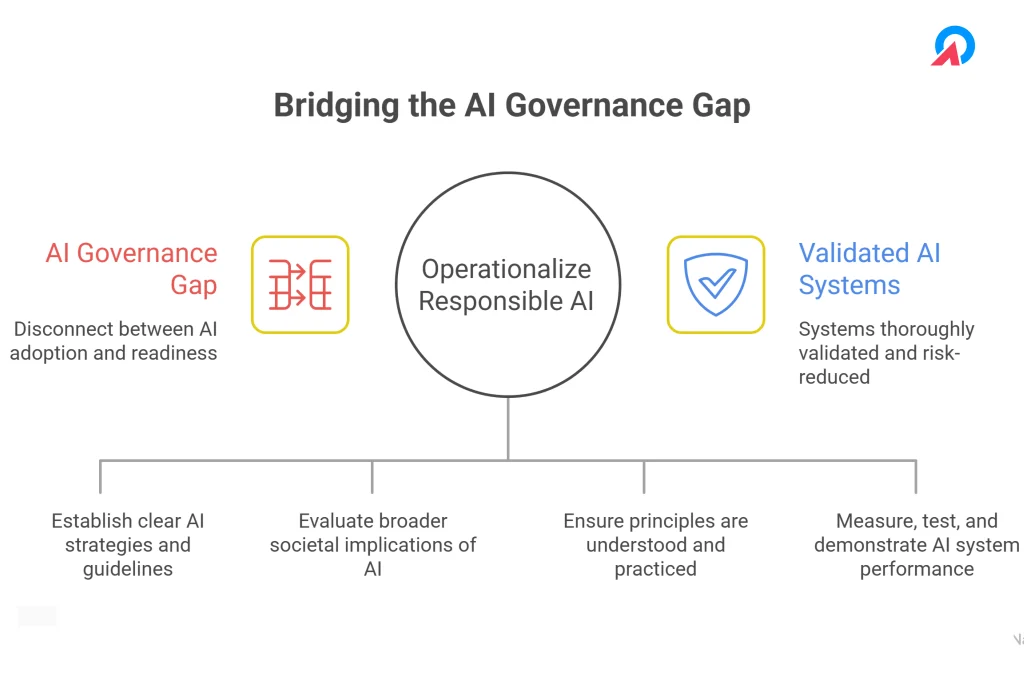
Not so long ago, analysis of over 1000 companies across 13 sectors by the Thomson Reuters Foundation’s AI Corporate Data Initiative (AICDI) revealed a widening gap between AI adoption and readiness to govern these systems effectively. Nearly 50% of the surveyed companies said they had a defined set of AI strategies and guidelines. Yet, transparency gaps in the environmental, social, and governance (ESG) aspects of AI adoption persist. The survey also found more staggering revelations: more than two-thirds of companies with AI strategies did not assess the technology’s broader societal implications. Investors, regulators, and users have grown more aware of the systemic risks to communities, vulnerable populations, and democratic processes.
In 2026, AI governance is no longer simply defining responsible AI principles or a static document with management-level oversight. With frequent regulatory actions, the principles are increasingly familiar. But if policies on paper aren’t understood and actively practiced by AI development and deployment teams, enterprises sit on latent risks that can unfold as reputational damage or a hit to market image. This calls for harder questions for your C-suite and AI leaders: How do you know those principles are being followed by the AI systems operating inside your enterprise? And when an important deployment decision must be made: What evidence supports that decision?
That is the AI governance gap — the difference between what an organization expects its AI systems to do and what its teams can measure, test, and demonstrate. At the end of the day, successful AI demos do not mean the systems are thoroughly validated.
Read the rest of the blog to understand our perspective on operationalizing responsible AI at scale with QualiZeal’s ValidAIte™, an enterprise-grade AI assurance platform that continuously evaluates, reduces risk, and provides audit-ready evidence to move from pilots to production.
What is the AI Policy-to-Evidence Gap?
If we think of enterprise AI policy as a ‘promise’, an enterprise leader would know it is a tall order. For instance, an AI policy can detail instructions that restrict:
- Exposure of customer data, whether intended or not,
- Use of AI without enterprise knowledge,
- Too much AI autonomy and decisioning without human oversight
- Fast-paced approvals of outdated outputs with superficial review
- Black-box decisioning and reasoning
- Agents’ boundary breaches and unintended collaboration
- Unassessed AI changes like silent drift, material misstatements, and indefensible audit trails.
However, when the CISO, CIO, or the board eventually demands evidence of how AI systems are actually adhering to these policies, most teams end up answering with ‘radio silence’. That silence usually stems from failing to translate weights, biases, loss functions, and other relevant technical metrics into legal or ethical policy. It’s also an uphill task to create a clear, auditable paper trail that explains the ‘why ’, especially for systems built on complex models with billions of parameters. Moreover, many AI assurance and Quality teams haven’t quite learned to operationalize explainability tools like SHAP and LIME. Lastly, several teams rely on an exhausting manual auditing process to track data lineage, model drift, and bias metrics. The lack of automated tooling makes it difficult to create evidence artifacts.
To illustrate, below is a table of differences between governance language and evidence questions that help move from abstract principles to AI governance obligations that need to be operationalized.
| Governance Language | Evidence Questions |
| Sensitive Data Protection | Can the system prove that the sensitive data isn’t disclosed under normal use or adversarial scenarios? |
| Human Oversight | Where in the agent value chain is the human intervention point? What triggers escalation to human reviewers? Is it effective? |
| AI Output Accuracy | What are the accuracy benchmarks set for the AI system, and under what conditions? |
| Agent Boundaries, Authority, and Limits | Can the system provide transparency into the actions the agents can take, did take, and were prevented from taking? |
| Manage AI Risks | What are the common AI risk classifications, severity scores, and residual risk decisions? |
Why AI Governance is Harder with LLMs, RAG, and AI Agents?

These questions provide objective, observable proof of how systems behave in production, rather than internal, philosophical beliefs about intent. And if you are still hung up on archaic ways of governing systems with probabilistic behaviors, chances are you have no mechanism to make your AI systems safe, ethical, and reliable.
- With an LLM, the same prompt can produce different outputs across different runs.
- Imagine introducing a RAG to the system; the output depends on the prompt + system instructions + model + retrieved context + retrieval quality + ranking + source freshness + generation.
- Now, try introducing an agent; the output depends on the goal + LLM + memory + tools + permission + planning + execution + environmental state.
- Later, try adding more agents to the equation. The output passed through Agent 1 → Agent 2 → Agent 3 → tools• database → APIs → humans → Agent 1.
This significantly changes the AI governance controls and layers, prompting AI development and QE teams to consider how they can prove the entire system behaves exactly as intended. The evaluation isn’t simply about proving safety or functionality.
Depending on the use case, organizations must examine these core dimensions of trust such as:
- Reliability and accuracy
- Bias and fairness
- Safety
- Explainability
- Data and privacy boundaries
- Context-sensitive behavior
- Performance as models, data, and workflows change
Organizations can draw on established approaches such as the NIST AI Risk Management Framework, Test, Evaluation, Verification and Validation (TEVV), the EU AI Act, and their own internal governance requirements. These provide important direction. But frameworks do not execute themselves.
Without standardized assurance criteria, different teams can interpret “acceptable” differently, creating inconsistent release decisions, greater reliance on manual review, and difficulty reconstructing the basis for approval when a model, workflow, or policy changes.
AI Risk to Evidence: The Risk–Metric–Test–Evidence Framework
A practical way to answer that question is through a consistent assurance chain:
Risk → Metric → Test → Evidence
The Risk–Metric–Test–Evidence, or RMTE, framework, QualiZeal’s own IP, turns a governance concern into something measurable and reproducible. For leadership, its value is not the terminology. It is the connection it creates:
Business risk → engineering evaluation → governance decision.
1. Decide what failure the business cannot tolerate
AI assurance should begin with the risk, not with whichever metric happens to be available.
“Improve chatbot accuracy” is too broad to govern.
A useful risk statement identifies the failure, the context in which it matters, who or what it may affect, and its severity. The RMTE approach treats risk in business language rather than test-harness terminology.
That allows leadership to decide whether a particular risk requires a hard release gate, additional oversight, or another form of control.
2. Define what “acceptable” means before testing begins
Once the risk is clear, the organization can decide how to measure it.
A usable metric needs more than a label such as “accuracy” or “safety.” It requires a computable definition and a threshold justified by the severity of the underlying risk.
This matters because governance becomes actionable only when teams know where the boundary between acceptable and unacceptable behavior lies.
3. Test behavior, not demonstrations
The test determines whether the system actually operates within that boundary.
For GenAI, reproducibility does not mean expecting identical outputs every time. It means defining the evaluation clearly enough to assess behavior consistently across relevant inputs, contexts, populations, or repeated runs.
This moves assurance away from isolated examples and toward observable system behavior.
4. Preserve evidence that can survive scrutiny
“We tested it, and it passed” is a conclusion. It is not, by itself, evidence. The evidence should preserve what was evaluated: the inputs, outputs, scores, calculated metrics, thresholds, and resulting decision. The RMTE framework describes this as evidence over opinion — an assurance claim becomes meaningful when measurement and an artifact support it.
For leadership, that creates traceability. A release board can understand why a system was approved. A risk function can see which controls were applied. An auditor can inspect the underlying evidence. And an engineering team can rerun the evaluation when the system changes.
Enterprise scale changes the problem.
Validating one AI application once is difficult enough. At enterprise scale, the challenge is applying the same decision logic across multiple models, agents, use cases, teams, and system changes without every group creating its own definition of “safe enough.”
Enterprise consistency does not mean identical thresholds. Different use cases carry different risks. What should remain consistent is the discipline used to define, test, and evidence those decisions. Without that consistency, AI governance risks becoming a collection of local decisions rather than an enterprise operating model.
AI governance cannot be a one-time approval
AI applications do not remain static. Models change. Data changes. Prompts and workflows evolve. New tools may be connected to agents. Permissions may change. Internal policies may also be updated. That means an assurance decision made at one point in time cannot automatically answer whether the system remains acceptable later.
The governance model therefore needs to support a continuing cycle:
Identify the risk. Define the measurement. Run the test. Capture the evidence. Re-evaluate when something changes.
The RMTE approach is explicit on this point: defining a risk and a metric does not constitute validation. The loop closes only when the test has been executed, and the evidence exists.
This shifts AI governance from a one-time approval activity toward a discipline of ongoing assurance.

Operationalizing the assurance model
The next challenge is applying this discipline consistently across different AI applications, risks, teams, and governance requirements. This is where an operational layer becomes useful. ValidAIte applies this assurance logic across the governance lifecycle. It connects governance expectations from approaches such as NIST AI RMF and the EU AI Act with TEVV-style evaluation and the RMTE discipline of turning risk into measurable evidence. The point is not to introduce another governance framework. It is to make existing governance expectations executable.
In practice, that means translating identified risks into measurable criteria, defining thresholds, running repeatable evaluations, and retaining the evidence behind governance decisions.
ValidAIte therefore sits behind the governance decision rather than replacing it.
Conclusion:
There seems to be a peculiar comfort in a 100-page AI governance document with formal definitions and signatures at the bottom. But within the dense forest of AI governance strategy, it can get overwhelming and intimidating to navigate responsible AI principles, risk taxonomies, model cards, control libraries, security standards, user policies, privacy requirements, and regulatory obligations. It feels like encountering a hidden tiger. However, governance docs are just PDFs above engineering, or AI risks are paper tigers. But paper burns, and evidence survives. Now, with the EU AI Act in force, it demands that companies demonstrate clear and meaningful governance beyond a mere risk checklist and policy document. The most important directive of all—governing intelligent systems is based on the principle that human oversight remains in place.
Connect with our experts to request ValidAIte’s demo.