

The use of AI in highly regulated industries like banking and finance, particularly in loan processing, isn’t the problem. The technology’s integration has become commonplace, automating parts of the credit lending lifecycle—understanding user profiles, market volatility, liquidity risks, and customer objectives—to make financial products more inclusive, accessible, consistent, personalized, error-free, and driven by real-world data.
Across pilot projects in the banking industry, the lack of AI explainability, transparency, and ethics has been identified as a consistent detractor to AI model deployment and executive buy-in. In 2026, the opacity of AI systems is no longer the argument. For end users, regulators, customer advocacy groups, internal boards, and AI development teams, the internal reasoning of AI models will be negotiable.
Read the blog further to understand explainability testing as a mission-critical pillar of Quality Engineering for AI systems used in credit approvals, underwriting, and risk scoring at scale.
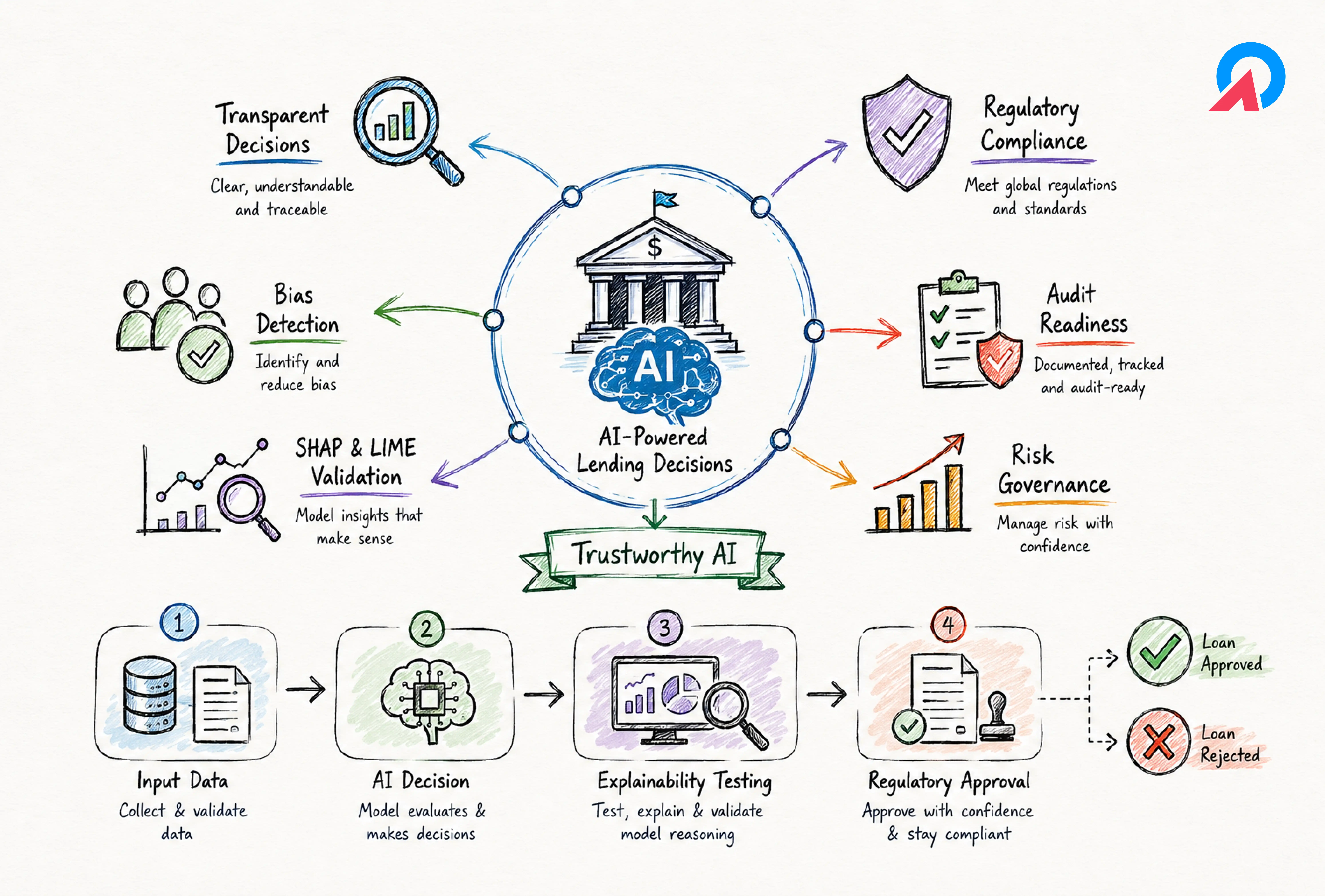
Opaque AI is Not Scalable and Production-ready AI
No matter how cutting-edge and mature the AI systems are, if the answer to ‘whether their actions are explainable’ is unclear, they are not production-ready! Moving from ‘black-box’ to AI explainability involves making AI-driven decisions simpler to understand, clearer, more interpretable, and accountable to everyone outside data science, AI development, and security teams. Further, AI systems introduce complexities such as non-determinism, context-sensitive behavior, hidden bias in datasets, poor training data quality, model evolution, and multi-dimensional evaluation requirements.
Regulators ask more profound questions to ensure that organizations are duly prioritizing AI transparency, traceability, and responsible design and development, such as:
- Why was this decision made?
- Can it be explained clearly and consistently?
- Can it be defended under audit?
Explainability enables model traceability, visibility into data lineage, and human intervention layers that help evaluators to approve or invalidate decisions. This helps create clear, explainable logic and decision paths that can be referenced by relevant teams and stakeholders for compliance audits, error and risk remediation, and decision-making.
Why Testing AI Explainability is Now the Gold Standard in QE?
Think of a typical banking scenario: an AI system used in lending can generate outputs that overwhelm users with too much information or confuse them, clouding their judgment and affecting their actions. It may create cognitive load, but wouldn’t be able to justify decisions (approvals, rejections, or miscalculations) or detect errors due to inaccuracies, bias, and discrimination in the training data against certain demographics, race, and ethnicity, automation bias, etc.
And the outcome? The loan officer, underwriter, or the bank will never be able to explain why a loan was rejected or sanctioned for an applicant. If a model underperforms, without explainability, even the developers will be unable to fix what they don’t understand.
Or think of another scenario: two applicants with nearly identical financial profiles (similar income, credit histories, and debt-to-income ratios) apply for loans. If the AI system is evaluated using traditional testing approaches, QE teams can assess whether the AI model performs within expected thresholds and behaves consistently across the same datasets, thereby missing out on obvious explainability issues. When these systems are in production, one loan candidate will be approved, and the other will be rejected. The generated explanations suggest that approval was based on “stable income patterns” and rejection on “income variability”. At a glance, both seem reasonable. But only explainability validation would help reveal if

- Small input variations led to disproportionate shifts in feature importance
- A proxy variable influenced outcomes inconsistently
- Similar profiles yield different reasoning patterns
Testing AI for explainability breaks down machine learning algorithms (used in traditional, simpler, and complex deep-learning systems) using techniques such as LIME (Local Interpretable Model-agnostic Explanations), SHAP (SHapley Additive exPlanation), Captum, counterfactual explanation generation, human evaluation, and other interpretability models to gain a better understanding of their decision-making processes.
Explainability testing frameworks are essential for upholding stakeholder and customer trust and meeting compliance needs. The GDPR’s Article 22 classifies AI systems used in hiring, credit scoring, and law enforcement as high-risk, giving users the right to an explanation. The EU AI Act has outlined critical regulatory requirements for AI explainability, including extensive documentation, transparency, and risk governance.
Insufficient proof or a lack of insight into decisions driven by algorithmic bias has resulted in lawsuits and investigations.
Explainability vs Interpretability: Decoding the Misconception
Equating interpretability with explainability readiness is based on a flawed assumption. An AI model’s interpretability helps us understand how it internally functions and how it dispenses an output. Model interpretability is essential for developers and data scientists to ensure models perform as intended. Explainability, on the other hand, is about clearly explaining the AI model decisions and outcomes in a manner that is easy to comprehend. It helps close the gap in a user’s understanding of AI model complexity or black-box nature, building confidence in their outcomes. In the banking and financial context, generating an interpretation is not the same as explaining and validating it. An explanation that changes under small variations, differs across similar profiles, or lacks alignment with domain logic cannot be relied upon in a regulated environment.
QualiZeal’s newly launched ValidAIte is an enterprise-grade AI assurance platform purpose-built to validate non-deterministic AI systems, with a strong focus on explainability, governance, risk control, and responsible AI adoption. The platform embeds AI Quality Engineering and assurance directly into the testing lifecycle, ensuring that every evaluation process, score, judgment, metric, and outcome is interpretable, explainable, and fully traceable by design, supporting enterprise governance, audit readiness, and regulatory scrutiny.
ValidAIte helps organizations move beyond traditional performance testing by validating whether AI systems are trustworthy, transparent, and evidence-driven in real-world enterprise environments.
Core Explainability & Governance Capabilities

ValidAIte’s explainability-first validation framework for enterprise AI systems helps evaluate banking systems across the following dimensions:
- Decision transparency
- Feature attribution accuracy
- Explanation consistency
- Reasoning reproducibility
- Evidence traceability
The platform ensures that every AI outcome is measurable, auditable, and explainable by design. Further, it supports governance requirements aligned with the NIST AI Risk Management Framework (AI RMF) across Trust, Risk, Metrics, Testing, Evidence, and Observability.
For industries such as banking and financial services, where explainability and auditability often matter more than raw model throughput, ValidAIte prioritizes deeper observability and interpretability over speed alone with:
- Enhanced logging and trace instrumentation
- Rich interpretability metadata and reasoning traces
- Focus on audit-centric assurance rather than throughput optimization
- Use of validation metrics such as:
- Trace completeness %
- Audit confidence score
- Explanation fidelity
- Evidence coverage and attribution accuracy
RAG Validation & Grounded AI Outputs
ValidAIte also validates Retrieval-Augmented Generation (RAG) systems by testing both retrievers and generators to ensure AI outputs remain grounded in the enterprise context and supported by verifiable evidence.
The platform evaluates:
- Retriever relevance and context accuracy
- Grounding quality of generated responses
- Source attribution and citation correctness
- Hallucination exposure and unsupported claims
- Evidence-to-response alignment consistency
Conclusion: Explainability must be engineered into the system.

Explainability must move beyond tooling and become part of how AI systems are designed and validated. This approach requires a shift in the mindset where explanation becomes a testable artifact, systems are validated for consistency across similar scenarios, monitored for stability under input variation and model updates, and enabled with traceability across the lifecycle.
The bottom line? Explainability must become something that is measured, tested, and reproducible. This is where most organizations face challenges because explainability is often handled in isolation. QualiZeal helps organizations adopt a structured evaluation approach that:
- Connects risk, testing, and compliance expectations
- Translates regulatory requirements into testable conditions
- Enables repeatable validation across scenarios
- Produces evidence that supports audit and governance
AI-powered Quality Lifecycle Management (QLM) tools improve test case prioritization and fault detection efficiency by learning from historical execution data, especially in continuous integration environments.
AI is transforming lending, but transformation without explainability creates fragility. Connect with our experts to ensure your banking AI systems are protected against compliance risks and explainability blind spots.