
Quick Summary : AI misuse is one of the most significant blockers to moving from pilot to production. AI systems are not like traditional software systems and have a high propensity to generate unsafe, biased, or policy-violating outputs without any malicious activity directed at the system. Gartner’s 2025 findings warned that at least 50% of generative AI (GenAI) projects would be abandoned after the proof-of-concept stage due to poor data quality, inadequate risk controls, escalating costs, or unclear business value. CrowdStrike’s 2026 Global Threat Report also finds that adversaries have been actively exploiting vulnerabilities in AI systems by injecting malicious prompts into GenAI tools and abusing AI development platforms. The report also found that this trend was prevalent for more than 90 organizations and AI-powered misuse increased operations by 89%, year-over-year.
Enterprise AI has reached a turning point. Organizations are no longer asking whether the system or tool works but are more focused on whether it can be trusted in production. With AI systems becoming a new hotbed for threats and prompts emerging as a new form of malware, enterprises need continuous AI testing and misuse detection as safeguards to help ensure the production of reliable and governed AI systems while mitigating the stated risks.
As an enterprise AI leader, you may wonder whether traditional security tools created for deterministic software would work for Large Language Models (LLMs) and AI agents. The answer is a resounding no. One-time testing and static guardrails are no longer effective. For these reasons, the most advanced enterprises are implementing continuous AI assurance by combining testing, monitoring, governance, and evidence-based validation throughout the complete AI lifecycle. Read the rest of the blog to explore how continuous monitoring of AI systems is the key to reducing AI misuse.
Why Is AI Misuse Different from Traditional Security Risks?
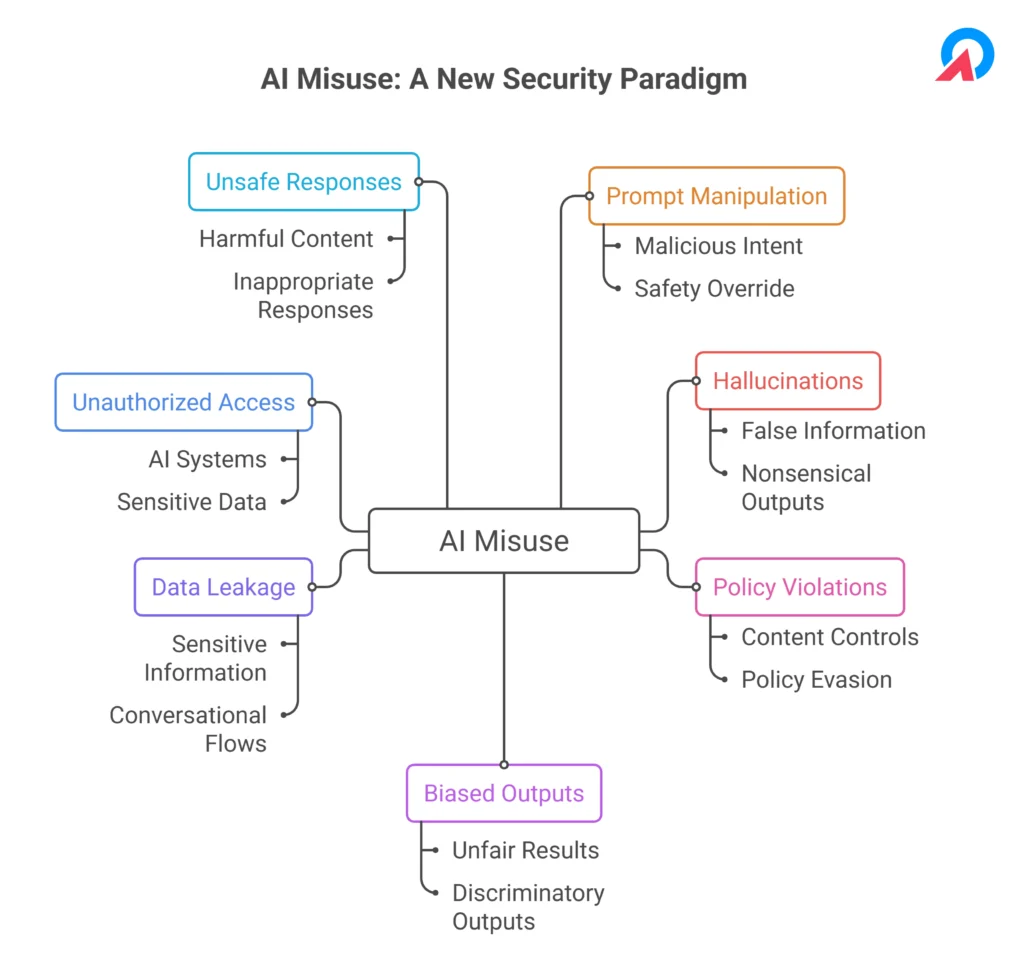
AI systems have become ubiquitous across customer support, financial services, healthcare and clinical support, software development, and core enterprise operations. This changes the risk profile drastically. AI misuse can happen through prompt manipulation, hallucinations, policy violations, biased outputs, data leakage, unauthorized access to sensitive information, and unsafe responses generated during legitimate user interactions. Moreover, unlike traditional software, it is easier to exploit AI and flout security checks without abusing infrastructure. Simply put, AI misuse is conducted under the guise of authorized protocols utilizing prompt engineering by legitimate users, and common misuse patterns include:
- Inputs that guide malicious intent as legit prompts that override safety
- Policy-evasive prompting that bypasses content controls
- Data exfiltration via conversational flows
- Model steering to produce biased, unsafe, or non-compliant outputs
- Repeated probing to reverse-engineer system behavior
- Silent misuse that degrades trust without triggering hard failures
The challenge is that these behaviors rarely appear as isolated incidents. They emerge as patterns over time, making continuous observation far more valuable than one-time testing.
What Is AI Misuse Detection?
AI misuse detection is the practice of continuously evaluating how AI systems behave in real-world environments to identify unsafe, non-compliant, abnormal, or malicious interactions before they become business risks.
Rather than asking only, “Did the model generate the correct response?”, enterprises now ask: Is the response factually reliable? Does it follow organizational policies? Does it expose confidential information? Is it fair and explainable? Can we provide evidence during an audit?
These questions require far more than functional testing. And this is where QualiZeal’s ValidAIte™ provides enterprise value.
Built as an AI assurance framework, ValidAIte™ evaluates and verifies AI systems across trust, safety, governance, compliance readiness, transparency, and operational risk while producing audit-ready evidence and an AI Trust Score that supports production deployment decisions.
Why Are Traditional AI Guardrails No Longer Enough?
Many organizations still depend on prompt filters, keyword-based moderation, manual reviews, and periodic red-team exercises. These controls remain important but cannot keep pace with continuously evolving AI behavior. Without continuous evaluation, organizations rely on assumptions instead of measurable evidence.
Several factors make traditional safeguards insufficient, such as,
- Attack techniques evolve rapidly.
- Context changes the meaning of prompts.
- Safe prompts may still generate unsafe outputs.
- AI models change after updates or fine-tuning.
- Human evaluation does not scale across millions of interactions.
According to Gartner, organizations must move from policy‑based governance to enforceable technical controls as AI expands and evolves.
How Does Continuous Monitoring Reduce Enterprise AI Misuse Risk?
Continuous monitoring extends AI testing beyond deployment. Instead of validating a model once, organizations continuously observe production behavior to detect new risks as AI systems evolve. An effective monitoring strategy evaluates:
Identifying Behavioral Patterns: Rather than reviewing isolated prompts, monitoring identifies repeated misuse attempts, unusual user behavior, and emerging attack patterns across sessions.
Detecting Hallucination and Accuracy: Monitoring constantly assesses whether a given response is factually consistent, cites sources (where necessary), and remains compliant with trusted enterprise knowledge.
Safety and Policy Compliance: Every response can be cross-examined to determine whether it complies with internal policies, industry regulations, and the company’s standard operating procedures (SOPs) for policy violations, before such violations become problematic.
Risk Scoring: Not all the given responses will have the same business issues and/or concerns. Continuous monitoring prioritizes incidents, issues, concerns, and/or responses based on severity, business impact and/or context, and operational and regulatory risk.
Actionable Responses: Unlike basic alert generation, mature AI assurance platforms provide the following: adaptive guardrails, automated decision rollbacks, escalation, human review, and evidence for audits.

How ValidAIte™ Assures and Tests AI Systems for Misuse Scenarios?
Enterprise AI assurance requires more than dashboards and alerts. QualiZeal’s ValidAIte™ provides an independent framework for validating AI systems before and after deployment. It evaluates AI applications across the seven critical trust dimensions, including reliability, safety, fairness, explainability, transparency, governance readiness, hallucination exposure, guardrail effectiveness, and compliance readiness.
Rather than relying solely on manual testing, ValidAIte™ combines automated evaluation, continuous validation, and governance evidence to help organizations make confident deployment decisions.
The platform assures AI systems by identifying vulnerabilities to misuse before production by executing test suites for prompt injection, jailbreak, toxicity, data leakage, hallucination, adversarial prompts, policy compliance, and role boundary. Further, aligned with the internally developed governance RMTE (Risk→Metrics→Test→Evidence) framework, NIST AI RMF, EU AI Act readiness, and TEVV principles, ValidAIte ensures comprehensive validation across security, policy compliance, safety, and governance.
Why Enterprise IT Needs to Move from AI Testing to Continuous AI Assurance?
The discussion in enterprise AI has matured from verifying models to validating that AI can be trusted.
Testing is still a necessary component but may not be enough to discover emerging misuse, risks, or production drift. Organizations now require continuous insight into AI system behavior, its compliance posture, whether it’s meeting enterprise expectations, and more.
QualiZeal’s ValidAIte™ offers tangible value by combining AI assurance, continuous evaluation, governance, and audit-ready evidence. These elements assure AI systems before deployment and then allow for continued validation while in production.
Continuous AI assurance is emerging as the new standard-not another layer of governance-for enterprises, as they integrate Agentic AI into mission-critical applications. Have you implemented it yet? Get started today!
Frequently Asked Questions
1. What is AI misuse detection?
AI misuse detection is the continuous monitoring of AI systems to identify unsafe, malicious, non-compliant, or abnormal behavior before it causes an operational, regulatory, or reputational issue.
2. Why is continuous monitoring required for Agentic AI applications?
AI models evolve and create probabilistic outputs. The continuous monitoring capabilities of systems like ValidAIte™ help detect hallucinated content, prompt attacks, policy violations, and model drift, which might be missed during static testing.
3. How is AI assurance different from AI testing?
AI testing is used to validate functionality before a system’s production use. In contrast, AI assurance extends throughout the entire AI lifecycle to review AI models on reliability, security, governance, explainability, and fairness.
4. What is ValidAIte™?
ValidAIte™ is an enterprise AI assurance solution from QualiZeal that validates AI systems on trust, safety, governance, readiness to comply with requirements, and operational risk. It produces both a quantitative and qualitative AI Trust Score and provides ready-to-use AI evidence for audit.
5. What types of AI systems can ValidAIte™ assess?
ValidAIte™ can assess chatbots, LLM applications, AI agents, copilots, predictive AI models, recommendation engines, and multi-agent systems integrated into the enterprise environment.
6. Which AI governance frameworks does ValidAIte™ align to?
ValidAIte™ is used to achieve AI assurance, which aligns to a variety of well-established AI governance frameworks, including QualiZeal ‘s internally established RMTE (Risk→Metrics→Test→Evidence), EU AI Act readiness, NIST AI Risk Management Framework (AI RMF), and TEVV requirements for enterprise AI validation.