
Modern cruises are marketed for their conspicuous luxury and exclusive guest experiences. From the well-connected digital ecosystem that begins at the pre-booking stage to post-disembarkation, the industry has captured the attention of new-generation customers who care about the quality of experiences, meaningful upgrades, and personalized itineraries. While the data forecasts suggest a record-high sailing momentum in 2026 at 21.7 million passengers, a marked 4.5% increase over 2025, the recent route shifts and surging fuel prices due to geopolitical conflicts force cruise companies to prioritize customer confidence and price sensitivity. Across the shipboard systems, shore-based platforms, payment systems, exclusion management platforms, crew operations, third-party integrations, and guest-facing applications, the need for system performance and resilience without disruptions demands a differentiated Quality Engineering approach.
Read the blog further to understand how QualiZeal’s AI-powered Quality Engineering approach enables cruise companies to accelerate digital transformation goals by ensuring shipboard and shoreside systems perform continuously, securely, and flawlessly, even under spotty connections and across global regulatory environments.
The Growing Complexity of Cruise Technology Ecosystems
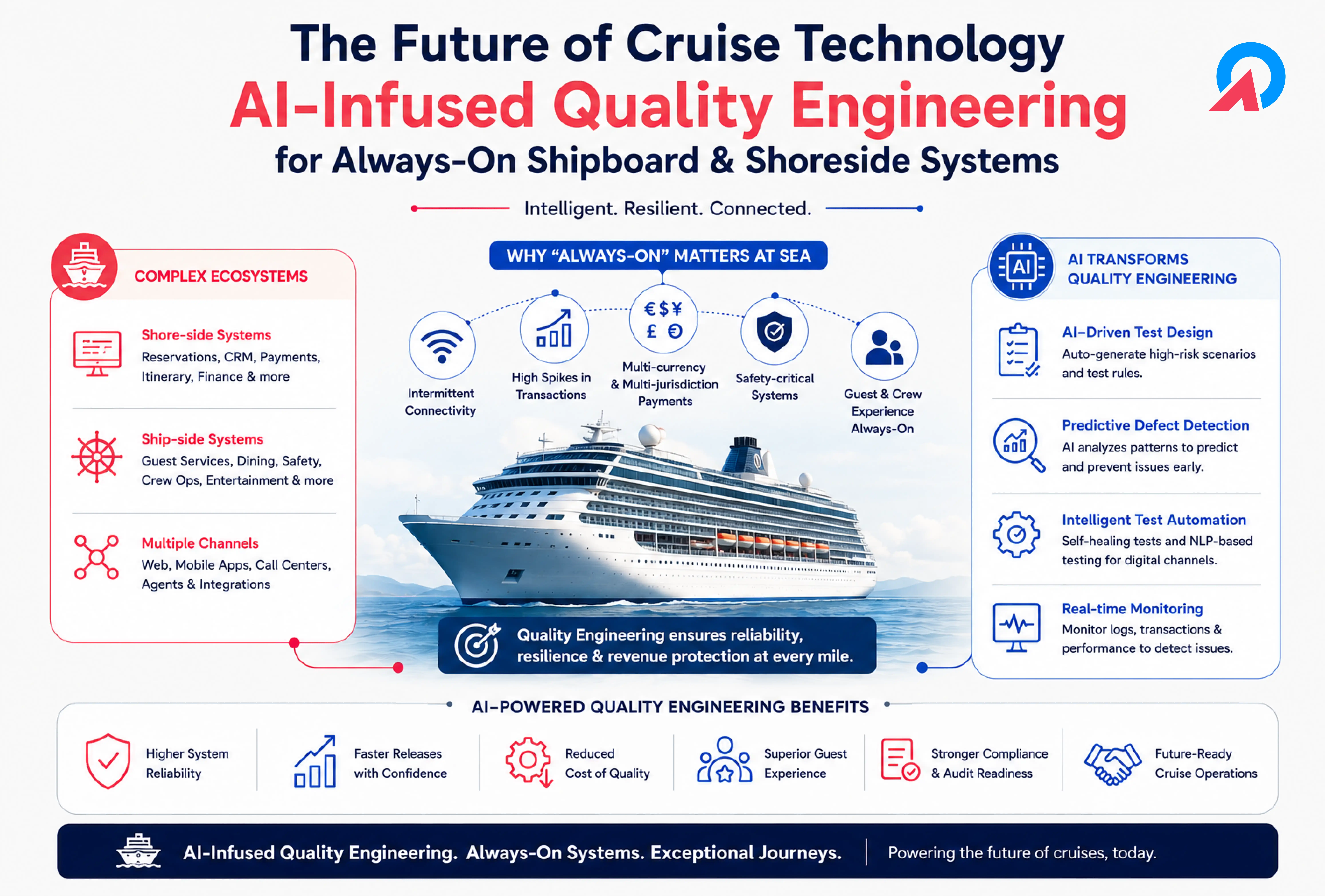
Premium cruise operators approach Quality Engineering to enhance platforms across the cruise value chain, protect revenue, enable confident releases, and uphold brand value. Platforms like Seaware, Fidelio, Amadeus, AMOS, and others underpin a wide range of mission-critical operations across the cruise lifecycle, including:
- Shore-side systems: reservations, pricing, CRM, payments, loyalty, itinerary planning, finance, and marketing
- Ship-side systems: onboard POS, guest services, entertainment, dining, safety, crew management, and real-time operational integrations
These systems operate across multiple channels—web, mobile apps, call centers, travel agents, and APIs—and integrate with payment gateways, PMS, POS, financial systems, and port authorities. Given the need for powerful pricing flexibility, integrated CRM, predictive maintenance, resilient navigation systems, and always-on guest engagement experience, the cruise industry technology stack involves interconnected legacy and modern systems. They significantly increase digital and operational complexity for cruise operators, requiring end-to-end testing.
Further, integrated communication platforms, passenger management systems, and predictive analytics models are central to cruise operations. They demand consistent performance, data accuracy, and resilience across shipboard and shoreside environments, making quality a critical challenge.
Why “Always-On” Means More at Sea
Unlike land-based enterprises, cruise technology must perform under uniquely challenging conditions:
- Intermittent connectivity between ship and shore.
- High transaction spikes during embarkation, disembarkation, and flash promotions.
- Multi-currency and multi-jurisdictional payments.
- Safety-critical systems integrated with guest and crew operations.
With the rapid digitalization of the cruise and broader maritime industries, advanced technologies, including AI, IoT, and data analytics, are increasingly integral to operations, decision-making, and competitive performance. Traditional QA approaches struggle to keep pace with this complexity, leading cruise operators to adopt Quality Engineering models that help them think the bigger picture, assuring multiple cruise ships in the fleet, increasing guest returns, scalable testing strategies for fleet-scale assurance, and cost reduction, among others.
Quality Engineering: A Strategic Capability, Not a Testing Phase
In modern cruise technology ecosystems, the scale, interdependence, and always-on nature of shipboard and shoreside systems demand a more deliberate approach. Therefore, quality must never be treated as a downstream activity. Quality Engineering must be viewed as a strategic capability—not a tool or platform for running one-time checks —but as a means of embedding quality across the software lifecycle.
By aligning engineering, operations, and business objectives, it ensures that systems remain reliable, secure, and resilient under real-world conditions. For cruise operators using rule-driven platforms, integrated payments, and ship–shore synchronization, Quality Engineering helps shift the focus from defect detection to system-level reliability and continuous assurance.This foundation enables scaling AI-powered cruise systems, integrating customer-facing chatbots that resolve passenger queries with contextual accuracy, on-board in-cabin and assistant services for booking and reservations, embedding agent-powered check-ins, and much more with confidence. Concurrently, AI-powered Quality Engineering platforms help transform cruise quality assurance for deterministic systems into an intelligent, unified function.
In essence, both deterministic and non-deterministic systems used in the cruise context require deep, continuous validation, along with risk-based quality governance, to minimize operational disruption.
Where AI Transforms Quality Engineering in Cruise Systems
1. AI-Driven Test Design for Rule-Based Platforms
Cruise reservation systems like Seaware rely on highly configurable rule engines governing pricing, promotions, loyalty tiers, cabin availability, and guest eligibility. AI-assisted QE tools can:
- Analyze historical defects and production incidents
- Auto-generate high-risk test scenarios
- Identify edge cases in combinable pricing and promotion rules
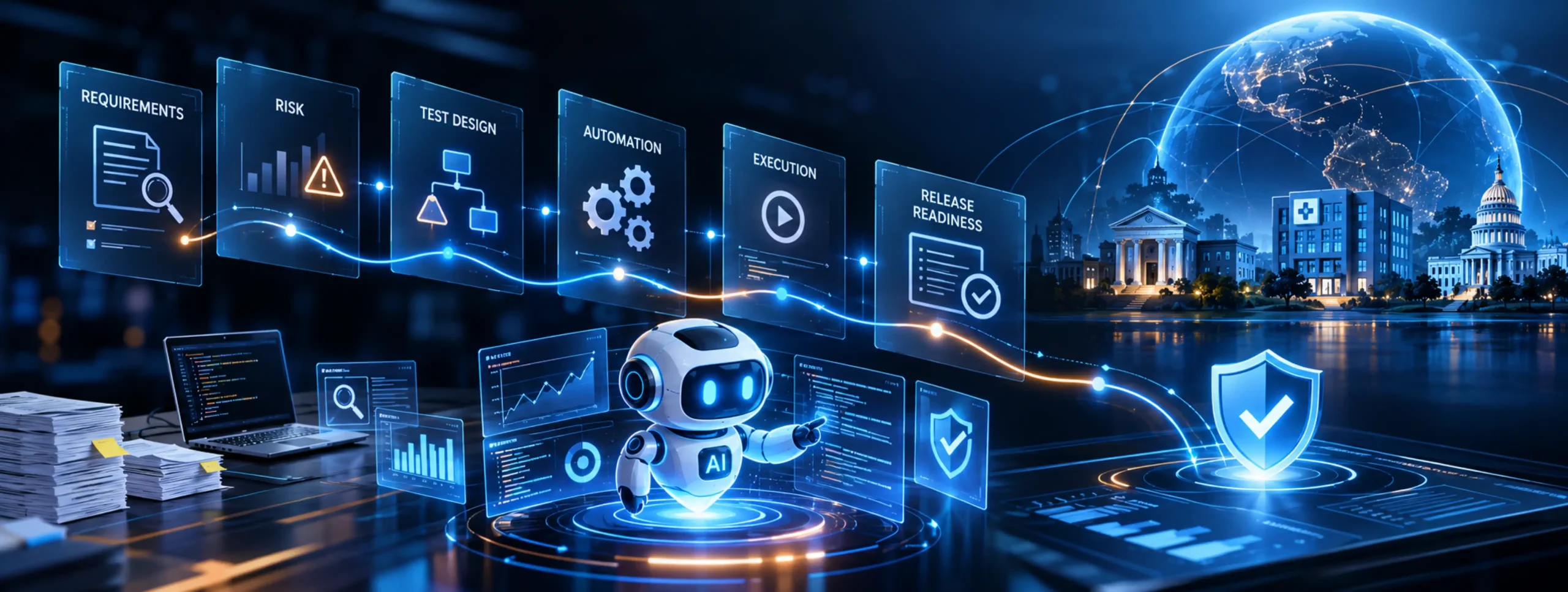
AI-powered Quality Engineering tools and platforms intelligently automate the entire testing lifecycle, enabling predictive analytics, automated test generation, and continuous validation across highly integrated shipboard and shoreside systems. These ecosystems rely heavily on rule-driven logic, experience intermittent connectivity, and drive real-time guest operations where consistent quality and performance matter. QA teams can leverage AI-powered capabilities to eliminate the scope for failures.
2. Predictive Defect Detection Across Ship-Shore Integrations
Cruise platforms rely on continuous data exchange between shipboard and shoreside systems, often experiencing delayed or batch synchronization. AI models that are trained on logs, API responses, and historical failure patterns can:
- Predict integration failures before they happen.
- Identify data mismatches across inventory, payments, and CRM.
- Decrease post-deployment incidents.
3. Continuous Testing for Always-On Operations
Cruise systems cannot afford long maintenance windows. AI enables continuous testing pipelines that:
- Automatically trigger regression tests after configuration changes.
- Validate weekly upgrades across development and UAT environments.
- Smoke tests across critical booking and payment flows.
Continuous testing allows for faster detection and resolution of defects. It also lowers test-fix turnarounds, which reduces feedback cycles and risk exposure in DevOps and CI/CD workflows.
4. Intelligent Test Data Management for Realistic Scenarios
Cruise testing requires highly realistic data, such as citizenship, passport information, currencies, loyalty tiers, and regulatory details.
AI-powered data engineering supports:
- Creating synthetic but compliant test data
- Dynamically masking personally identifiable information
- Modeling scenarios for non-citizen travelers and cross-border payments
AI-powered Quality Lifecycle Management (QLM) tools improve test case prioritization and fault detection efficiency by learning from historical execution data, especially in continuous integration environments.
AI-Infused QE Across Shipboard Systems
Shipboard systems increase risk because of guest proximity and safety concerns. AI-driven QE improves:
- POS Testing: Validating high-volume transactions onboard
- Performance Engineering: Ensuring dining, entertainment, and booking apps function well during peak load
- Security Testing: Ongoing vulnerability scanning of onboard networks
Maritime cybersecurity risks have become a strategic focus as digital systems grow in the sector. Research indicates that cyber threats to maritime and port operational technology are becoming more sophisticated and common.
Bridging Business and Technical Knowledge with AI
One of the main challenges in cruise platforms is that business users and technical teams work separately. Tools that serve as AI-assisted QE accelerators with capabilities like requirement interpretation and test case generation, help close this gap by enabling:
- Translation of business requirements into test scenarios
- Faster UAT readiness
- Reduced reliance on extensive platform expertise for every release
The Business Impact of AI-Infused Quality Engineering
For cruise operators, the benefits of AI-enabled QE go beyond defect reduction. Quality Engineering not only assures cruise systems but also creates revenue opportunities for companies looking to make guest and passenger experiences, digital capabilities, AI-powered customer-facing interfaces, their brand, and competitive differentiators. In the age of speed and an AI-first mindset, AI-infused QE delivers the following impact that translates to long-term business outcomes:
- Faster time-to-market for promotions and itineraries.
- Higher booking conversion through reliable digital touchpoints.
- Less revenue loss from pricing or payment errors.
- Higher guest satisfaction during both pre-cruise and onboard experiences.
Conclusion
As cruise technology ecosystems become more connected and always-on, AI-based Quality Engineering is becoming a necessity. By adding intelligence to testing, data validation, performance, and security, cruise operators can offer reliable digital experiences from shore to ship and back.
The future of cruise technology will depend not just on innovation, but also on how consistently, securely, and smoothly that innovation works at sea.
If your organization wants to implement AI-based Quality Engineering in both shipboard and shoreside systems, now is the time to move forward.
Discover how QMentisAI helps engineering and business teams accelerate quality on a large scale. This approach leads to smarter test design, faster release cycles, and ongoing assurance for essential cruise platforms.
Contact our experts today!