
Digital accessibility is no longer a reactive technical afterthought. For CIOs, it is about more than compliance and legal risks. In fact, it has become an ethical and revenue imperative to front-end digital accessibility, embedded right at the software development lifecycle for better customer reach and long-term digital reliability.
According to a recent WebAIM accessibility evaluation of over a million home pages, 56,114,377 unique accessibility errors were identified, averaging 56.1 per page. These errors have a significant impact on the end-user experience and pose a risk of noncompliance with WCAG 2.2 Level A/AA. In 2026, commitment to accessibility grows with nearly 77% of organizations reportedly assigning dedicated budgets and 68% planning to increase it annually.
The vision for the future is to stitch together challenges of growing error density, page elements, mobile, voice, and digital interfaces, and AI tools with test strategies that scale alongside modern delivery pipelines.
Read the blog further to understand the need for accessibility testing and the shift towards AI-powered platforms like QMentisAI as a force multiplier and a proactive step towards meeting strict regulations, such as the Americans with Disabilities Act (ADA) and Web Content Accessibility Guidelines (WCAG) 2.2.
Accessibility Testing: From Compliance Activity to Strategic Responsibility
Digital accessibility for applications, websites, and digital platforms across user groups, including those with audio, visual, and cognitive impairments, is based on the POUR (Perceivable, Operable, Understandable, and Robust) principles. Testing for accessibility was once viewed as a periodic validation task.
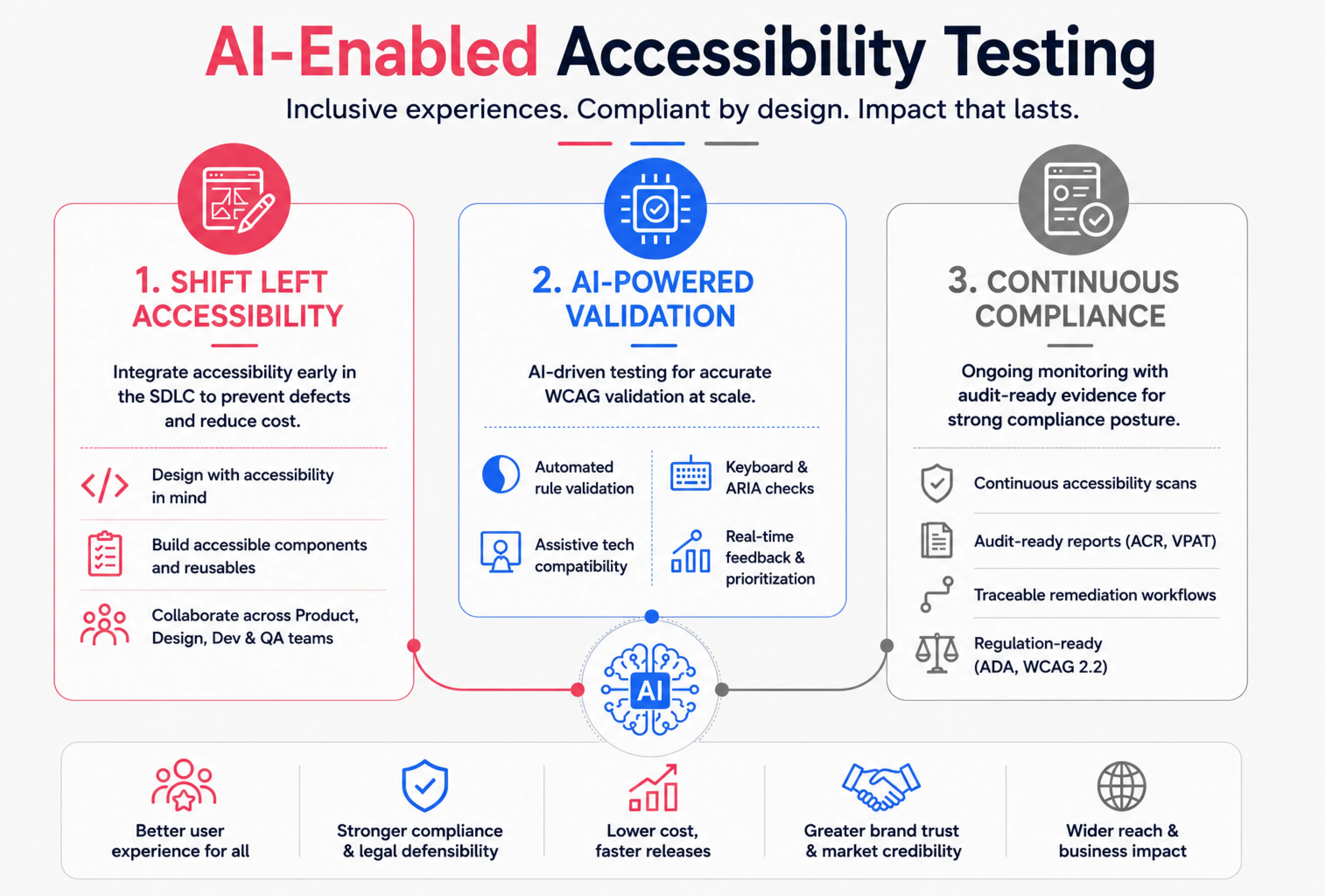
Teams performed manual checks, generated reports, and moved forward once compliance thresholds were met. Today, accessibility ‘shifts left’, integrating AI-assisted tools, automated testing, assistive technology testing, and manual testing to assess usage components such as keyboard navigation, screen readers, and focus management. Digital accessibility is now a core part of Quality Engineering strategy, helping standardize WCAG 2.1 guidelines as the accessibility baseline and expanding the focus beyond static page validation to real user journeys such as login flows, mobile interactions, and keyboard navigation workflows.
This change reflects a broader reality beyond meeting minimum requirements, delivering usable and inclusive digital experiences.
For CIOs, this shift affects multiple areas:
- Compliance readiness of the latest digital and mobile platforms.
- Strong audit defensibility with proof points.
- Proof of customer accessibility and inclusive experience across digital channels.
- Procurement eligibility in regulated industries.
- Increase in brand and stakeholder trust, translating into market credibility.
Accessibility Testing Happens Too Late in the Lifecycle
There is a common misconception that accessibility testing can be a post-development activity. This creates several downstream challenges, such as costly, effort-intensive redesign or refactoring, release-cycle delays and disruptions, and engineering overkill. High-maturity organizations never underestimate accessibility requirements by shifting validation into design systems and reusable components. This shift-left approach aligns the product, engineering, design, and QA teams, ensuring everyone plays an equal role in following accessibility guidelines and preventing defects from spreading across applications.
Compliance Requirements Are Becoming More Evidence-Driven
Accessibility is no longer satisfied by simple scan results. Organizations are now expected to produce tangible evidence and audit-ready proof in the form of Accessibility Conformance Reports (ACR), Voluntary Product Accessibility Templates (VPAT), and Traceable remediation workflows.
These artifacts provide measurable legal defensibility to withstand reviews, defining exactly what was tested, the testing methodologies, the WCAG version, the testing matrix, the user impact, etc.

One-Time Accessibility Audits No Longer Work
Traditional accessibility audits provide only a snapshot of compliance and are counterproductive to agile development, frequent releases, and dynamic changes and upgrades to products. Moreover, new defects appear at the same frequency as applications evolve, driven by the changes in the accessibility standards and assistive technologies, customer expectations, and the pace of market innovation. The use of automated tools and periodic regression testing helps proactively track and address accessibility issues introduced during code changes and updates. CIOs must prioritize making accessibility testing an ongoing discipline rather than a milestone activity.
The Rise of AI-Enabled Accessibility Testing
Beyond automation, tools built to test prioritize scale. AI has changed the game with its accuracy in spotting hard-to-track issues manually, assessing contrast ratios between text and background colors, delivering real-time developer feedback, and prioritizing categories of accessibility errors by severity. AI-enabled accessibility testing supports several key advancements:
Automated Accessibility Rule Validation:
AI-powered testing engines can run intelligent evaluation of UI components against accessibility guidelines. These tools typically target the following areas for validation:
- Color contrast alignment
- ARIA labeling structure
- Keyboard navigation paths
- UI interaction patterns
Automated rule validation significantly improves coverage across interfaces and reduces manual testing effort.
Workflow-Level Accessibility Testing
Modern accessibility testing extends beyond individual pages to full user journeys, targeting multi-step workflows, dynamic UI changes, form-based interactions, and authentication processes. Validating accessibility across workflows helps guarantee consistent user experiences.
Intelligent Defect Prioritization
While not all accessibility issues have equal severity and risk weightings, they require equal effort and resources for resolution. AI helps analyze accessibility findings and group them into categories, from most significant defects to low-priority issues. This enables QA teams to focus on high-impact issues and their resolution, reduce remediation grunt work, and increase resolution efficiency.
Concurrently, AI-powered accessibility tools are not replacements for human testers and accessibility experts. It amplifies human expert insights and validation, which is essential for accessibility scenarios involving assistive technologies and usability behaviors.

How QMentisAI Enables Enterprise-Scale Accessibility Testing
As accessibility expectations evolve, organizations require platforms that can support large-scale validation workflows. QualiZeal’s QMentisAI is built for large enterprises that manage multiple applications and platforms, undergo frequent releases, face high regulatory requirements, and use cases with a high risk of accessibility violations. QMentisAI is the intelligent alternative to the slow, inconsistent, and expensive testing options, and it can be readily embedded into the Quality Engineering ecosystem. Here’s how the tool aids in enterprise-scale accessibility testing:
Integrating Accessibility into Functional and Regression Testing
One of the most important advancements in accessibility testing is integration into existing regression workflows. QMentisAI allows accessibility validation to run alongside functional test execution. This ensures that accessibility checks are performed continuously rather than as isolated activities. By aligning accessibility testing with regression cycles, teams can:
- Detect accessibility issues early
- Maintain accessibility readiness across releases
- Reduce the need for separate testing workflows
This integrated approach supports shift-left accessibility strategies and improves delivery consistency.
Automated WCAG-Aligned Validation
QMentisAI supports structured validation workflows aligned with accessibility standards, specifically targeting requirements such as color contrast testing, keyboard navigation validation, screen reader compatibility checks, and captioning and interface clarity validation.
These validation steps form the foundation of inclusive digital testing environments and ensure accessibility compliance across platforms.
Automated WCAG-aligned testing improves repeatability and strengthens compliance confidence.
Accessibility Testing Across User Journeys
Enterprise systems require accessibility validation across full workflows rather than isolated screens. QualiZeal’s QMentisAI supports accessibility testing across the page-level interfaces, component-level UI elements, and end-to-end business workflows. This ensures accessibility coverage across real user journeys and dynamic system interactions. By enabling workflow-level testing, the platform significantly improves reliability across customer-facing applications.

Severity-Based Reporting and Governance Visibility
CIOs require clear insights into accessibility readiness across projects.
QMentisAI supports governance through:
- Centralized reporting dashboards
- Severity-based accessibility classification
- Traceable remediation workflows
- Audit-ready documentation visibility
These insights allow leadership teams to monitor accessibility maturity and make informed decisions about release readiness.
Continuous Accessibility Validation Across Delivery Pipelines
Modern software delivery requires continuous validation. QMentisAI enables accessibility testing within CI/CD workflows, allowing teams to:
- Detect regressions automatically
- Maintain accessibility standards across updates
- Reduce compliance risk over time
Continuous accessibility validation ensures that accessibility remains intact as systems evolve.
Why CIOs Are Acting Now
Accessibility factor of applications and platforms is not just a competitive differentiator; it represents the brand’s inclusive and forward-thinking mindset. It reflects the CIO’s empathy for diverse groups and their ability to anticipate their needs, driving innovation with a humane touch.
Regulatory enforcements and procurement teams prioritizing accessibility readiness in vendor evaluations push the boundaries of expectations at the legal level. However, the end users define the shelf life and the success of your devices and platforms across scenarios. The mandate is clear: modern development environments should think beyond speed and flexibility, making digital accessibility the de facto requirement. Organizations that adopt AI-enabled accessibility testing are better prepared to meet regulatory expectations, support diverse users, and maintain reliable digital systems.
At QualiZeal, we help enterprises plan embedding accessibility testing across the development lifecycle through our in-house IP-led, intelligent, and agent-driven Quality Engineering platform, QMentisAI.
Connect with our experts to strengthen digital accessibility compliance. Or request a demo of QMentisAI to support your accessibility journey.