
Enterprise AI Development: The $47.76 Billion Opportunity with a Trust Problem
In 2026, unlike the previous years, will not be about promises; it will be about proofs when it comes to AI initiatives. Still doubtful? Then here’s a number that should stagger every business leader: The global enterprise AI market hit $47.76 billion in 2025 and is projected to reach $520.69 billion by 2033, growing at a staggering 34.8% CAGR. And here’s another number that speaks about the unpleasant realities: nearly 64% of organizations lack complete visibility into their AI risks, creating massive security blind spots.
These sobering realities of enterprise AI development reveal serious risks that outpace governance and deep validation, leading to compliance gaps and potential exposure to unauthorized access, Shadow AI, and unfairness and bias. The priorities for the year are crystal clear: almost every AI product development team, leader, and board of organizations across industries want AI systems that are not just another fancy toy with an ‘innovation’ tag.
The goal is to build AI systems that organizations can trust at scale, generate ROIs that justify investment decisions, and deploy to production without the risk of becoming the next compliance nightmare or security breach. In the rest of this blog, we explore a fundamentally different engineering approach powered by NexaAI’s trust-first architecture that helps transform every AI ambition into enterprise-ready outcomes.
Why Enterprise AI Development is a Fundamentally Different Discipline?
Building an enterprise AI system differs from traditional software development. Moreover, the development isn’t just limited to deploying an innovative feature or piloting a chatbot. It is about operationalizing AI systems that can safely act at scale, influence decisions, and operate under constant regulatory, security, and business scrutiny.
AI systems for enterprise scenarios and workflow processes millions of user queries, interactions, and transactions in seconds. At any stage, meeting core enterprise mandates like security, governance, scalability, auditability, and zero-downtime reliability is essential. Any AI system that falls short of these pillars becomes a long-term risk rather than a business accelerator. At its core, enterprise AI spans three tightly coupled layers:
- Infrastructure: To securely scale compute, data pipelines, and storage.
- Models: That continuously learn, adapt, and evolve.
- Applications: For integrating AI decisions into enterprise workflows and systems
Furthermore, these layers evolve dynamically and often independently, creating blind spots that traditional engineering and testing models were never designed to handle.
Why Traditional Development Models Don’t Work for Enterprise AI?
Most organizations still approach AI product development with the same mindset used in linear software development playbooks, which include fixed requirements, deterministic logic, and periodic testing. But AI systems operate on probabilities, data dependencies, and continuous learning. Their behavior changes over time, even without code changes.
This mismatch is the primary reason many enterprise AI initiatives lag at the PoC stage or fail miserably to move into production.
Across industries, the same gaps consistently surface. Below are some of the challenges that hold back confident release and scaling of enterprise AI systems:
- Lack of visibility: Enterprises cannot govern AI systems they cannot fully observe, especially as Shadow AI proliferates.
- Security and privacy risks: AI systems behave like privileged insiders, accessing vast, sensitive data with limited AI-specific controls, increasing the risk of unauthorized access, accidental exposure, and cybersecurity threats.
- Regulatory complexity: AI compliance is continuous, not point-in-time, as AI models can drift over time, leading to compliance risks after deployment.
- Talent constraints: Enterprise AI requires rare, cross-functional expertise that most organizations lack at scale, such as MLOps and data engineering teams familiar with production systems, AI ethicists, AI security specialists, and Quality Engineers who understand AI testing needs and frameworks.
- Trust and explainability gaps: With AI systems operating as black boxes, decoding their decisions becomes difficult, eroding customer and stakeholder trust, thereby failing regulatory scrutiny.
- Data dependency risks: AI quality is inseparable from data quality, lineage, and exposure. AI systems depend on massive datasets, continuous data streams for model updates, diverse trained data for unbiased outcomes, supervised learning, and real-time feedback loops.
- Continuous monitoring demands: Unlike software, AI systems never “stabilize” after release.
These gaps explain why AI ambition outpaces readiness, demanding a trust-first, continuously governed development paradigm that helps close the gap between experimentation and enterprise-scale reality.

NexaAI: QualiZeal’s Trust-first Architecture for Enterprise AI Development
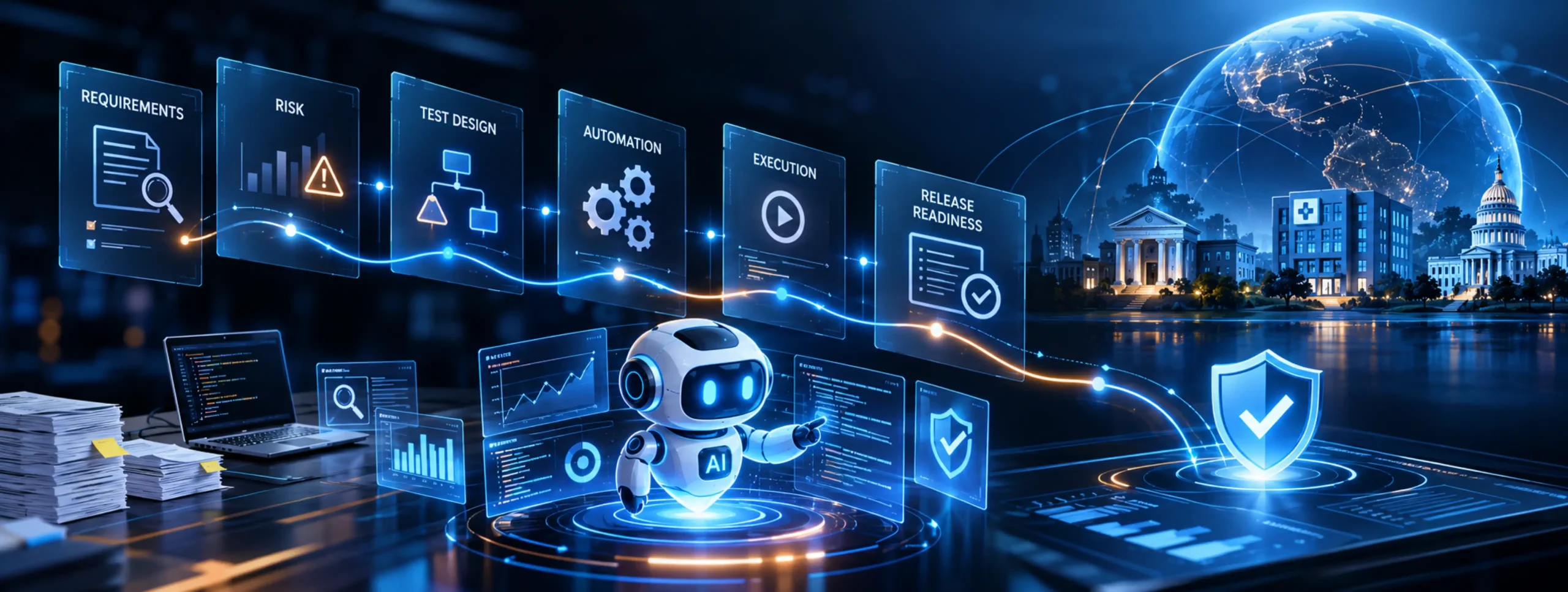
Throughout QualiZeal’s projects spanning Quality Engineering for enterprise software and AI systems, one truth has become clearer: trust cannot be retrofitted; it must be foundational. NexaAI is our latest enterprise AI service, enabling clients to build and deliver AI systems that boards approve, CFOs fund, and CIOs can confidently scale. Built on a trust-first philosophy, NexaAI transforms the development paradigm that starts with:
- Governance architecture aligned with global industry regulations, such as the EU AI Act, ISO/IEC 42001 for AI management systems, and NIST.
- Security framework designed to address AI-specific risks, such as the OWASP Top 10 for LLMs and agentic systems.
- Quality Engineering is integrated throughout the AI development cycle.
- Continuous compliance mechanisms from day one.
- Explainability built into model architecture

The NexaAI Framework: Four Foundational Pillars
Recent stats from the MIT study, State of AI in Businesses in 2025, revealed that billions of dollars in investments in enterprise GenAI pilots are yielding zero results. The study further unveiled the reasons behind the GenAI divide: the vast majority are generic tools that are good enough for demos but brittle in workflows. In 95% of failure cases, enterprises are stuck in a high-adoption, low-transformation mode. The remaining 5% with successful GenAI initiatives demonstrated a different approach, with strategies designed to address friction that addresses evolution, like new protocols, conflicting incentives, and embedded into high-value workflows and tools, with memory and learning loops.
NexaAI is QualiZeal’s in-house enterprise development service, built with a deliberate intent to help enterprises not chase pilots but build AI with discipline to scale with trust, compliance, and measurable value confidently. Here’s how its four trust-first pillars enable NexaAI to account for frictions:
Pillar 1: Governance by Design
Governance is never an afterthought; it is by design and architecture.
NexaAI embeds governance at every layer, including:
- Policy Enforcement: In automated guardrails that prevent non-compliant actions.
- Role-Based Access Control: For granular permissions for AI systems and users.
- Audit Trail Generation: For complete lineage tracking for every AI decision.
- Compliance Monitoring: To enable real-time validation against regulatory requirements and standards.
- Risk Assessment Frameworks: To allow continuous evaluation of AI system risks.
The governance pillars enable building AI systems in the same way as building a house, with the plumbing and electrical systems integrated from the blueprint stage. It does not allow retrofitting these critical components into finished walls or AI systems at the post-development stage.
Pillar 2: Security-First Architecture
NexaAI is built to address the unique threat landscape of AI systems.
Traditional security perimeters are insufficient for AI, and therefore, it implements data, model, and operation security layers:
Data Security:
- End-to-end encryption for training and inference data
- Data anonymization and pseudonymization
- Secure data enclaves for sensitive workloads
- Privacy-preserving techniques (differential privacy, federated learning)
Model Security:
- Model access controls and authentication
- Adversarial robustness testing
- Model watermarking and version control
- Supply chain security for third-party models
Operational Security:
- Zero-trust architecture for AI workloads
- Runtime monitoring for anomalous behavior
- Automated threat detection and response
- Secure model deployment pipelines
Pillar 3: Quality Engineering Throughout
QualiZeal’s breadth and depth of Quality Engineering expertise is integrated in NexaAI to define new standards of quality for AI systems across dimensions like:
Model Quality:
- Performance benchmarking across diverse scenarios
- Bias and fairness testing
- Robustness validation
- Drift detection mechanisms
Data Quality:
- Automated data validation pipelines
- Quality scoring and monitoring
- Anomaly detection in training data
- Provenance tracking
System Quality:
- Integration testing with enterprise systems
- Performance and scalability validation
- Reliability and fault tolerance testing
- User experience quality assessment
Operational Quality:
- Continuous monitoring in production
- Feedback loop integration
- Automated retraining triggers
- Quality degradation alerts
Pillar 4: Continuous Compliance, Adaptation, and Change Enablement
Compliance needs evolve at the same pace as AI and regulatory developments. Moreover, to ensure successful user adoption, enterprises need to act on change enablement to make talent and AI initiatives palatable to one another. As a part of NexaAI’s service, adoption playbooks, role-based secure prompt-engineering training, centers of excellence with KPIs, and AIOps for proactive anomaly detection and safe auto-remediation help boost adoption, enhance cultural readiness, and resilient AI operations.
How NexaAI Addresses Each Challenge
| Challenge | Traditional Approach | NexaAI Trust-First Approach |
| Visibility Crisis | Reactive discovery of shadow AI | Centralized AI inventory with automatic discovery and classification |
| Security Gaps | Perimeter security added after deployment | AI-specific security architecture from design phase |
| Compliance Complexity | Periodic audits and manual checks | Continuous compliance validation with automated controls |
| Talent Scarcity | Hire expensive specialists for every project | Embedded expertise in framework with guided workflows |
| Trust Issues | Try to explain black boxes after the fact | Explainability and transparency built into architecture |

Conclusion: Building the Future on Trustworthy Enterprise AI Foundation
The $47.76 billion enterprise AI market represents more than just investment dollars; it signals a massive opportunity and a fundamental shift in how businesses operate. But here’s what separates winners from cautionary tales: trust infrastructure.
Like any other technology, such as electricity, automobiles, or the internet, that reached mass adoption only after trust frameworks emerged, enterprise AI can reach scalable adoption only after demonstrating safety standards, proving regulatory readiness, and continuous quality. The pattern repeats in the following stages of the AI advancement curve. And the organizations that manage to unlock AI’s transformative value will not be the most advanced data science teams or the most sophisticated models. They’re the ones who solved the trust equation first. QualiZeal’s trust-first playbook transcends methodology and becomes a strategic imperative.
However, innovation doesn’t slow down for the sake of governance. It’s about building AI architectures that boards can confidently approve, customers can trust, regulators can validate, and teams can scale.
Ready to transform your enterprise AI strategy? Let’s connect.