
Agentic systems and assurance frameworks allow continuous quality in packaged enterprise applications and platforms. However, sustained value comes from a partnership, not from a tool vendor. Enterprises require a QE leader with AI-native innovation, domain expertise, and industry acumen to deliver reliable and scalable outcomes.
In 2025, enterprises faced a flurry of business uncertainties while managing ambitious AI-related project aspirations. The rapid shifts revealed the severity of prevailing challenges, including legacy monolithic environments, low-quality data, and accelerating operational costs, as well as technical debt. Together, these issues compound existential risks for organizations, hindering their ability to embrace digital strategies and adopt advanced technologies. While these risks remain constant, they will continue to define how organizations will approach technology investments in 2026. This is more evident in the growing reliance on cloud-native, commercial-off-the-shelf, and highly integrated packaged applications for enterprise resource planning (ERP), customer relationship management (CRM), human capital management (HCM), supply chain management (SCM), and other similar applications.
QE for Packaged Applications Demands a New Quality Paradigm
Packaged applications from vendors like Salesforce, SAP, Oracle, ADP, Workday, Guidewire, and more once meant stable, long-term technology investments. However, recently, enterprise applications and systems are updated continuously, extended through APIs, configured with low-code/no-code tools, and integrated with AI copilots and agentic workflows. With quarterly release cycles and integration complexities becoming the norm, these platforms must evolve into living systems where quality is assured and embedded.
As a pure-play Quality Engineering company, QualiZeal does not approach packaged applications testing through a legacy lens. The fragmented nature of modern packaged application environments demands an approach that’s well-aligned with today’s realities: AI-powered testing, AI-enabled test automation, and autonomous, goal-driven agents that continuously observe, reason, test, and adapt across enterprise systems.
Testing Needs Intensify with AI Capabilities
To understand why testing has become mission-critical, it is essential to examine the current stage of the packaged applications landscape. The rise of SaaS, aPaaS, and embedded AI capabilities within ERP and CRM platforms has introduced new levels of flexibility, but also new layers of complexity. According to Gartner, by the end of 2026, 40% of enterprise applications will be integrated with task-specific agents. By the end of 2025, most enterprise applications would have embedded AI assistants to simplify tasks and user interactions that depend on human input.
Legacy to cloud migrations, system transformation and modernization, embedded analytics, and AI-driven workflows continue to turn packaged applications into the backbone of enterprise-wide digital transformations. However, more than 70 percent of recently implemented ERP initiatives fail to fully meet their original business goals, with nearly a quarter failing catastrophically. Additionally, almost 75 percent of ERP strategies remain poorly aligned with the overall business strategy, resulting in inconsistent outcomes.
While the statistics vary by source and platform, one conclusion is clear: testing and operational inefficiencies are among the most common barriers to success. Traditional testing methods were primarily designed for static systems with predictable release cycles. They are not well-suited or equipped to handle continuously evolving platforms driven by complex configurations, integrations, and AI-enabled behaviors.
The Expanding Scope of Testing and QE for Packaged Applications
Testing for packaged applications means validating beyond core functionality. To ensure successful implementation, modernization, or migration initiatives, organizations must address a slew of quality dimensions, including:
- Functional testing to validate core business processes.
- APIs, third-party systems, and data flows integration testing.
- Performance testing to ensure scalability and responsiveness
- Security testing to safeguard sensitive enterprise and customer data from privacy and cybersecurity breaches.
- Regression testing to protect existing functionality amid frequent updates and release cycles.
- Usability and adaptability testing to support adoption across user groups and roles.
While these testing types are well understood, the challenge lies in executing them continuously and efficiently as platforms evolve at speed.

Agentic AI in Quality Assurance: The Shift from Scripted Testing to Orchestrated Quality
AI has reshaped Quality Engineering, opening new possibilities for how testing is designed, executed, and optimized. According to the World Quality Report 2025, nearly 95% of organizations are already utilizing generative AI for test data management in ERP and enterprise applications. At the same time, agentic technologies are gaining momentum across the QE domain.
Agentic AI introduces a fundamentally different approach to testing for packaged applications. Instead of relying on static scripts, autonomous agents operate with defined goals and the capability to observe, reason, and adapt independently. In the context of ERP, CRM, and industry platforms, these agents can:
- Monitor release notes from platforms such as Salesforce, Workday, SAP, and Guidewire.
- Predict which business processes and configurations are impacted during each release.
- Auto generate and prioritize test scenarios based on the risk, test priorities, and usage patterns.
- Validate AI-enabled features, including copilots, recommendations, and rules engines.
- Learn from production incidents and adjust test coverage accordingly.
This testing paradigm represents a significant departure from conventional practices. Agentic AI orchestrates quality, making informed decisions and involving human testers only when expert oversight is necessary.
When viewed through the lens of enterprise risk, this approach promises more value. For instance, data errors that were missed and discovered after ERP implementation can disrupt financial reporting. Defects in HCM systems can impact payroll accuracy, hiring outcomes, and employee trust, ultimately leading to non-compliance with corporate governance policies and external audits. CRM failures can affect and compromise revenue pipelines and customer engagement.
In the insurance domain, platforms such as Guidewire directly influence the accuracy and speed of claims, thereby affecting customer experience. In adverse scenarios, these errors can be costly and have significant legal, financial, and reputational implications for insurance companies. Such a risk-sensitive climate in enterprise ecosystems cannot make quality a periodic objective. It must be continuous, contextual, and adaptive.

Assurance Frameworks as the Foundation for Trust in AI-driven systems
As AI and agentic systems become embedded in packaged applications, quality assurance must extend beyond traditional validation. This is where the AI assurance framework plays a pivotal role. At QualiZeal, this philosophy is rooted in our work across AI for QE and QE for AI. Through QMentisAI, our generative AI-powered testing platform, we automate and simplify many of the most time-consuming aspects of testing, including test case generation, design, and documentation. This capability is further enhanced by the use of AI-powered automation platforms, leveraging our strong partnerships with Tricentis and PCloudy to enable scalable and resilient test execution across complex enterprise environments.
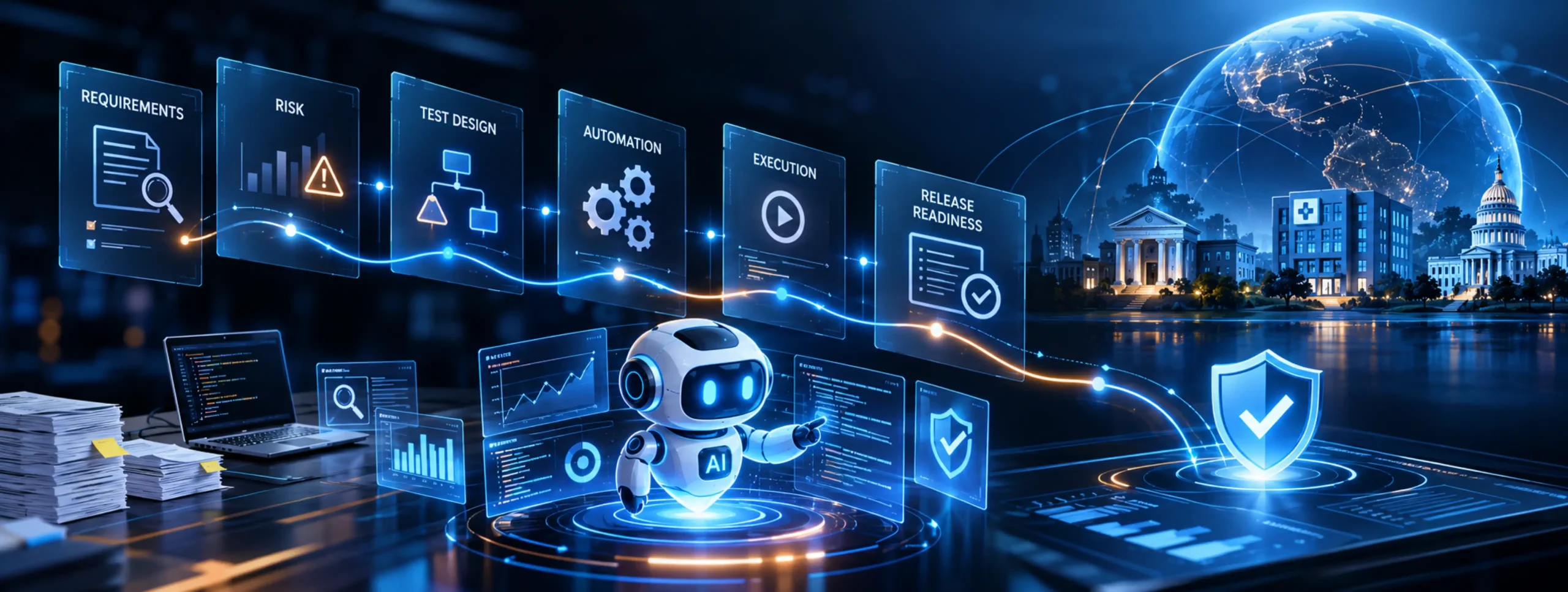
As an example, consider SAP transformation programs. As more organizations migrate from legacy SAP ECC to SAP S/4HANA, manual testing becomes an impractical quality roadblock due to the scale and frequency of changes. By integrating QMentisAI for automated test design, Tricentis Tosca for execution and analysis, LiveCompare for change impact detection, and qTest for centralized test management, enterprises gain end-to-end visibility across the SAP lifecycle. This approach reduces risk, improves efficiency, and delivers actionable insights from requirements through to release readiness.
Extending this foundation is ValidAIte, QualiZeal’s AI assurance and governance framework designed to meet enterprise-grade needs for reliability and trust in GenAI systems, including AI copilots and conversational interfaces embedded within packaged applications. ValidAIte embeds Quality Engineering across the AI lifecycle, spanning training, validation, deployment, monitoring, and retraining. Together, these capabilities introduce a missing layer between AI innovation and enterprise trust. They enable organizations to govern and validate systems across key assurance dimensions:
- Functional assurance to ensure core business flows remain intact.
- AI assurance to validate the accuracy, fairness, and explainability of outputs of AI copilots.
- Ensure process assurance to maintain configurations, workflows, and integrations in alignment.
- Operational assurance to support performance, resilience, and release readiness.
Regulatory readiness with the assurance and automated documentation to meet audit and compliance requirements such as SOX, HIPAA, and GDPR.
Why Continuous Quality Requires a QE partner, not just Tools
Enterprises don’t need just another plug-and-play tool provided by a tool vendor. They need a QE partner that brings an automation-first, AI-native, and platform-powered discipline, such as QualiZeal.
Our approach is grounded in an AI-ready workforce and deep domain QE expertise. With over 600 Tricentis-certified professionals, we bring one of the world’s largest pools of certified QE talent capable of leveraging industry-leading AI-powered tools and validating AI behaviors, testing complex enterprise systems, working alongside autonomous agents, and interpreting AI-driven insights.
Additionally, QualiZeal’s depth in packaged application testing across platforms such as Salesforce, SAP ECC, S/4HANA, Workday, Guidewire, and other industry-specific systems is another compelling differentiator that enables enterprise clients’ digital transformation initiatives. Our delivery model is based on domain-aligned pods with cross-functional teams that can understand unique release cadences, configuration-driven risks, and industry-specific workflows. This way, we ensure that our quality strategies are not generic but tailored to the realities of each platform and business context.
Ready to partner with AI-native QE leaders to keep pace with the evolution of packaged enterprise platforms?
Connect with us to unlock the full potential of your enterprise application investments.