
The end of 2025 is here. Across industries and geographies, one thing that is impossible to ignore is that change is continuous and not episodic. The relentless momentum of change compels a reflection on what intelligence means in today’s AI-driven world. Because the worldview of intelligence is not limited to the raw, human-like cognition. Globally, enterprises seek purposeful intelligence to comprehend whether their AI systems are accurate, ethical, and reliable, and also capable of delivering tangible outcomes in enterprise contexts. This year’s QE Conclave 2025 reaffirmed this perspective more clearly than any single report or analyst prediction.
With QualiZeal as the title sponsor, this year’s edition strengthened the mission of designing a practitioner-led forum for the entire ecosystem, ranging from emerging startups to large global enterprises. We were joined by speakers from Southwest Airlines, Everest Group, Broadridge India, PlatformBuilds, and Mastech Digital, bringing deep industry perspectives.
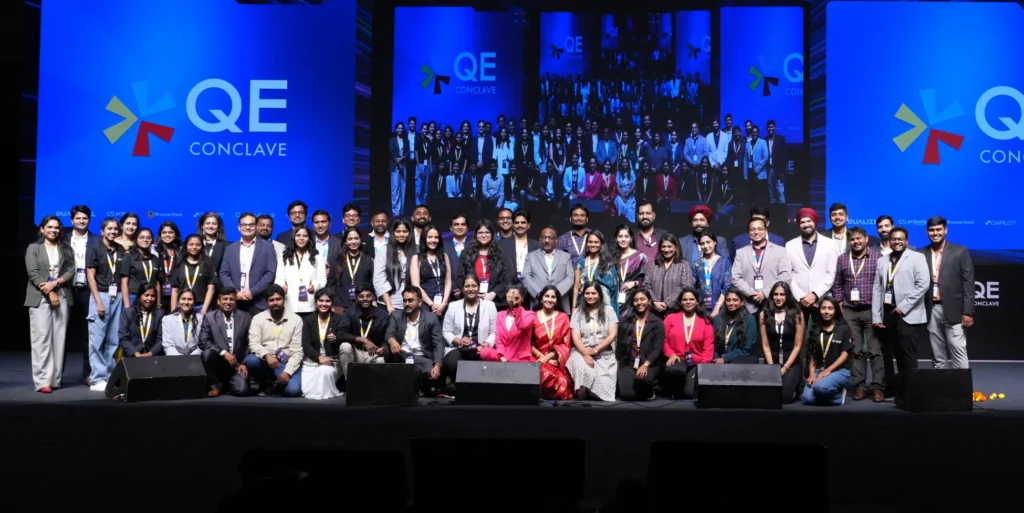
Our sponsors, pCloudy, BrowserStack, QApilot, ContextAI, and Synthesized, added tremendous value through technology insights and thought leadership. The QE Conclave also became the ideal stage to unveil QualiZeal’s own ValidAIte™—representing our commitment to QE for AI in front of over 1,000 attendees from 400+ companies.
And this year, in terms of scale, depth, audience reach, partner participation, and thought leadership, QE Conclave exceeded even our boldest expectations. Read the blog for distilled insights from the panel discussion at the QE Conclave on the theme, The Trust Imperative: Reimagining QE for an AI-first future.
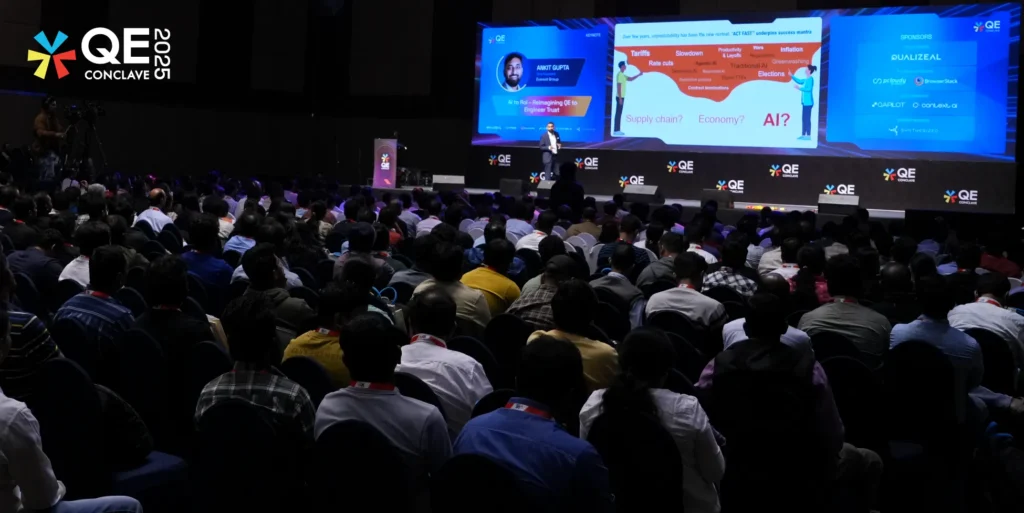
A Forum for Real Ideas, not Slogans
QE Conclave 2025 was a nexus of ideas, practical experiences, leaders’ visions, and cross-industry dialogue that reinforced trust as the defining quality metric for modern enterprise systems. The event featured keynotes from several industry veterans, and an analyst talk that bridged AI with enterprise ROI. It included hands-on tech sessions, partner booths showcasing cutting-edge tools, and the official premiere of ValidAIte, QualiZeal’s AI assurance platform with a real-world use case from the insurance domain.
The Trust Imperative: What QE Conclave 2025 Taught Us About Change, AI, and Quality Engineering
Lately, the conversation about AI has undergone a dramatic shift from scepticism to leveraging AI initiatives as a strategic business opportunity. AI is already impacting real customers, enterprise operations, and business decisions. While its adoption is accelerating, the impact of trust and value has not kept pace with the scale of investments and expectations. The recent MIT GenAI Divide 2025 report’s findings, which indicate that 95% of GenAI implementations are failing to deliver value, demonstrate a widening gap between adoption and meaningful outcomes. This value gap is now one of the most urgent issues that the QE community must address by testing AI systems with proof, not just promises. Our discussions explored the role of AI across aviation, payments, financial services, software development, testing, and the data engines that power AI systems. The panelists agreed on a central theme that trust engineering must be built into the SDLC and STLC—not added as an afterthought.
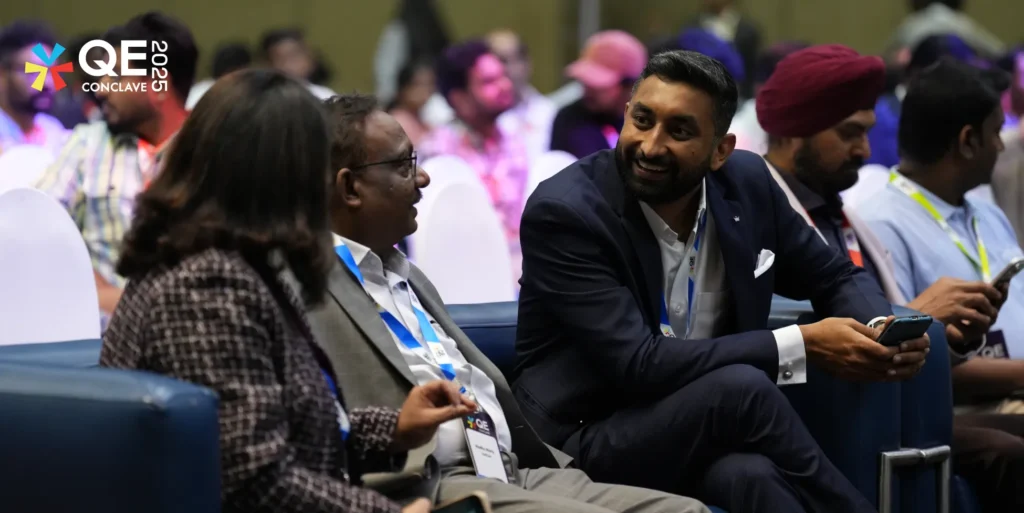
The panel discussion, “The Trust Imperative: Reimagining Quality Engineering for an AI-First Future,” was moderated by Anurup Gaurav, AVP and Head of Marketing at QualiZeal. The session brought together esteemed panelists who are leaders with diverse backgrounds and insights that shaped rich perspectives about AI in the present world and the future:
- Madhu Murty Ronanki: Co-Founder and Head of India Operations, QualiZeal, with four decades of experience in software testing, QE, and digital transformation across global enterprises. Madhu’s long view on the evolution of the QE industry, technology landscapes, and their intersection with quality set the tone for the discussion.
- Jyoti Rai: Managing Director of Technology at Southwest Airlines, leading transformative engineering initiatives in an industry where reliability and safety are non-negotiable.
- Kavita Bhanwadia: Head of Platform Engineering at Broadridge, experienced in AI/ML, solution architecture, intelligent automation, and building inclusive systems that drive measurable business impact.
- Shiva Kumar RV: Founder of PlatformBuilds and former architect of India’s national payments infrastructure at NPCI, bringing a perspective rooted in scaling mission-critical systems where trust is a foundational requirement.
- Jitendra Chakravarty Putcha: Chief Delivery Officer at Mastech Digital, a veteran data and quality leader with deep expertise in data governance, analytics, and real-time validation frameworks.
A Hype to Reality: Rise of AI and Role of Quality Engineering
The panel opened with a question, Is AI a bubble? During 2023, AI was anticipated. In 2024, it was adopted. In 2025, it has become pervasive, evolving from basic chatbots and assistants into intelligent systems and autonomous agents. Madhu’s response set the intellectual foundation for the discussion. From his vantage point, AI is far more than a fad. In fact, he declared it to be the most powerful general-purpose technology that humanity has ever built. As he noted, its value is not in hype or novelty but in how enterprises choose to harness it.
“Yes, financial bubbles may form around infrastructure and speculative investments,” he said. “But as a technology, AI is solid. It will change how work is done, including quality engineering, making some processes extraordinarily efficient and others more demanding of human judgment.”
This insight was acknowledged across the panel: AI is real, but enterprises are still wrestling with where, when, and how to use it effectively. As Kavita pointed out, the foundation of AI is rooted in principles derived from how humans think, a combination of science, mathematical reasoning, and pattern recognition. That foundation is strong, yet, like the cloud before it, there will be cycles of adoption, refinement, retreat, and re-adoption as organizations learn the proper use cases.
Building on MIT’s report findings, Jitnedra clarified that the problem is not AI itself; the problem is how enterprises approach it. Far too often, organizations deploy AI piecemeal, buying models and building interfaces, without reimagining the systems that underpin their enterprise operations. The top 5% of the enterprises succeed in their AI mission not because they have the best talent or tools, but because they revisit their assumptions and redesign systems with comprehensive frameworks, guardrails, and integration strategies.
“This isn’t about blaming AI,” he argued. “It’s about embracing systems thinking instead of isolated experimentation. If we do that, the narrative can flip, and 95% success becomes possible.”
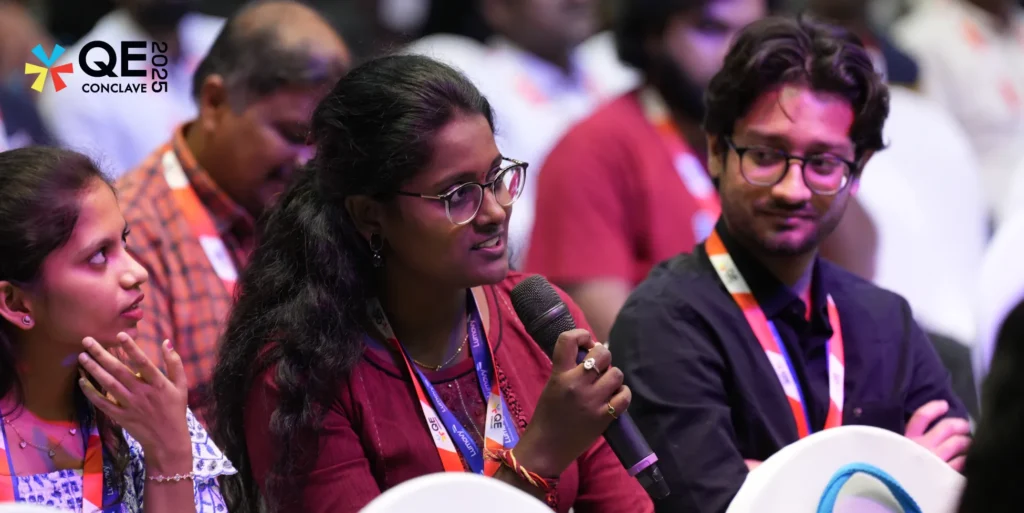
Trust at Scale: Engineering Confidence in Everyday Systems
Few ideas commanded as much attention and a spotlight as the discussion around trust, as an engineering imperative. Shiva’s reflections bridged the gap between the abstract and the operational. By drawing on his experience of building India’s retail payments infrastructure, he highlighted a simple truth that systems that billions depend on cannot have any room for surprises. In the payments industry, trust is not earned by flashiness or intelligence for its own sake; it is earned through predictability, error-free execution, and resilient architecture.
His rule book for engineering trust began with one principle: AI must be boring. Boring, in this context, means dependable, predictable, and free of surprises. It means favoring design patterns like versioning, shadow modeling, and staged deployments that build confidence over time. In systems where failure has systemic consequences, trust is not a feature; it is a contract and a mandatory requirement.
Shiva’s description of inferencing engines with safe fallbacks, error handling, and model version control could easily apply to critical enterprise systems of any kind. His overall narrative imparted one key lesson: accelerating intelligence responsibly requires both structure and innovation.
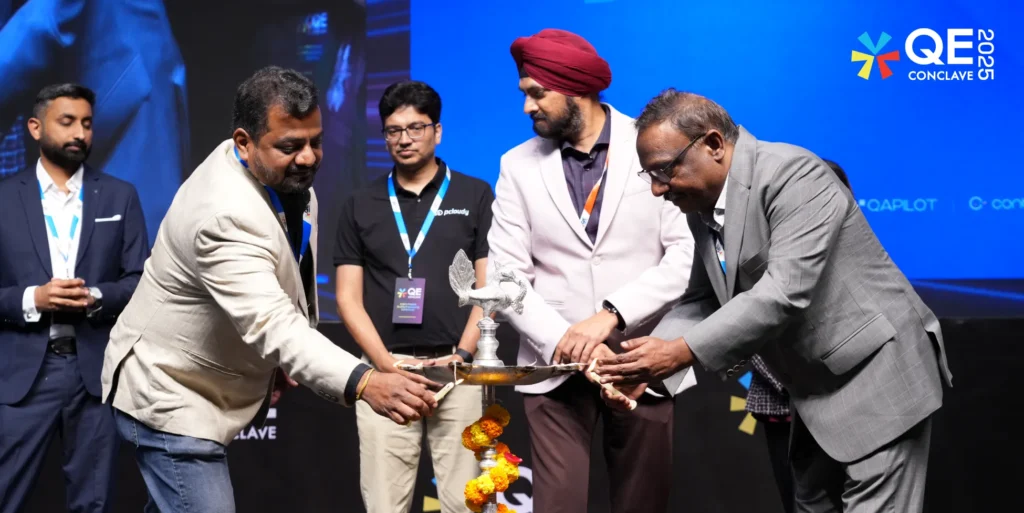
Modernization, Culture, and People
When the conversation shifted to real-world transformation, Jyoti’s experience at Southwest Airlines offered a powerful counterpoint to technology-first narratives. Modernizing at scale, especially in safety-critical and customer-centric industries like aviation and airlines, is challenging enough without introducing unpredictable change on top. Yet Southwest’s journey demonstrated that transformation succeeds when it starts with people. “Change isn’t magic,” she said. “But it begins with a foundation built by the people who understand the work, the pain points, and the pathways forward.”
For Southwest, empowerment came not just through training but also through trust, as teams were given the autonomy to shape the roadmap, define success, and own outcomes. The results were tangible: 30% faster delivery cycles and measurable improvements in engineering quality, without sacrificing operational stability. AI and automation helped accelerate delivery, but culture and clarity of purpose enabled adoption without disruption.
What the Future Holds: Evolving Roles and Collaborative Intelligence
A recurring question throughout the panel was about the future of jobs and human relevance in an AI-driven world. When two of the most frequent questions about AI are “Will it take my job?” and “Will it kill us?”, the panel’s response was grounded in realism and optimism. Madhu explained that models of engagement are shifting, especially in IT and services, but not necessarily in ways that eliminate demand for human expertise. Rather, the nature of work changes from repetitive tasks to roles that require context, orchestration, oversight, and strategic judgment.
Jyoti echoed this by citing an airline founder’s insight: If you don’t change, you die. According to her, the workforce must adapt, augment, and evolve, not resist change. Kavita added the evolutionary perspective: across industrial revolutions, adaptation, not strength or intelligence alone, has determined survival.
In this context, quality engineering is not shrinking but expanding — from checking outputs to orchestrating collaborative intelligence where humans and AI work together. Roles like AI bias testing, AI governance, context engineering, and systems assurance are already emerging as high-impact careers that did not exist a few years ago.
Trust Guides the Next Frontier
QE Conclave 2025 was a mirror reflecting where we stand as an industry and where we must go next. If there is one theme that resonated across the event from keynotes to partner booths, from analyst insights to panel debates, it is this: trust is the foundation of meaningful progress and value-creation in an AI-driven world.
In a world where intelligence lacks a central definition, tools, models, and platforms will inevitably evolve. As technologies continue to grow, regulators will also develop their methods to scrutinize how AI systems serve the broader interests of society. But trust that is engineered through discipline, observability, governance, and human collaboration will remain constant.
As we look towards 2026, enterprises that embed trust into their quality engineering DNA will not only survive change but also define it. The next stage in QE is about orchestrating the optimal blend of human expertise and AI. This evolution marks a decisive shift from Quality Engineering to Quality Intelligence.
Connect with us to discuss your enterprise’s quality goals for 2026.