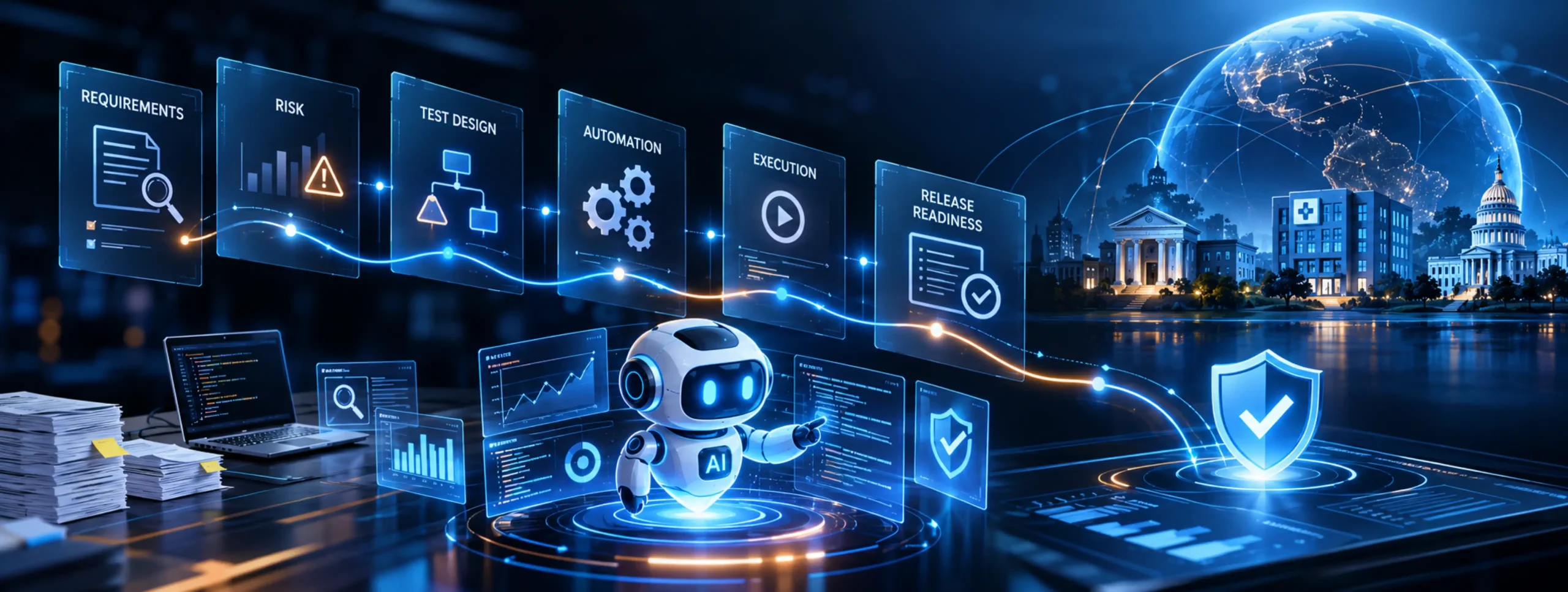

According to a PwC Survey, the buying decisions of over 73% of customers are influenced by customer experience (CX). Nearly 82% of customers are likely to return for future purchases with an emotionally connecting brand. Positive experiences often drive customer loyalty and brand advocacy. Modern Quality Engineering in retail can be a compelling force that enables businesses to keep up with the demands for customer-centricity and the growing influence of generational shifts.
Moreover, becoming relevant in today’s digital and AI-driven markets requires a proactive approach to embed quality throughout retail workflows, products, apps, and systems.
Read the blog to understand how modern Quality Engineering helps retailers move over ‘reactive approaches’ by prioritizing quality control from the start at the technology and process level to deliver seamless, digital CX.

Competition for Seamless Digital Experience
Today’s customers are familiar with AI-driven interactions while digitally engaging with brands. The responsiveness, frictionless, and elastic customer support from businesses drive modern retailers to go beyond conventional strategies. Having an excellent CX tech stack is essential for achieving a desired level of optimization that starts with understanding:
- Customer behaviors and psychographics
- Customer journey maps
- End-to-end retail workflows
- Phygital (digital and physical) touchpoints
- Existing retail management (RMS), CRM, and other platforms
Quality Engineering in retail has become the frontline force driving superior digital and in-store experiences. QE engineers are involved across phases of development of retail digital, in-store, and POS systems to investigate their efficiency, user navigation, overall usability, performance, load speed, checkout, and more.

From Checkout to Loyalty: How Quality Engineering Elevates Every Retail Interaction
Let’s examine how Quality Engineering in modern retail also helps maintain consistent and reliable CX across digital and physical touchpoints:
Retail Digital Resilience
The retail industry experiences the highest cost of downtime averaging $287 million. Downtime costs include direct costs (loss of revenue, backup recovery costs, productivity loss, legal fines, etc.) and indirect costs (shareholder value, brand reputation, etc.).
Quality Engineering prevents such costly digital breakdowns during high-traffic retail periods. Simulating peak traffic loads and edge scenarios during development and testing ensures that websites and apps perform under pressure. This helps retail businesses predict and maintain performance capacity, especially during events like Black Friday and other seasonal sales.
Quality Engineering also helps retail enterprises modernize their ERP systems, leveraging automation and performance testing to identify bottlenecks and upgrade customer-facing platforms and applications to reduce site or cart abandonment. Quality Engineers perform stress and endurance testing for mobile app devices and operating systems, cross-browser testing, load testing, and UI/UX validation to improve their digital resilience.
Bug-free Apps: From First Tap to Checkout
Every bug-free second matters in retail. Reports also state that nearly 82% of consumers abandon carts due to poor UX. Retail quality assurance is the best solution here, ensuring smooth payment flows, fast-loading mobile apps, and responsive design. It also ensures secure transactions by helping retail businesses comply with Payment Card Industry Data Security Standard (PCI DSS) and General Data Protection Regulation (GDPR) requirements.
Retail QE applies functional testing, combining test automation and RPA, to deliver reliable and user-friendly retail software. By applying gateway validation and data security testing, Quality Engineering helps ensure the retail apps function exactly as intended without the risks of downtime from bugs or errors.

Reliable In-store Retail Tech Ecosystem
52% of U.S. shoppers report that waiting to pay, often due to malfunctioning or slow payment kiosks, is a significant source of frustration during in-store shopping. The retail and consumer goods (RCG) sector may face substantial losses due to insecure and slow payment systems. Quality Engineering addresses this issue by ensuring the efficient operation of POS systems, digital signage, inventory apps, and self-checkout kiosks. It also helps prevent pricing errors, checkout delays, and other hardware malfunctions.
The process happens by automating test cycles and enabling real-time issue detection. With hardware-software integration testing, simulated POS device lab testing, regression testing, and system uptime assurance keep the in-store retail tech ecosystem up to speed. Modern Quality Engineering services also include A/B testing for retail marketing campaigns at target audiences to predict and optimize performance.
Product Quality Assurance with Every Item on the Shelf
74% of customers say product quality is the most important factor in keeping them loyal to a brand.
Quality Engineering in retail helps businesses collaborate with vendors to validate product specifications, safety, and durability ahead of shelf placement. This leads to a streamlined process that reduces returns, increases satisfaction, and upholds the brand promise. QE solutions for product quality assurance include:
- Pre-launch Product Validation: Identifies defects and design flaws early to avoid costly recalls or reputation damage.
- Supplier Quality Assurance: Ensures vendors meet predefined safety, durability, and compliance benchmarks.
- Failure Mode Testing: Detects potential product failures under stress or varied usage to prevent customer dissatisfaction.
Consistency Across Channels = Loyalty
QE practices ensure continuity and alignment across all customer touchpoints. Businesses can easily implement end-to-end scenario testing to simulate the customer journey and identify friction points early. Quality Engineering in retail also supports omnichannel journey assurance. This helps ensure that all systems related to inventory, payment, and customer support interact flawlessly across digital and physical platforms. By conducting rigorous quality checks and executing coordinated test strategies, brands can guarantee consistency across service quality no matter where the interaction happens.
The result? Dependable, repeatable experiences with end-to-end scenario testing strategies that promote long-term brand loyalty.
Data-Driven QA for Customer-Centric Optimization
Experiments that significantly change CX, especially those involving multiple elements, outperform simpler A/B tests. That’s the tangible impact of robust data-driven testing on CX outcomes.
Quality Engineering ensures that businesses are able to leverage their real-time data to help explore the patterns behind common customer frustrations, such as frequent app crashes, slow-loading pages, or abandoned carts during checkout. These insights enable teams to detect and resolve issues faster and anticipate potential problems before they impact users.
Data-driven QA creates a continuous feedback loop in which insights from user behavior, support tickets, and system logs are fed back into the testing cycle. This loop allows QE teams to conduct root cause analysis, test high-risk scenarios, and prioritize fixes that will most impact the customer journey.
Moreover, brands can proactively fine-tune digital touchpoints, enhance usability, and ensure system performance meets rising customer expectations. This is usually achieved by integrating advanced analytics into enterprise Quality Engineering processes.

Quality as a Brand Differentiator
In a hyper-competitive market, quality becomes a key differentiator that shapes customer perception and brand equity. Buyers’ willingness to return to the same retail brand stems from a growing expectation of consistent and satisfying interactions across all platforms.
When customers receive a high-quality experience, they begin to associate the brand with reliability, innovation, and trust. This emotional connection often becomes the deciding factor in repeat purchases, recommendations, and overall loyalty.
Quality Engineering plays a key role in modern retail transformation. It embeds continuous improvement cycles, test-driven development, and customer satisfaction testing. It helps retail brands anticipate issues before they reach the customer and enforces uniform standards across channels, such as mobile apps, e-commerce platforms, and in-store systems.
More than just preventing defects, retail Quality Engineering improves brand image by enabling the consistent delivery of exceptional experiences. Continuous improvement ensures product and service quality evolve with customer expectations and market trends. Test-driven development helps catch issues early in the cycle, while customer satisfaction testing ensures real user feedback is integrated into every release.
Over time, this builds a foundation of trust that attracts new customers and turns existing ones into brand advocates.

The New Retail Battleground Is Quality
Quality Engineering in modern retail has become a strategic imperative for businesses worldwide. You no longer need to depend on outsourcing for digital storefronts or payment security assurance. All you need is a trusted quality-focused partner offering retail-quality assurance for positive business outcomes.
Are you looking to engineer flawless CX in retail? Connect with our experts at QualiZeal for more information about AI-powered Quality Engineering in retail. From back-end systems to the checkout lane, we ensure the most customized solutions for success.