
In 2026, MedTech innovation is at the cusp of transformation driven by AI, patient-centric models, and ever-evolving compliance expectations. Despite macro uncertainties and a turbulent global trade ecosystem, last year the industry emerged with increased revenue reaching $584 billion, increased investments, and rapid integration of AI and digital innovation. While the MedTech space performed strongly, demonstrating its growth appetite and readiness for further innovation, the risk of outpacing the compliance models built to support it lingers strongly.
The new mandate is no longer restricted to product innovations and their downstream impact on business value. The impact is measured directly in terms of patient outcomes, contribution to clinical support and precision, and support to preventive care interventions. GenAI and agentic systems are at the forefront of this wave of change. Connected platforms, AI-enabled imaging systems to deliver multi-dimensional diagnostics, AI-native platforms that support personalized and real-time clinical decision support, and cloud-based engineering workflows aren’t edge cases anymore. They strongly represent the maturity level at which AI-powered MedTech platforms and systems are designed, tested, and released.
That creates a genuine bind for quality, regulatory, and engineering leaders. Their priority is to move fast enough to stay competitive, but not so fast that patient safety, audit readiness, or regulatory confidence slips.
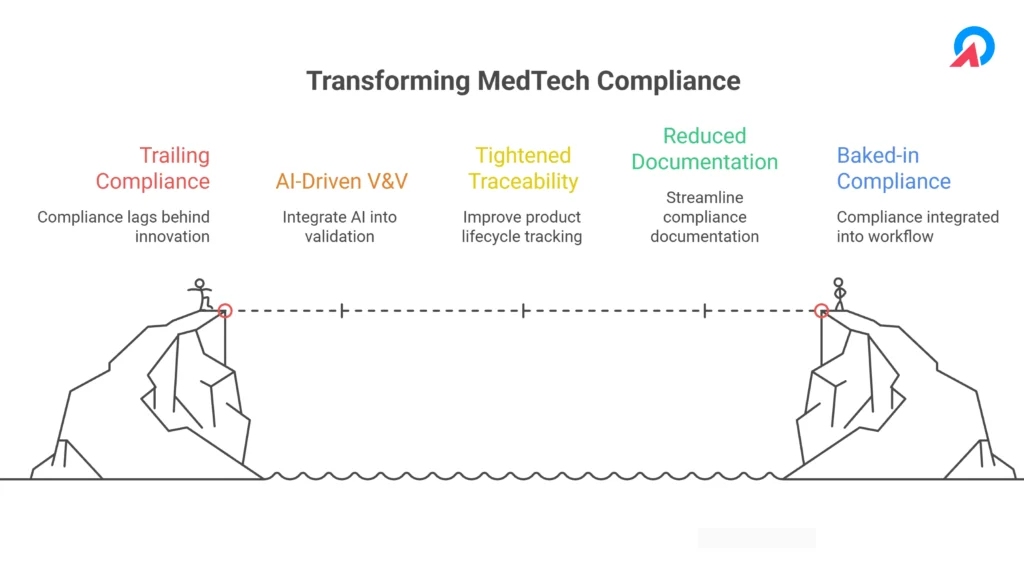
Read the rest of this blog to understand how AI-driven validation and verification (V&V) is the answer to that bind. AI-driven V&V can tighten traceability, reduce documentation overkill, and transform compliance into a de facto workflow baked into the product lifecycle instead of trailing behind it.
Why Compliance Got Harder
Medical device systems and platforms are not just about building hardware designs and overseeing a handful of controlled software releases. Today, MedTech is a confluence of connected health models blending medical devices, remote monitoring tools, digital engagement systems, and home-based care that integrate AI/ML models, cloud connectivity, cybersecurity obligations, and post-market monitoring.
The FDA has acknowledged this shift directly: AI/ML-enabled software can learn from real-world use and experience, and that learning behavior introduces regulatory considerations that span the entire product lifecycle, not just the release point.
For MedTech organizations, the implication is straightforward but uncomfortable: compliance can’t stay a static, end-of-development paperwork exercise. It has to become something that’s built in and updated continuously as the product changes.
Where Traditional Validation and Verification Falls Short
For decades, traditional methods of MedTech V&V have focused on confirming whether systems are fit for purpose, requirements are tested, and evidence exists when auditors come asking.
However, this is suitable for the pace MedTech now moves at. The cracks show up in predictable places:
- Testing documentation scattered across disconnected tools, with no single source of truth.
- Traceability between requirements, risks, code, and tests that lags behind actual development
- Impact analysis does not reflect dynamic changes.
- Compliance gaps that surface at a later point and sometimes during the post-release stage
- AI-enabled systems evolve post-deployment in real production environments due to changing data patterns, probability-based data generation, and hallucinations.
With agile delivery pressures, these issues compound. While development sprints move in days, compliance evidence takes longer (almost weeks) to catch up. In a highly-regulated environment like MedTech, this lag creates a risk of non-compliance, legal fines, and reputation damage.
From One-time Paper-based Documentation to Continuous Compliance
Static documentation, siloed systems, and reactive audits have taken a backseat and moved toward real-time, risk-based system tracking. And with AI becoming a part of the Good x Practice (GxP)-regulated systems, traditional methods of validating MedTech platforms are insufficient to flag risks that result in compliance errors. The International Society for Pharmaceutical Engineering (ISPE)’s Good Automated Manufacturing Practice 5, or GAMP 5, framework advocates a risk-based approach to validating computerized systems. The newer GAMP guidelines extend to AI-enabled systems operating in GxP environments, with patient safety, product quality, and data integrity as the throughlines. For MedTech companies, this means that the V&V approach must evolve beyond functional testing to include continuous evaluation of AI behavior, traceability, human oversight, and evidence-based assurance.

Rather than keeping validation as a periodic evidence-gathering exercise, it has to become a form of continuous assurance where every requirement, risk, design decision, code change, test case, defect, and approval stays linked across the full lifecycle, not just at milestone reviews.
How AI Actually Helps in V&V
AI has been a primary driver for ditching repetitive, manually driven tasks. But to maximize its value without cutting corners on compliance, AI must not replace human judgment. The overarching objective is to give quality and regulatory teams faster, more consistent, and more visible insight into what’s already happening. Below are some of the common ways AI-powered capabilities amplify MedTech devices compliance validation and verification:
Intelligent traceability:
AI can demonstrate how test requirements connect to risks, design controls, test cases, defects, and release evidence, which is core to MedTech compliance. AI can identify missing links, surface relationships between test artifacts and compliance requirements that might otherwise go unnoticed. It helps assess test coverage gaps that the Quality Engineering team can identify and address before the auditor does. The payoff is fewer fragmented evidence trails and stronger audit posture overall.
Faster change impact analysis:
Dynamic changes to the product can ripple into requirements, risks, tests, documentation, and release readiness. AI can help map test and device artifacts with the changes to flag areas that need more validation. This task is hard to achieve using manual approaches, especially in agile environments where changes land constantly. For AI-enabled devices specifically, this matters even more, since modifications can shift safety and effectiveness profiles across the lifecycle. The FDA’s draft guidance on AI-enabled device software functions points toward exactly this kind of lifecycle-based risk management for marketing submissions.
Automated documentation support:
MedTech compliance documentation consumes administrative and operational bandwidth. AI can generate, summarize, and organize it directly from connected lifecycle data, including requirements evidence, test summaries, risk linkages, approval records, release documentation, etc. Audit-ready report generation and documentation enable better compliance efficiency.
Risk-based test optimization:
Not every requirement carries equal weight. Some workflows have a direct impact on patients. AI can help prioritize validation effort based on risk level, change history, defect patterns, and system criticality, so the deepest testing goes where it actually matters. This aligns with the GAMP’s broader principle of scalable, risk-based validation rather than applying uniform rigor everywhere.
Continuous audit readiness:
Scrambling to assemble evidence right before an audit shouldn’t be the norm. AI-driven workflows that keep evidence trails, such as requirements, risks, tests, defects, approvals, and release records, continuously updated provide MedTech organizations a much steadier foundation for regulatory submissions, internal audits, and quality reviews alike.

How QualiZeal Strengthens AI-Driven V&V for MedTech
For MedTech organizations, AI-driven validation and verification has to be more than a layer of automation bolted onto existing processes. It needs regulatory awareness, lifecycle traceability, intelligent testing, human oversight, and audit-ready governance working together, not as separate initiatives.
QualiZeal builds this through its AI-first Quality Engineering approach to assure traditional, GenAI, and agentic systems, anchored by two in-house, IP-led platforms, QMentisAI and ValidAIte.
QMentisAI: Intelligence for Next-Gen Quality for Traditional Software.
QMentisAI leverages GenAI and agentic capabilities to accelerate quality workflows across the testing lifecycle requirements, test planning, test design, defect analysis, and optimization. In validation and verification of MedTech systems and platforms specifically, it supports requirement-to-test scenario generation, risk-based test design and prioritization, defect analysis and clustering, validation coverage insights, and regression optimization as requirements shift. The net effect of leveraging QMentisAI as a Quality Lifecycle Management platform is enabling testing teams to move away from manual, fragmented testing approaches and implement intelligent automation across the lifecycle, making it genuinely connected, trackable with reporting, quality risk insights, and self-healing.
ValidAIte: Assurance for the GenAI and Agentic Systems.
ValidAIte provides AI assurance for systems used in regulated settings like healthcare and life sciences where trust and risk management aren’t optional extras. For MedTech teams, the platform strengthens AI governance and compliance readiness, model risk assessment, bias and drift and performance validation, audit-ready evidence generation, and lifecycle traceability.
Together, the two platforms give MedTech organizations a complete ecosystem for V&V where speed, compliance, and patient safety aren’t competing priorities. The platforms are purpose-built to help them move forward together.
The Business Case for MedTech Leaders

The value here isn’t confined to compliance teams. In the MedTech industry, compliance and governance responsibility spreads across the organization. Engineering teams need a leg up in processes that guarantee less repetitive documentation work and provide clearer visibility into test coverage. Quality teams get stronger traceability, sharper risk management, and better audit readiness. Regulatory teams gain submission confidence because the evidence behind it is complete, current, and connected rather than assembled at the last minute and can be readily shared with the audit teams.
For business leaders, the impact compounds further: faster release cycles, less compliance rework, better product quality, stronger audit preparedness, and tighter alignment between innovation and patient safety.
At QualiZeal, we help MedTech and life sciences organizations modernize Quality Engineering through AI-first validation approaches, built around QMentisAI and ValidAIte.
Is your enterprise looking to strengthen compliance, speed up validation, and build genuinely audit-ready AI systems?
Connect with our experts to talk through what a quality transformation could look like for your MedTech platforms and systems.