
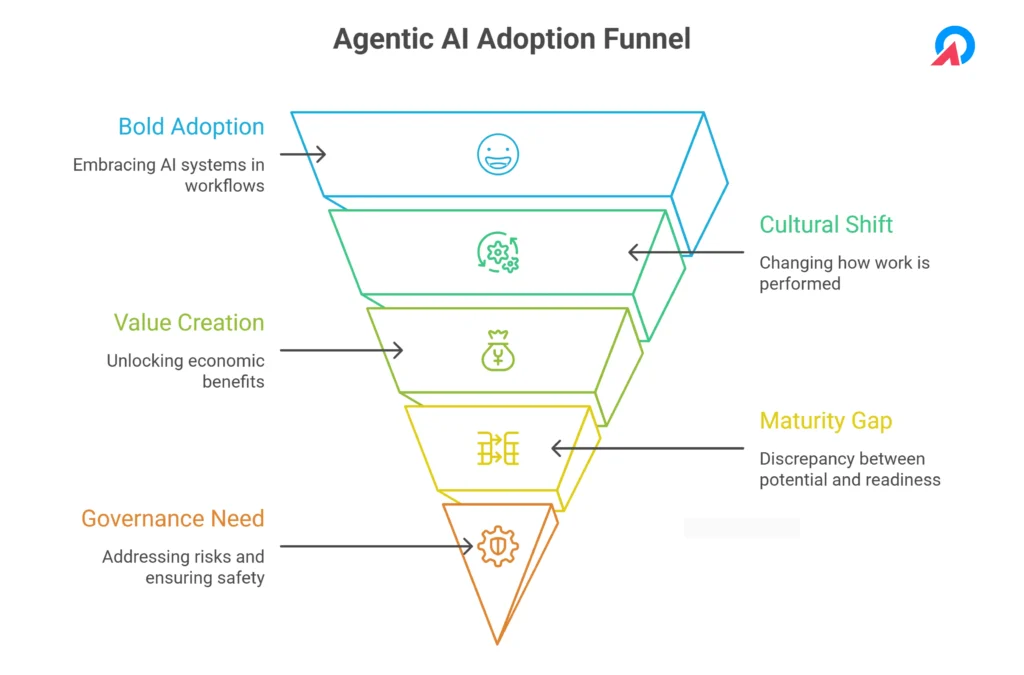
Enterprise conversations around AI have moved from skepticism to bold adoption. With agentic AI systems now growing in prominence across critical workflows, this shift isn’t about chasing the next shiny thing. In fact, autonomous systems represent a cultural shift in how work gets done: agents reason and execute tasks, and humans step in at specific control points rather than supervising every action.
The upside of the agentic wave is enormous. McKinsey projects agentic AI could unlock somewhere between $2.6 trillion and $4.4 trillion annually in value across more than 60 generative AI use cases, including customer service, software development, supply chain optimization, compliance, and more. But only 1% of surveyed organizations report having reached real maturity with agentic AI, and 80% say they’ve already encountered risky agent behavior, including improper data exposure and unauthorized system access.
That gap between opportunity and readiness is why CIOs, CROs, and CTOs now carry a new responsibility: bringing agentic governance up to speed and looking well beyond the governance programs originally built for generative AI models and their outputs.
Part of that shift requires a change in perspective. Governance can no longer be a policy document that theoretically describes the rules of the game. A policy offers no guarantee that an agent will actually act on those rules, or that its decisions are accurate and explainable. It doesn’t expose the failure modes an agent will encounter in the real world. It covers risks that are likely to emerge in controlled test scenarios but stumbles when conditions get messy.
Through this blog, there’s another misconception worth addressing: AI governance and governance testing are not the same thing. Read this article to explore what governance testing actually means for autonomous systems that can plan multi-step tasks, call APIs, move data between systems, and get work done with very little human handholding.
AI Governance vs. Governance Testing: The Thermostat Analogy
Here’s a simple way to think about the difference. Imagine a thermostat set perfectly to 20°C. That’s governance — a configuration, a rule, a stated intent. Now imagine walking over with a thermometer actually to check whether the room is 20°C. That’s governance testing.
AI governance defines the rules and the guardrails. Governance testing is the engineering discipline that goes in and challenges those rules — probing the agent’s policies, safeguards, and control measures to see whether they actually hold up under pressure. AI governance is a statement of intent, and governance testing is verification. Enterprises that only have the former are, in effect, trusting the thermostat’s dial without ever checking the room.
Traditional AI Testing vs. Governance Testing for Agentic AI
This is where the real technical divergence shows up. Agentic systems need a fundamentally different testing approach and not just a heavier version of what already exists.
- The unit under test changes. Traditional AI testing is largely an exercise against a fixed model artifact: given an input, does the system produce an acceptable output? It’s a single-inference problem. Agentic systems break that model completely. When an autonomous system is making decisions, invoking tools, and coordinating with other agents, the unit under test shifts from a single inference to a trajectory — an entire chain of reasoning, tool calls, and state changes that has to be evaluated as a whole.
- Determinism disappears. Traditional AI outputs can vary or be wrong, while sounding plausible and confident. With agentic systems, non-determinism exists across runs, driven by sampling, dynamic context, and the state of the environment. The same agent, given the same task, can take a different path every time.
- Validation scope expands. Traditional validation centers on accuracy, precision/recall, F1, AUC-ROC, calibration, and bias/fairness against static datasets. Agentic systems need a broader lens to understand whether the agents’ planning processes are sound, whether they are selecting the right tools for the right reasons, and whether the parameters are correct. Do they tend to drift from their goal across a long, multi-turn context? And what’s the task completion rate once you introduce the noise of a real environment instead of a clean test bed?
- The attack surface widens. Traditional AI risk shows up as data poisoning, biased training sets, membership inference, and direct prompt injection. Agentic systems inherit all of that and add a new layer where indirect prompt injection gets buried in a document or webpage the agent reads mid-task. Agents also carry the risk of memory or context poisoning that persists across sessions, where one compromised agent can influence others in a multi-agent system. They can experience privilege escalation, where an agent chains together access it was never meant to have.
- Guardrail testing gets sequential. Traditional guardrail testing checks input/output filters on a single response. Agentic guardrail testing has to hold up across an entire sequence to understand whether the agent stays within its approved action logic set over 20 steps, intervenes human reviewers at the right checkpoints, and respects hard limits like API call caps, spend ceilings, and rate limits, even under pressure to finish a task.
- Identity and access become a testing concern. This barely registers at the model level in traditional testing. But agents typically hold service credentials or scoped API tokens. Hence, governance testing has to validate credential scoping, session isolation between users and tenants, and confirm an agent can’t use one tool’s output to gain access that was never granted elsewhere.
- Traceability has to be reconstructable, not just logged. Traditional testing logs input/output pairs, maybe with an explanation layer like SHAP or LIME for a single prediction. Agentic governance testing requires full decision-trail logging — chain-of-thought where available, every tool invocation with its parameters, intermediate state, and the rationale behind each branch point. That trail has to be complete, tamper-evident, and reconstructable on demand, because that’s exactly what regulators under the EU AI Act, NIST AI RMF, or ISO/IEC 42001 will ask to see.
- Failure modes compound. Traditional testing looks for mispredictions and edge cases. Agentic systems fail differently — a small hallucination early in a chain corrupts every step that follows. Add the risk of runaway loops, agents that hallucinate a fake tool response instead of retrying sensibly, and orphaned, half-completed multi-step transactions.
- Testing needs a real environment, not a dataset. Static test data is enough for traditional systems. Agentic systems need sandboxed, high-fidelity simulation environments that mimic real tools and APIs — including realistic latency, errors, and rate limits — so agents can run actual multi-step tasks without touching production.
- Human-in-the-loop becomes a first-class test case. For agents, this has to be explicit: does the system pause correctly at an approval gate, respect a rejected approval, and honor a human override mid-execution?
- Testing doesn’t stop at launch. Traditional testing largely wraps up before deployment, with drift monitoring as a lighter add-on. Agentic systems adapt their behavior as context, memory, and the surrounding tool ecosystem evolve — so governance testing has to extend into production as continuous behavioral monitoring, canary agents, and periodic red-teaming. It’s not a gate you pass once. It’s a discipline you sustain.
Anchoring all of this are frameworks worth knowing: NIST’s AI RMF (its Govern/Map/Measure/Manage structure maps naturally onto an agentic testing program), ISO/IEC 42001 for organizational-level AI management controls, the EU AI Act for risk-tiering and documentation obligations on high-risk deployments, and the OWASP Top 10 for LLM Applications for prompt-injection and tool-abuse risks.

Where ValidAIte Changes the Equation
ValidAIte is QualiZeal’s enterprise-grade assurance framework for GenAI and agentic systems, purpose-built to validate and govern where reliability, fairness, and safety aren’t negotiable. Where traditional QA has always operated on a binary pass/fail outcome, ValidAIte pushes Quality Engineering toward probabilistic governance — measuring how confidently, consistently, and ethically a system performs, rather than simply confirming that it “worked” once.
On the compliance side, ValidAIte integrates globally recognized frameworks like NIST’s AI Risk Management Framework and ISO/IEC 42001 directly into its technical testing. This ensures that governance isn’t just internal best practice living in a slide deck. It’s mapped to the external standards regulators and auditors actually recognize. ValidAIte goes a step further by aligning with the NIST AI RMF, TEVV, the EU AI Act, and QualiZeal’s own internally developed Risk–>Metrics–>Track–> Evidence (RMTE) framework.
At the center of the framework sits the Trust Score, a mechanism that pulls multiple trust dimensions into a single, business-readable output that non-tech stakeholders can also interpret. It helps measure trust across two dimensions that matter most: “valid and reliable,” which tests whether an answer is genuinely grounded in retrieved knowledge or quietly invented; and “accountable and transparent,” which confirms an agentic workflow can show exactly which step it took and why. This ensures the agent’s decisions can be traced, not taken on faith. In practice, that’s RAG-grounding testing paired with decision-trail auditability, the two technical differentiators that separate agentic governance testing from everything that came before it.
The Trust Score Dashboard also functions as a genuine governance decision system. Leaders can use it to decide whether to scale, pause, retrain, or add oversight to a given copilot or agent — and QE teams can finally move from saying “we tested it” to showing precisely what was tested, how, and what still needs attention.
ValidAIte also treats explainability as something that has to be engineered, not bolted on afterward. Explanation becomes a testable artifact in its own right, validated for consistency across similar scenarios, monitored for stability as inputs vary and models get updated, and traceable across the entire lifecycle of the system.

The Bottom Line:
Agentic AI doesn’t fail the way traditional software or even traditional AI models fail. It fails in chains, across sessions, through tools it was trusted to use responsibly. Governance policy alone can’t catch that. It takes governance testing — a discipline that treats verification, not intention, as the standard for trust.
For enterprises moving agentic systems from pilot to production, that distinction isn’t theoretical.
Is your enterprise looking for t an agent governance and continuous validation framework that can withstand an audit, a regulator, or a bad day in production? That’s the gap ValidAIte was built to close.
Connect with us to book a demo.