


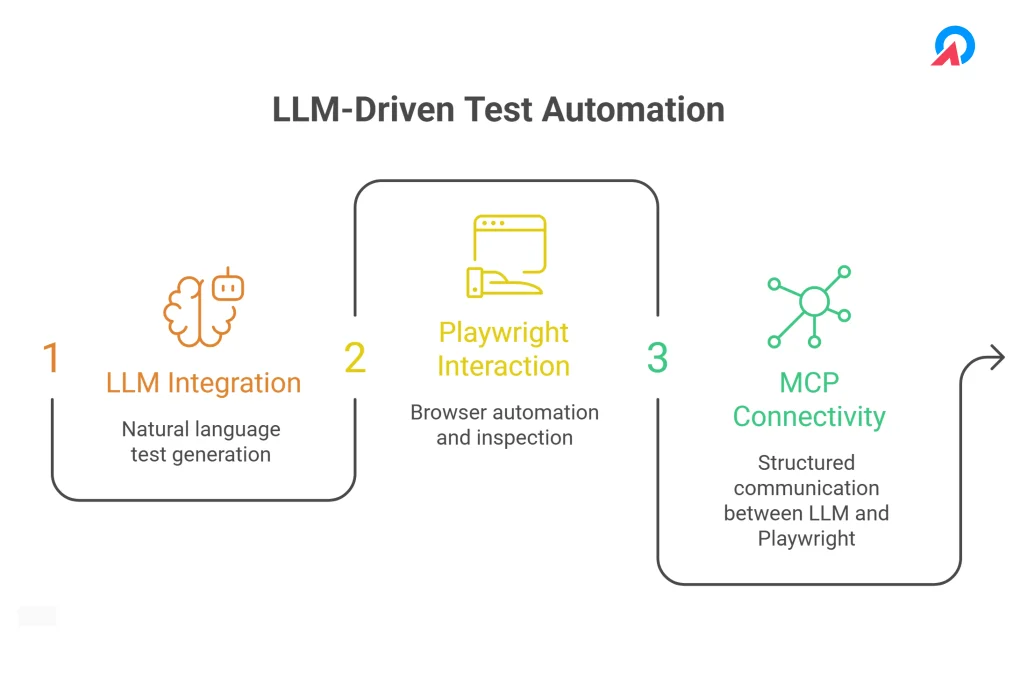
Large Language Models (LLMs) have made test automation smarter, faster, and more adaptive by understanding and analyzing testing requirements to deliver relevant responses. From test case generation to code fixes, they drive coverage and scalability. LLM-ready test automation using Playwright MCP (Model Context Protocol), Quality Engineering teams can leverage it as a smart quality-control assistant. LLMs let testers describe what they need in natural language, while Playwright acts as the testing eyes and limbs that programmatically open, control, and test web browsers. And MCP provides the connectivity for the LLMs to communicate with Playwright and use its browser capabilities.
In 2026, testing teams aren’t short on automation frameworks. They already have Playwright’s modern cross-browser testing with built-in tooling for projects, page objects, utilities, fixtures, locator standards, assertion rules, and review practices. The challenge begins when LLMs enter the workflow. LLMs evolve rapidly, with massive leaps in reasoning and context windows, increasing token usage and eventually enabling better use. At the same time, LLMs carry inherent drawbacks and vary in their ability to generate code, understand system and architectural complexity, or provide contextually relevant suggestions. For instance, a prompt like “generate a Playwright test for checkout” produces code fast. Fast code is not framework-aligned code — it duplicates utilities, hardcodes data, invents brittle locators, and ignores your conventions.
The productivity promise shifts from faster creation to faster correction.
Playwright MCP gives LLM-driven workflows a structured way to interact with the browser and inspect page state. It provides browser automation through the MCP and lets LLMs interact with web pages using structured accessibility snapshots instead of relying only on screenshots or long manual descriptions.
Read through this Part 1 of LLM-Ready Test Automation Frameworks Using Playwright MCP, a blog series, to understand how AI-assisted automation will scale only when LLMs can combine browser interaction, framework knowledge, and governance guardrails. Not when they generate isolated scripts from incomplete prompts.
And the business outcome: faster usable drafts, fewer corrections, better reuse, less duplicate code, and tighter control.
Why Prompting Alone Fails in Test Automation
Most experiments start the same way: “Generate a Playwright test for this user flow.” The LLM answers instantly. The code even looks reasonable. But enterprise automation is not executable code — it is maintainable, reusable, reviewable code that matches the framework: page object structure, existing utilities, data management, approved locators, mandatory assertions.
When those rules are absent from the prompt, the model invents its own.
| AI Output Issue | Why It Happens | Delivery Impact |
| Duplicate helper methods | Existing utilities are not visible | More code to maintain |
| Hardcoded test data | Fixture rules are missing | Poor reuse and data risk |
| Brittle locators | Locator strategy is unclear | Higher flakiness |
| Weak assertions | Validation standards are missing | Lower defect-detection confidence |
| Inconsistent structure | Framework conventions are not available | Higher review effort |
AI can generate automation. The problem is that it generates without browser context or framework context.
What Playwright MCP Actually Adds
Playwright MCP helps solve one side of the problem: browser interaction.
Imagine your Quality Engineering team is testing a website in Japan but do not speak Japanese to understand whether a customer can make a dinner reservation on the site. You LLM-based testing assistants can understand your testing requirements written in prompts. But it needs an interpreter in between to communicate with the website users in Japanese. Playwright interacts with the browsers but would need a communication bridge with the LLM. In this scenario, the automation ends up being fully dependent on someone who can manually know Japanese labels and writing in every touchpoint. Playwright MCP framework will help perform testing in English by providing the right context like a multilingual assistant.
Playwright MCP allows an LLM-driven workflow to navigate pages, inspect structure, interact with controls, and observe application behavior through Playwright-powered browser automation. Its snapshot-based model operates on the accessibility tree, returning page elements as structured text with references the LLM can use for actions such as clicking, typing, and checking controls. (Playwright)
That changes the operating model.
| Without Playwright MCP | With Playwright MCP |
| AI depends mostly on written descriptions | AI can interact with the browser through structured page context |
| Engineers describe pages manually | Page state can be inspected through accessibility snapshots |
| Test steps are inferred from text | Flows can be explored and validated more directly |
| Elements may be guessed | Elements can be referenced from structured snapshots |
| Reviewers correct basic flow gaps | Review can focus more on framework alignment |
Playwright MCP helps the LLM interact with the application. It does not automatically make the LLM understand your enterprise automation framework.
What MCP Does Not Solve
Browser-aware AI does not become framework-aware AI. MCP can inspect and drive a page. It still does not know:
• which page objects already exist
• which utilities must be reused
• which fixtures are approved
• which locator and assertion standards the team follows
• which code patterns are prohibited
In testing terms, MCP still can’t answer what must be tested; it can misinterpret the intent, fail to provide business understanding, and replace a test automation framework. It cannot detect bugs, solve test maintenance issues, or avoid hallucinations.
This is the clean separation:
| Capability | Primary Source |
| Browser interaction | Playwright MCP |
| Existing framework reuse | Framework knowledge |
| Duplicate code prevention | Utility catalog + generation rules |
| Safe AI usage | Governance model |
| Production readiness | Human review + engineering approval |
MCP gives the LLM browser access. Framework knowledge tells it how to contribute.
Governance decides what it may touch.
Playwright MCP improves what the LLM can observe in the browser. But browser context alone is not enough. Teams still need disciplined prompting to define the LLM’s role, intent, task, framework context, expected output, and response format. We will cover this in Part 2 through the RITCOF prompt engineering framework.
Simple QE Example: Checkout Flow
One commerce flow a QE team wants to automate:
Registered user logs in, searches for a product, adds it to cart, applies a valid coupon, completes checkout, and verifies order confirmation.
Without MCP: the engineer hand-describes every button, field, coupon step, and confirmation message.
With MCP: the workflow inspects page state, finds elements, acts, and observes transitions directly.
Application understanding is solved. Framework understanding is not — the LLM still needs rules like these:
| Framework Rule | Expected AI Behavior |
| Use page objects | Do not place all actions inside the test file |
| Reuse login utility | Do not create a new login method |
| Use fixture-based data | Do not hardcode users, products, or coupons |
| Follow locator standards | Avoid brittle selectors and raw XPath |
| Use assertion helpers | Do not validate only with page-load checks |
| Flag missing utilities | Do not invent methods silently |
So the correct model is not:✗ Playwright MCP generates enterprise automation.
The correct model is:Playwright MCP supports browser-aware automation assistance. Framework context and governance make the output enterprise-ready.
That is the foundation of an LLM-ready automation framework.

Human-in-the-Loop and Governance Still Matter
AI-assisted automation must not become uncontrolled generation.
Not this: ✗ AI generates. Team accepts.
This: AI explores, suggests, generates, explains, and flags gaps. Humans review, approve, refine and govern. Human review stays essential: flow accuracy, framework alignment, data safety, assertion quality, release confidence.
There is also a security point. MCP tools can provide powerful browser automation capabilities, so they should be enabled only in trusted environments with clear access, data, and approval controls. The Playwright MCP documentation specifically warns that the unsafe tool for running arbitrary JavaScript in the Playwright server process is RCE-equivalent and should only be enabled for trusted MCP clients. (Playwright)
A practical enterprise setup should define:
| Control Area | Practical Guardrail |
| Environment | Use approved test or lower environments |
| Data | Avoid production credentials and sensitive data |
| Access | Limit MCP usage to trusted clients and users |
| Review | Require human review before merging generated code |
| Auditability | Track AI-assisted changes and review decisions |
Playwright MCP can accelerate the journey. Ownership still remains with QE and engineering leaders.
What Leaders Should Measure
Generation speed is not the metric. The better question: Did AI produce automation that the team can reuse, maintain, and trust?
| Metric | Why It Matters |
| First-pass acceptance | Measures how much AI output is usable without major rework |
| Duplicate code reduction | Shows whether AI is reusing framework assets |
| Review correction rate | Shows how much cleanup is still required |
| Framework alignment | Confirms adherence to page object, fixture, locator, and assertion standards |
| Sensitive data avoidance | Confirms AI is not introducing security or compliance exposure |
The goal is not faster test generation. It is faster, safer, reusable, framework-aligned automation.
Reader Call to Action
Do not start by asking AI to generate hundreds of tests. Start with one flow.
Pick a flow with reusable assets but repetitive test code. Use MCP for browser-aware exploration, give the LLM your framework rules, then ask five questions:
- Did AI understand the application flow better?
- Did it reuse existing utilities?
- Did it avoid duplicate code?
- Did it follow fixture, locator, and assertion rules?
- Did reviewers spend less time correcting basic issues?
Five yeses mean you have the beginning of an LLM-ready automation model. Any no tells you exactly which framework knowledge must be made clearer before AI can scale.

What Comes Next
Part 2 answers the next question: How do we feed framework knowledge to LLMs so they reuse what already exists instead of generating disconnected code?
| Coming Next | Why It Matters |
| Framework knowledge packs | Help LLMs understand existing automation assets |
| Utility catalogs | Prevent duplicate function generation |
| Page object maps | Guide reuse of existing page structures |
| Fixture guidance | Reduce hardcoded test data |
| AI generation rules | Define what AI can and cannot create |
Part 2 will also introduce RITCOF — Role, Intent, Task, Context, Output, and Format — as a practical prompt engineering framework for feeding framework knowledge to LLMs.
Part 3 will define reusable framework elements such as functions, classes, utilities, libraries, fixtures, and page objects.
Part 4 will focus on preventing duplicate or repeated automation code generation.
Conclusion
Playwright MCP is a real step forward: it gives LLM-driven workflows a structured way to interact with web applications. Interaction alone is not enough.
AI must also understand the framework it contributes to — what to reuse, what to avoid, what to flag, and when not to guess. That’s the shift from prompt-based generation to LLM-ready frameworks.
The winners will not be the teams generating the most code. They will be the teams helping AI generate the right automation, in the right structure, with the right reuse, under the right controls.
Explore how LLMs, MCP, and Playwright can work together to transform how your QE team creates, executes, and maintains tests.
Connect with the QualiZeal experts to make your test automation AI-ready.