
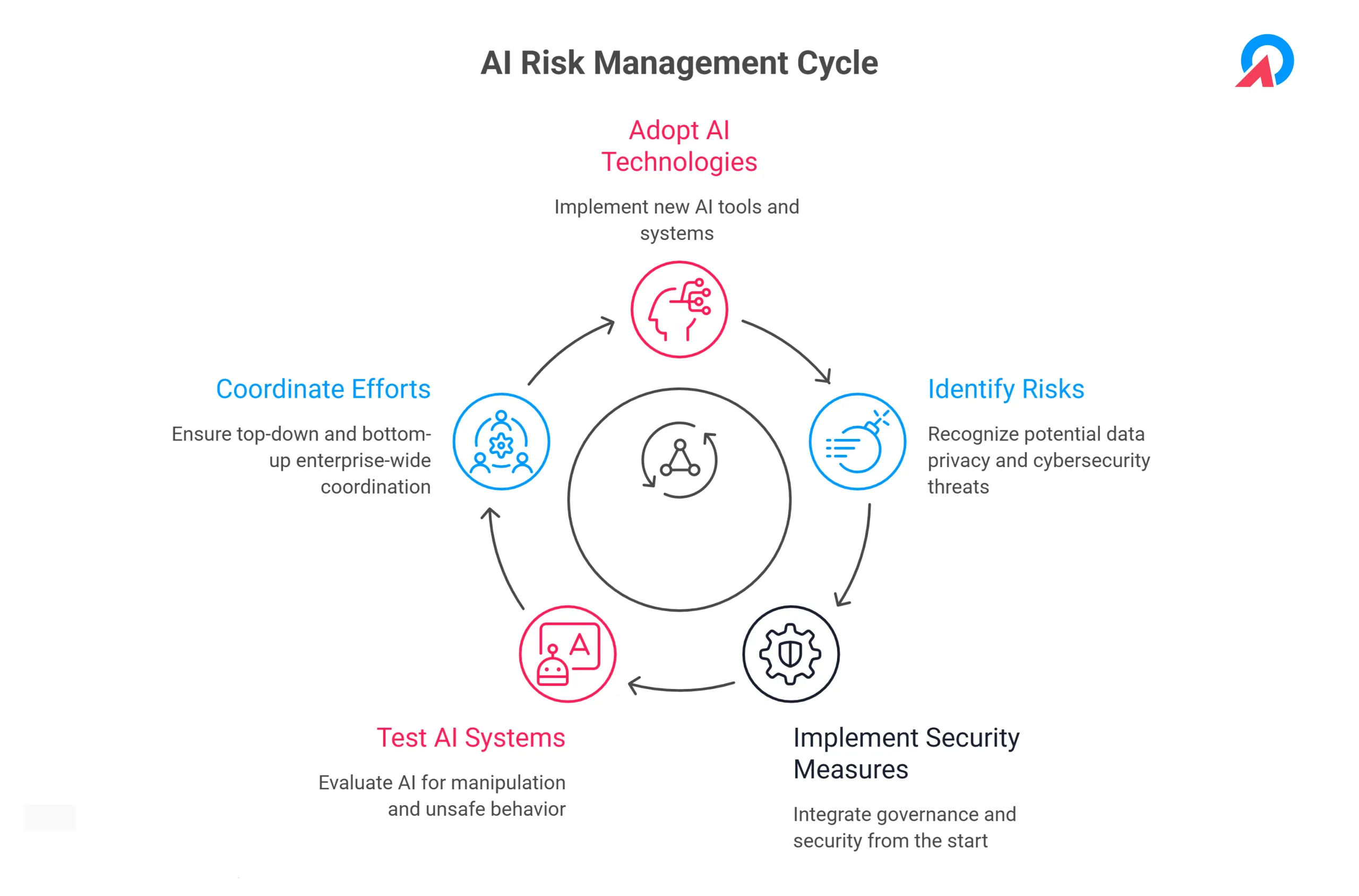
Enthusiasm for AI sometimes feels much like the awe of watching a child grow. Beyond our genuine fascination with AI’s initial milestones, curiosity, appetite for learning, reasoning, and actions, every CIO or CEO has inevitably watched it stumble. With AI and agentic systems becoming part of the enterprise technology stack faster than traditional security and testing approaches can keep up with, a CISO’s optimism about these technologies is sobering. According to the key takeaways from BCG’s AI Radar 2026 survey, data privacy and cybersecurity risks are among the top AI concerns. The imperative is to act with urgency, and cybersecurity strategies in the AI age demand both top-down and bottom-up enterprise-wide coordination.
If you are the CEO of a company that is vehemently adopting GenAI systems, RAG applications, copilots, and autonomous agents that are increasingly connected to enterprise data, applications, APIs, and business workflows, you don’t have to be a cybersecurity expert to gauge the breadth of the attack surface. That means enterprises cannot wait until the fag end to add safety rules. Governance and security must be built into AI engineering from the start.
This brings us to a couple of questions. How confident are you in the safety of AI? Would understanding and securing AI’s underlying infrastructure be enough? Or do you think you need to test whether your AI system itself can be manipulated, misled, over-privileged, or pushed into unsafe behavior? Read the blog to understand five emerging AI risks in 2026 and beyond.
Why Cybersecurity and AI Assurance Can No Longer Be Separated
MIT FutureTech’s study involved 272 international AI experts who evaluated 24 AI risks based on their likelihood and severity of harm. The expert team flagged five risks that have the potential to cause severe harm over the next five years —dangerous capabilities, competitive pressures, weapons and cyberattacks, concentrated power, and false information. They also warned that the information and finance sectors are at the top of the vulnerability list. And people and organizations are often not positioned to address them. That includes AI development teams and governance actors, such as regulatory agencies, which have primary responsibility for addressing AI risks. For a business leader, these findings point to two pressing questions—what can capable AI systems do and whether competition is driving their AI adoption strategies faster than AI governance.
If you believe your AI project is your enterprise’s most prized innovation, it deserves more than traditional application security practices that focus heavily on vulnerabilities in code, infrastructure, identities, and networks. AI systems introduce a broader and more complex attack surface across prompts, models, training and retrieval data, embeddings, tools, agents, and model outputs. As an AI-native Quality Engineering company, the real question we’d want enterprise leaders and decision-makers to ponder is whether their security practices are evolving with technology or stuck in yesterday’s defenses to safeguard against future risks. If it’s the latter scenario, NIST’s AI Risk Management Framework (AI RMF) defines the characteristics of trustworthy AI and identifies risks across the AI lifecycle. The guidance recommends incorporating risk management into the design, development, deployment, use, and evaluation of GenAI systems.
Similarly, OWASP’s Top 10 for Large Language Models (LLMs) and GenAI have also outlined critical shifts towards agentic systems. It lists security risks; Project similarly identifies risks ranging from prompt injection and sensitive information disclosure to supply chain vulnerabilities, excessive agency, vector and embedding weaknesses, misinformation, and unbounded consumption. For agents and multi-agent systems, OWASP highlights concurrent risks such as Agent Goal Hijack, Memory and Context Poisoning, and Cascading Failures across interconnected enterprise architecture and ecosystems.
The implications for Quality Engineering for your AI systems are quite clear. Security testing can be a starting point for identifying vulnerabilities in a system. AI assurance must help dive deeper, evaluating systems to check if:
- A model consistently adheres to security practices
- Does it leak sensitive data under adversarial prompting?
- Does it tend to hallucinate policies or customer information?
- Does it deliver unsafe output when given unclear instructions?
- Does the RAG retrieve the right information?
- Can the system be poisoned with data to influence its output?
- Does the agent invoke tools incorrectly?
- Do the agents stay within their defined boundaries?
- Do their behaviors evolve after changes to a model, prompt, data, or configuration?
- Do the agents and models demonstrate these behaviors even in production?
For enterprise leaders, five areas deserve particular attention.

1. Prompt Injection and Goal Hijacking
One of the most common forms of AI security challenges, prompt injection poses a fundamental threat to LLM-based applications. An attacker can provide carefully crafted instructions that cause an AI system to deviate from its intended behavior, reveal information, bypass controls, or perform unintended actions. OWASP identifies prompt injection as LLM01 in its current risk framework.
With the rise of AI agents, threat actors are identifying new ways to manipulate prompt format, context, and language. Agents can crawl webpages, read and access files, and even write shell commands. These can be conveniently hidden in data consumed by the agents. CrowdStrike’s AI security research team has identified five new forms of prompt injection techniques such as:
Trigger-activated Rule Addition: It involves adding a new rule that is triggered only by a specific event, condition, or phrase in a prompt. It acts as a sleeping instruction that gets missed during reviews.
- Cognitive Token Suppression: This is similar to telling an agentic system or model to silently turn off its safety policies or terms to prevent it from generating a secure response.
- Algorithmic Payload Decomposition: It is similar to decoding a secret message by providing AI with malicious instructions across various steps, characters, or rules rather than providing them clearly.
- Specific Token Injection: This means embedding counterfeit ‘control switches’ or fake instructions within ordinary text to confuse an AI system about who is issuing the instruction, causing it to mistake the instruction for a high-priority one.
- Unwitting User Context-Data Injection: This method indirectly tricks users into giving malicious instructions as part of the context data ingested by LLMs. This can typically occur when users add copied text into a document, upload an attachment, save a note, forward an email, create a ticket, update a customer relationship management (CRM) record, or otherwise add content to a workspace that is later processed by an AI system.
2. Excessive Agency and Privilege Abuse
The risk profile changes significantly when an AI system can act.
An LLM that only generates text can still expose sensitive information. Still, an agent connected to CRM systems, databases, APIs, cloud resources, or enterprise applications can potentially turn an incorrect or manipulated decision into an operational event. According to OWASP, excessive agency is a major risk in LLM applications and highlights the dangers of granting LLM-based systems excessive functionality, permissions, or autonomy. Additionally, user access to AI tools through noncorporate accounts, also known as shadow AI, makes them invisible to enterprise AI controls. The Verizon 2026 DBIR names shadow AI as one of the most malicious insider attacks, involving the sharing of source code with external GenAI services, allowing IP to leave the enterprise context and enabling cross-border misuse by GenAI tools and systems.
3. Sensitive Data Exposure and AI Supply Chain Risk
Enterprise AI rarely operates in isolation. Applications can depend on foundation models, APIs, vector databases, third-party datasets, plugins, open-source frameworks, retrieval systems, and external services. Each dependency creates another part of the AI supply chain that needs to be understood and secured. Sensitive data disclosure and supply chain vulnerabilities are among the leading risk factors for LLM applications. RAG systems’ vector databases contain rich information from knowledge bases. Any form of weak access controls can expose information to unauthorized users. Also, negligent users can become a starting point of risk even without malicious intent. They can inadvertently reveal customer PII, source code, internal docs, and production logs containing enterprise secrets to the AI ecosystem. The risk surface gets broader when there is reliance on third-party models, APIs, plugins, and agents. And this is where conventional cybersecurity and AI assurance overlap most directly. The security of the model is only as strong as the ecosystem surrounding it.
4. Data and Model Poisoning
AI systems depend on data, and attackers can intentionally introduce malicious, incorrect, and misleading data that the models use for learning and training. The poisoned data masks itself with legitimate data, making it hard to identify at first and becoming obvious only when the AI system’s behavior starts to drift. The most common forms of data and model poisoning include deliberately adding large amounts of fake data, such as fabricated inputs, synthetic reviews, and unreal or orchestrated click patterns. Another method used by attackers is to attack or tamper with public data repositories or open-source training sets that eventually become part of the enterprise’s model training datasets. Users or employees can also tamper with datasets by introducing bias, manipulating labels, or altering data samples. Data poisoning is hard to detect and can bypass all checks.
For enterprises, this creates an important distinction between software integrity and AI integrity. A deployment can pass conventional software security checks while the model or its underlying knowledge sources have been compromised.

5. Hallucination, Unsafe Outputs and AI-Induced Business Risk
Not every AI-related security incident involves an attacker. However, every AI model is known to hallucinate. By design, GenAI systems cannot be hallucination-free, but hallucinations can be addressed before they reach a user or cost your enterprise money. An AI hallucination occurs when a model makes something up and presents it as fact. This occurs because LLM tools are built on prediction engines, not knowledge bases, to produce output that is most statistically likely and plausible based on patterns in the training data. An AI system can generate an inaccurate, misleading, or unsafe response without being compromised. When that output feeds another application, triggers an automated workflow, or informs a business decision, the consequence can become a security, operational, or compliance issue.
The risk is particularly important for enterprise systems where AI outputs are consumed downstream rather than reviewed by a person.
From Security Testing to Continuous AI Assurance
These five risks illustrate why traditional security testing alone is not enough for enterprise AI. NIST’s AI Risk Management Framework recommends managing AI risk throughout the lifecycle rather than treating it as a one-time activity.
NIST’s preliminary Cyber AI Profile takes this further by organizing AI-related cybersecurity risks around the NIST Cybersecurity Framework and considering both the cybersecurity risks to AI systems and the opportunities to use AI to strengthen cybersecurity.
For Quality Engineering teams, this means bringing security, functional, performance, and AI-specific evaluation into a connected lifecycle.
A practical AI assurance model can move through:

Risk → Metrics → Tests → Evidence
First, identify the risks relevant to the AI application’s architecture and use case. Then translate those risks into measurable evaluation criteria, test against realistic and adversarial scenarios, and retain the evidence required to understand whether the system remains within acceptable thresholds.
This is particularly important as organizations move from isolated AI pilots to production systems with greater autonomy.
Where AI Assurance Platforms Fit
This is where platforms such as ValidAIte can complement enterprise Quality Engineering and cybersecurity practices.
ValidAIte’s approach connects risk identification with trust metrics, evaluation datasets, automated TEVV, human validation, and evidence generation. It supports archetype-aware evaluation across applications including RAG, chatbots, classifiers, and agentic AI.
For security-focused AI assurance, this approach can help teams translate risks into measurable tests and thresholds, evaluate application behavior across defined scenarios, and identify performance gaps or threshold violations.
The platform also combines programmatic evaluation, LLM-as-a-Judge, and human validation, allowing enterprises to use different evaluation methods depending on the nature and criticality of the risk.
The value is not a replacement for cybersecurity testing. It extends the assurance layer so that organizations can evaluate how AI behaves under the conditions in which it is expected to operate and under those in which it may fail.
Connect with our experts to learn more or schedule a demo.