
The recent $285 billion ‘SaaSpocalypse’ is less about the launch of Anthropic’s Claude Cowork launch and more about how equity investors perceived the plugin’s implications for the future of enterprise software and traditional IT services.
Until now, enterprise AI systems have primarily served as assistants, generating content, summarizing information, recommending code, and accelerating data analysis while humans still held the reins of delivery. Claude Cowork’s brand-new 11 role-specific agents alter that status quo. Cowork’s agents are designed to autonomously execute structured, multi-step tasks from start to finish, tasks that many enterprise software vendors and IT service providers position as core value propositions.
In demonstration, the autonomous plugins conducted legal research, gathered and interpreted information, and reviewed contracts with limited supervision, blurring the lines between their roles as productivity assistants and task execution agents.
Investors didn’t wait to compare the potential revenue-disruption models of autonomous digital workers with those of traditional IT and SaaS companies’ billing and engagement models. However, recent research from J.P. Morgan and subsequent commentary from technology leaders argue that the sell-off was indeed ‘micro-hysteria‘. It reflects a compression of expectations, not structural displacement, as AI is far more likely to enhance the capabilities of existing enterprise systems than to reinvent them.
Furthermore, MIT research indicates a 95% failure rate in moving from pilot to production, which reinforces the assumption that AI’s ubiquity will immediately eliminate the need for software or IT services is far-fetched. The idea entirely overlooks the operational friction between experimentation and scale. Moreover, this isn’t the first time that the markets have misread inflection points. Early computers were dismissed as glorified typewriters and calculators suited for low-level employees. Their impact was real, but it unfolded through integration rather than substitution.
Why This Shift Demands Serious Introspection for the IT Services Companies?
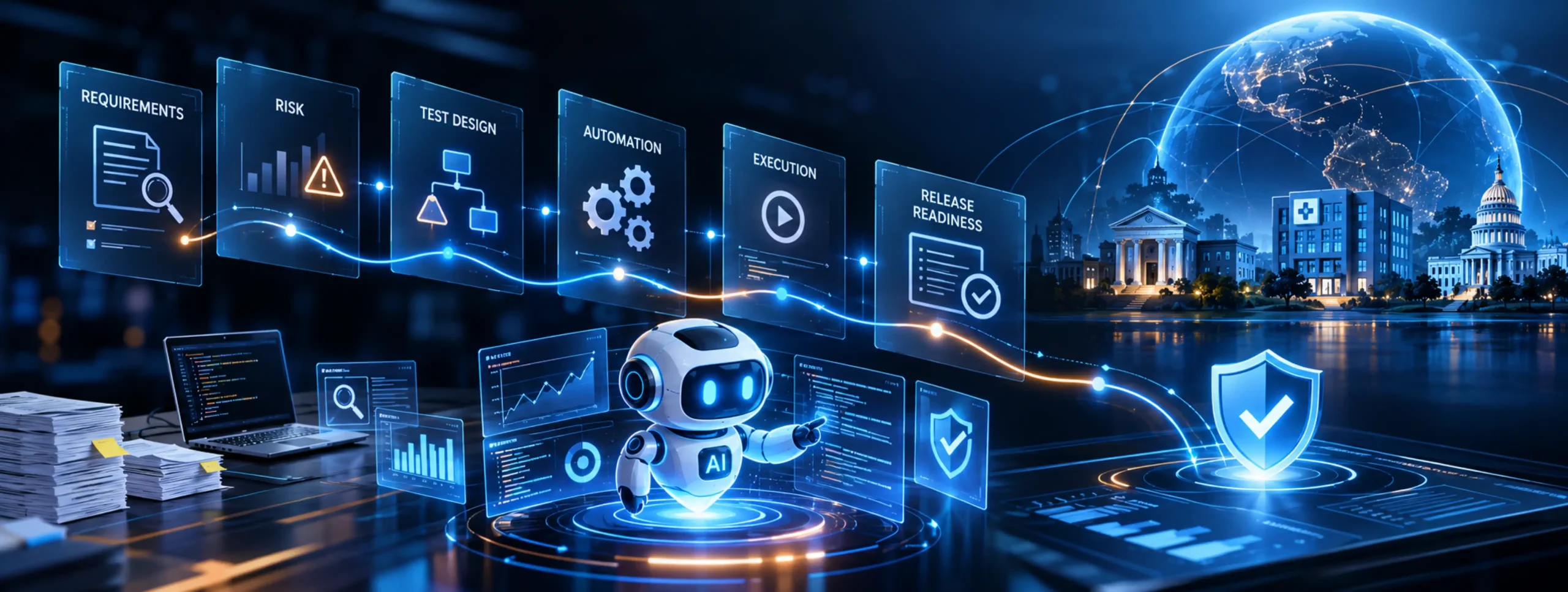
For IT services companies, the question is not whether automation will increase; it is more about where the value shifts. Enterprise delivery is contextual, relationship-driven, embedded within operational nuance, and scaled through effort. Yet, the valuation models anticipate future economics. With Claude Cowork, compressing the delivery timeline and having AI assume responsibility for testing, documentation, analysis, and routine controls, productivity and volume expansions captivated investors’ attention. However, it does guarantee uniform expansion of productivity, volume, and value. Throughout history, we have observed that when organizations accelerate execution and pursue large-scale automation to achieve economies of scale, quality suffers. This is precisely why Quality Engineering (QE) and software testing services companies exist: to ensure the ambition to scale doesn’t come at the cost of quality, reliability, and user trust.
For instance, imagine leveraging a GenAI tool to create a full-length movie in just 30 minutes. The speed, efficiency, and technical output may sound impressive. Still, it is most likely to lack the emotional depth, subtle creative nuances, and narrative coherence that the audience expects from a cinematic masterpiece. The same logic applies to scaling execution through autonomous agents, where speed can guarantee volume but without deliberate attention to quality.
And in the event of errors, the risks in traditional effort-based models are relatively lower, as mistakes remain localized and contained until they are duly addressed. But when unchecked errors in the decision logic are automated and scaled through autonomous agents, the flaw propagates systemically. Therefore, the conversation cannot just stop at productivity and must intentionally include quality controls and strict governance.

The Silver Lining for Quality Engineering & Other IT Services Companies
Even if an AI-native model like Claude Cowork becomes the norm, the shift will amplify the demand for AI implementation discipline, integration rigor, and continuous oversight. Therefore, QE will no longer be a downstream checkpoint. Rather than validating outputs in the end, it helps ensure that AI-driven execution is reliable, explainable, compliant, and aligned with business intent.
The industry is only just beginning to explain this need. At QualiZeal, we anticipated this shift and are armed with in-house IP-led innovations and deep expertise in non-deterministic systems to help enterprises validate their AI-driven systems, embed governance into automated processes, and ensure acceleration does not outrun trust.
The silver lining for IT services firms willing to recalibrate to the change is that enterprises are competing not just on advanced AI-driven capabilities but on trust as their absolute differentiator. Assuring quality would require addressing more complex questions, such as whether it’s possible to validate the AI’s decision-making continuously. Finally, will automated workflows remain compliant under the empirical conditions of varying data?
Through AI validation frameworks, responsible model implementation, and process QE, QualiZeal has already witnessed a shift from focusing on release testing to outcome assurance. In practical terms, that means not just assessing behavior, not just functionality, but primarily observing drift, not just defects, and making governance part of the delivery pipeline, not just as a result of audit, after failure.
Enterprise Leaders Must Rethink Investments Beyond Efficiency Gains
While efficiency gains from AI are real, they do not prove that AI-driven models are resilient. Enterprise leaders must prioritize understanding if these automation models are risk-resilient at scale rather than focusing on how quickly things can be automated. That also requires redistribution of current investments. Savings from automations, reinvested in assurance, monitoring, governance, and risk reduction, help balance efficiency and speed with reliability. This is exactly where QE providers evolve from delivery enablers to strategic partners.
Anthropic’s Agent Model has Blind Spots: Humans Remain Accountable
One key consideration both narratives—the pro-Claude model and the traditional software and IT services model—overlook is that, while enterprises increasingly depend on automation, accountability ultimately remains with humans. This imbalance elevates quality beyond a technical concern, making it a foundational business imperative.
Organizations can no longer afford a complacent belief that governance can be layered on top. We have observed this repeatedly in cybersecurity use cases and cloud adoption journeys, where quality controls retrofitted can never compensate for the complexities and unfortunate surprises.
The business value of QualiZeal is not promising a future solution to a hypothetical problem. It lies in working with space where risks are real, and enterprises are already feeling the pinch—the integration of AI into the delivery environment, where safety, trust, and reliability become quality, and quality becomes non-negotiable.
Conclusion
Technology cycles always favor early adopters. For the longest time, AI has been surrounded by our bold ambitions and extreme fears. The Anthropic Agent model is genuinely disruptive by creating a pathway for IT service providers toward AI-led engineering orchestration and platform integration. The evolution will allow us to move from execution to supervision. But the new narrative will be different: quality will hold the ultimate reins over innovation at scale. This is the space where QualiZeal has been preparing—where transformation is measured not by the speed of adoption, but by the confidence in delivery.
The future of enterprise AI will not be driven solely by organizations that are faster, but by those that are certain in their systems, their governance, and the integrity of their outcomes.