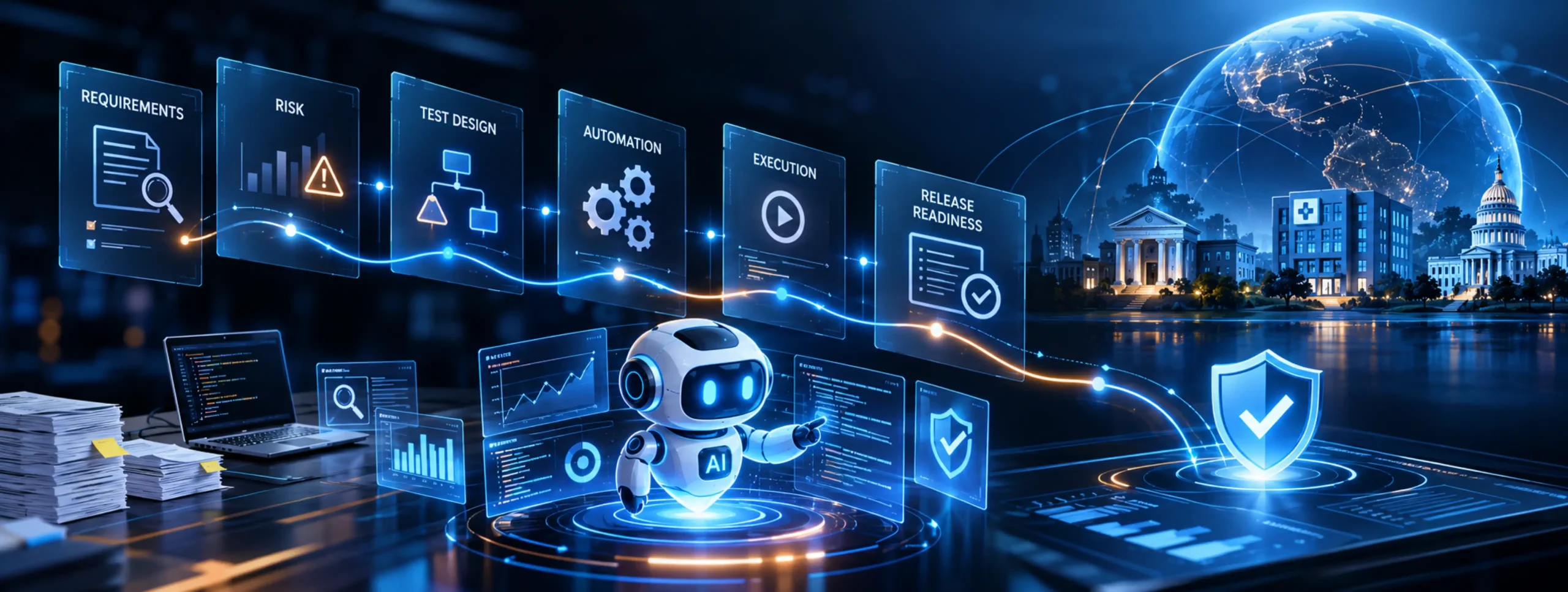

Artificial Intelligence (AI), especially in industries such as finance, healthcare, manufacturing, and government, has become ubiquitous. AI adoption, top-down, sharpens strategic decision-making to drive the necessary changes for reducing operational overheads by automating workflows and gaining real-time insights. While the technology becomes deeply integrated into business operations, risks such as model hallucinations, bias, and compliance breaches are emerging as critical challenges that boards and C-suites must address with urgency. That’s why organizations today need a modern approach to Quality Engineering, and QualiZeal’s ValidAite™ (an enterprise-grade assurance framework) acts as the last line of defense, ensuring that enterprise AI systems are not only functional but also ethical, transparent, and compliant.

The Three Lines of Defense for AI Testing
The three lines of defense are widely utilized in enterprise risk management and governance models across high-stakes industries, such as finance, banking, and regulated sectors, to ensure accountability, transparency, and effective risk control. With AI writing each line of code in application development or executing chatbot decisions, the standard testing falls short in detecting the uncertainties. Below, we have discussed the three lines of defense framework used in traditional risk management structures in the context of AI :
1. The First Line of Defense: Operational Management and AI Risk Mitigation
The strategies designed to identify and manage risks emerging in day-to-day operations and workflows comprise the first line of defense. Today, nearly 88% of businesses report using AI in at least one business function, and 23% have scaled AI agents across their enterprise functions, according to McKinsey’s recent State of AI reports. Risks from AI systems used at the operational level can emerge in the form of model inaccuracies, data quality issues, and non-deterministic behaviors. Understanding these common AI risk vectors requires a basic level of AI literacy to recognize the potential harm and promptly initiate effective risk management strategies. According to PwC’s AI Agent Survey, the most significant barrier to AI adoption is not the technology itself, but rather the mindset, readiness for change, and workforce engagement.
Workforce AI-readiness not only enables smooth AI adoption but also plays an integral role in building awareness about the inadvertent bias within AI systems that can result in skewed outcomes. Additionally, it enables the gatekeeping of AI systems and their outputs to mitigate potential data privacy and cybersecurity threats. QualiZeal’s ValidAite is a purpose-built, enterprise-grade assurance framework designed to validate and govern AI systems for reliability, fairness, and safety. Here’s how it supports AI builders and development teams to strengthen AI reliability at source, serving as the first line of defense:
How ValidAite Supports the First Line of Defense?
- Continuous Validation Pipeline: The framework continuously monitors the model’s performance across various datasets, user queries, and environments. It integrates into CI/CD, so that quality is prioritized at every iteration, not just at the end. The framework also validates that the results are within acceptable parameters.
- Shift–Left AI Quality: ValidAite evaluates AI models early in the development stage to assess them for bias, safety, drift, prompt quality, and failure modes.
- Scenario–based and Non-deterministic Testing: The framework ensures that GenAI models behave reliably across variations, edge scenarios, and unpredictable user prompts.
- Self-Healing Mechanisms: ValidAIte™ can detect and correct errors autonomously, thus reducing operational disruptions and ensuring model accuracy and reliability.
- Guardrails for GenAI Prompts and Responses: The ValidAite assurance framework ensures that each AI output adheres to business, security, and compliance requirements before being moved into production.

2. The Second Line of Defense: Risk, Compliance, and Governance in AI Testing
Risk and compliance teams, AI ethicists, and governance committees serve as the second line of defense by establishing policies, offering guidance, monitoring compliance, and proactively managing risks. With the increasing adoption of AI and the accelerated likelihood of AI-related risks, these teams oversee the first line of defense and stay in line with evolving regulatory and global standards (such as the EU AI Act, GDPR, HIPAA, and CCPA) to prevent non-compliance and legal penalties.
How ValidAite Enhances the Second Line of Defense?
According to a Wall Street Journal Research, the majority of enterprises (60% of the companies in the US) disclose AI as a material risk. ValidAite significantly enhances the second line of defense by enabling risk and compliance teams to have exclusive checks on AI risks before they become a problem downstream.
- Define Assurance Policy: ValidAite helps define assurance policies, risk taxonomies, and relevant guardrails, including model behaviors that are acceptable and those that are not.
- Regulatory Compliance: The framework is integrated with built-in compliance checks and real-time monitoring techniques to ensure that AI systems adhere to the latest regulatory standards and global compliance requirements.
- Executive-friendly Risk Dashboards: These enable the monitoring of risk metrics by quantifying bias, drift, explainability, and anomaly rates that emerge from the first line, presented via dashboards. Additionally, it provides advisory to AI teams with alerts on model risks exceeding thresholds, demand remediation, or to roll back deployments.
- Explainability & Auditability: It leverages Explainable AI (XAI) and Retrieval-Augmented Generation (RAG) to provide detailed, human-understandable data-driven insights, gaining clarity on AI’s decision-making processes.
- Bias Detection & Fairness Testing: ValidAite ensures that AI systems comply with regulatory standards and eliminate AI bias across outputs for diverse user queries and segments.
On the one hand, ValidAite ensures compliance and bias detection, NexaAI, QualiZeal’s AI development service, ensures that governance principles and compliance mechanisms are embedded right at the AI design phase. The plus point? NexaAI offers an AI Value Ledger that helps organizations capture and track performance metrics, such as ROI and compliance status, for various AI models. This transparent ledger, which ties AI results to business objectives, helps leaders beyond risk and governance teams visualize the AI’s impact on achieving business goals.

3. The Third Line of Defense: Independent Assurance and AI Validation
The third line of defense serves as an independent assurance layer, with internal audit teams evaluating the first and second lines of defense and risk control strategies. For industries such as healthcare, automotive, finance, retail, or public sectors, AI-based solutions have a profound impact on human decisions, directly affecting the lives of individuals or communities. Therefore, performing independent internal audits is necessary to provide objective assurance to senior leadership and C-level teams, verifying that risks have been thoroughly addressed through effective control structures and rigorous governance.
How ValidAite Acts as the Third Line of Defense?
As a third line of defense, ValidAite provides complete validation across the enterprise AI systems with:
- Holistic AI Evaluation: The framework periodically conducts architecture-specific validation, covering every model, agent, pipeline, external integrations, and tools across the entire AI ecosystem using data from the assurance tool.
- Early Risk Detection: ValidAite performs detailed monitoring to identify risks, anomalies, bias, model drifts, hallucinations, and data integrity issues before they impact operations and lead to failures. It generates audit evidence, such as model version history, risk incidents, and control failures.
- Auditor-Friendly: Auditors, investors, and stakeholders can obtain detailed audit trails and validation reports, along with real-time dashboards that showcase the performance and compliance status of the AI systems. The assurance framework helps reevaluate the impact and effectiveness of the first and second lines of defense by checking if the risk mitigation strategies are working adequately and identifying potential blind spots.

ValidAite as the Last Line of Defense for Scalable, Ethical AI
AI’s scalability and success depend on robust validation frameworks that ensure it is functioning correctly, ethically, and securely at all times. Modern enterprise landscapes require a fourth or final line of defense that includes external regulators, third-party auditors, and an external AI ethics board and reviewers. ValidAite plays a crucial role, providing comprehensive validation of AI systems to ensure scalability, transparency, and the responsible use of ethical AI throughout the AI lifecycle.
- Assurance Reports or Certified Extracts: ValidAite performs continuous validation across automated testing pipelines, reducing the need for manual oversight while ensuring compliance. The assurance reports generated can be used to produce for third-party auditors or agencies to verify compliance.
- Run Independent Audits of AI Systems: The framework conducts explainable testing through RAG to make AI’s decision-making process transparent, metrics-driven, and provides clear audit logs and risk dashboards for external scrutiny.
- Risk Ratings and AI Safety Seals: Beyond AI risk identification, such as model hallucinations, drifts, or compliance risks, ValidAite can help enterprises with regulatory-ready documentation that will be beneficial for submitting for certifications, external risk ratings, and AI safety seals based on ValidAite’s metrics.
Customers using ValidAite have reported 60% faster testing timelines, 90%+ test coverage, and significant reductions in operational overhead, demonstrating the framework’s effectiveness in ensuring scalable and trustworthy AI. ValidAite serves as the strongest form of independent validation, enhancing transparency, trust, and accountability for stakeholders, including customers, end-users, regulators, and the public.
Conclusion: Strengthening AI with Modern Quality Engineering will be the Last Line of Defense
There’s no denying that AI system adoption has immense potential to deliver success across industries. Frameworks like ValidAite elevate Quality Engineering for AI systems to a new level, surpassing model testing by deeply embedding assurance into risk governance and control layers. By demonstrating end-to-end assurance, ValidAite proves its value impact across the first, second, and third lines of defense. For enterprises seeking clear risk governance narratives that enhance their confidence in external validation, it can be the fourth or last line of defense.
Is your enterprise seeking a seasoned AI risk and quality partner? Get to know ValidAite to keep up with the ever-growing universe of AI risks and regulatory pressures.
Connect with our team to know more.